Cochlear Implant Support Group Links Patients, Community

Through a partnership between UC Health and the Hearing Speech & Deaf Center of Greater Cincinnati (HSDC), local patients with cochlear implants have a place to gather and share their experiences with the device.
Initiated 8 years ago when otolaryngologist Ravi Samy, MD, came to Cincinnati to direct UC Healths adult cochlear implant program, the Cochlear Implant Support Group now comprises 20 to 30 cochlear implant patients and their spouses who meet quarterly to share their experiences and learn from device manufacturers and health care professionals.
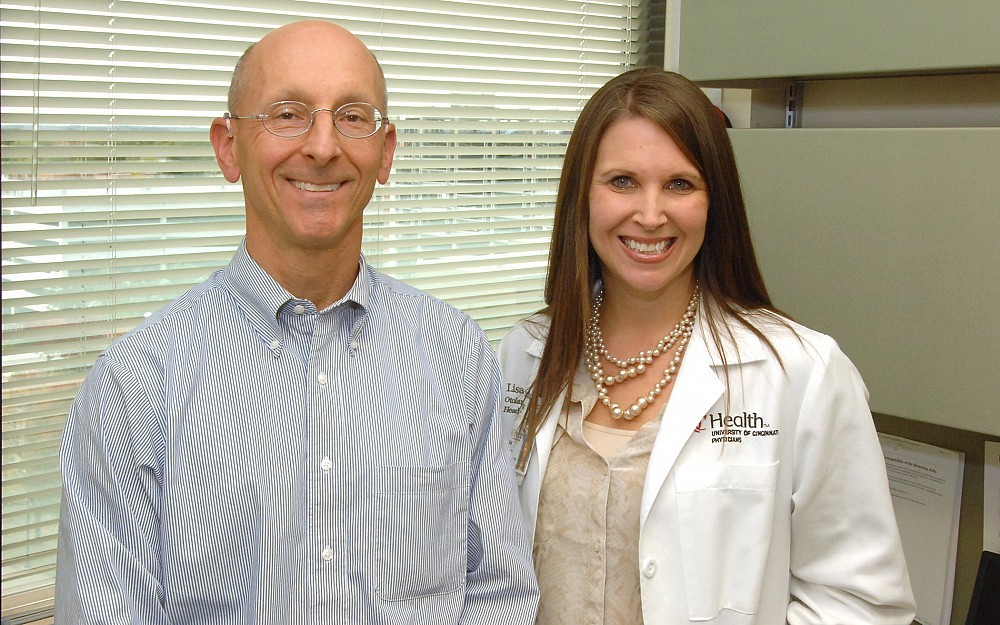
"Its a win-win, says UC Health audiologist Lisa Houston, AuD. "It creates a bridge between the two programs in the community. For patients, its a non-threatening environment to ask questions they may have been afraid to ask their doctor.
The Patient Experience
Brian Gallats first visited the group after receiving a cochlear implant in March 2011. He underwent surgery to implant his second device in September of that year.
Used for patients with moderate to severe to profound hearing loss, a cochlear implant is a small electronic device surgically implanted in the inner ear and activated by a device worn outside the ear. By bypassing the damaged portions of the ear, the implant can send sound signals directly to the wearers auditory nerve and the brain.
Gallat made the switch to cochlear implants after using conventional hearing aids for most of his life. He used his first hearing aid in kindergarten, after being born with approximately 70 percent hearing loss.
But by 2011, he said, "it became obvious to me that my hearing was terrible. I had absolutely nothing to lose with an implant.
Gallat first attended the group to talk with other members about what to expect once his device was turned on.
"I was hoping it was going to be good, he says, "but I really didnt know how the implant would turn out. When they turned it on, I remember Lisa was talking to me and I was reading her lips and hearing the soundsjust the way I was able to do it with my hearing aid. The sound made sense right away.
He was able to learn more about his new device in the support group meetings
"You learn about things that youd never think to ask of your audiologist, he says. "You begin to understand how you can help yourself even more with the implant.
Two years after his surgeries, Gallat regularly attends support group meetings, helps with presentations on device accessories and talks with new recipients.
"Theres a great social benefit to the group, he says. "You get to talk to people who have cochlear implants and their spousesand the doctors, the speech pathologists and the audiologists, they all help other people without expecting something in return. They are a warm and uplifting group of people to be around. There are people who dont have as much access to information as we have here in Cincinnati.
A Rewarding Local Partnership
With cochlear implant surgeries performed at UC Health, the Cincinnati Veteran Affairs (VA) Medical Center and Cincinnati Childrens Hospital Medical Center, Samy estimates Cincinnati is one of the top areas of the nation for cochlear implants in terms of volume.
Although the devices have been in use for over 25 years now, he says he was shocked by the lack of informationor misinformationabout them in the public. As a result, he said "when patients were implanted, they didnt have anyone else to go to or talk to. Thats when we started to get involved with the Hearing, Speech, and Deaf Center.
Both Samy and Houston remark that this is truly a unique and rewarding relationshipnot common to other centers in the country or region.
Jennifer Dively, AuD, CCC-A, audiology program manager at the Hearing, Speech and Deaf Center. "Its just amazing to see a community come together and to be able to share their experiencesusers, people who are considering an implant, and their families members, too. Its a wonderful group to work with and were thrilled to be a part of it.
Tags
Related Stories
On-site training in Speech & Hearing Clinic sets UC’s programs apart
August 27, 2026
At the University of Cincinnati’s Speech & Hearing Clinic, Doctor of Audiology and Speech-Language Pathology graduate students gain real-world experience while providing free speech and hearing services to the community.
Funding expands UC research into weight gain side effects of bipolar medication
August 26, 2026
University of Cincinnati researchers have been approved for funding by the Patient-Centered Outcomes Research Institute (PCORI) to expand the implementation of healthy lifestyle interventions and metformin prescription to help manage weight gain in overweight or obese youth taking second-generation antipsychotic medications.
One in four NFL players had CTE at death
August 25, 2026

Forbes cites research on concussions and football helmets by the University of Cincinnati in a report that found one in four NFL players had brain damage at death.