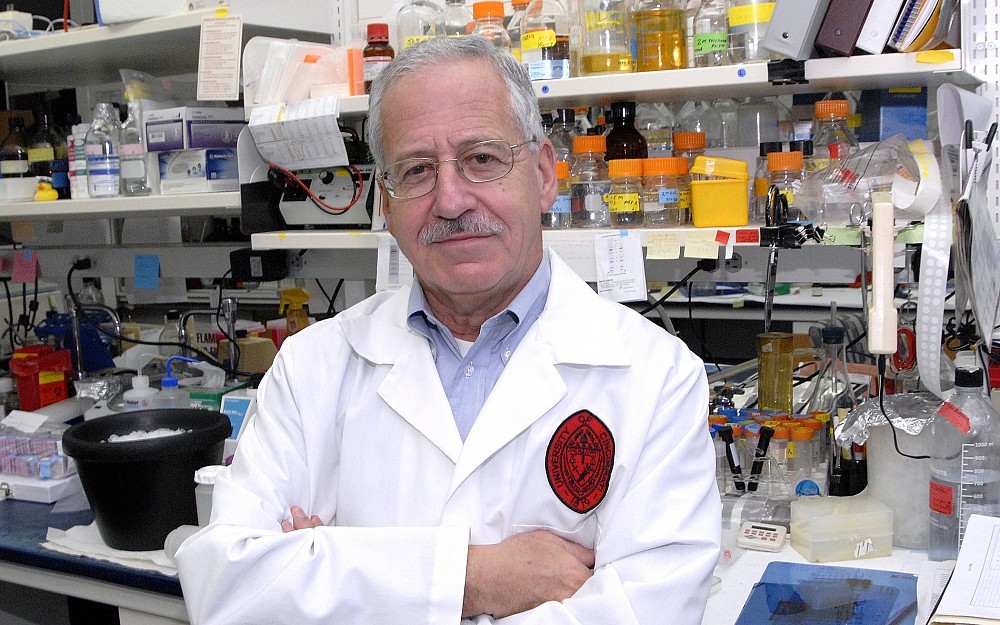
Focus On Research With Peter Stambrook, PhD

Peter Stambrook, PhD, co-leader of the UC Cancer Institute Comprehensive Head and Neck Center, and Charlotte Auerbach, PhD, the scientist who discovered that mustard gas causes mutations, have something in common.
"Just looking at this list of my predecessors (who have won the Environmental Mutagenesis and Genomics Society Award for outstanding research contributions) is humbling, said Stambrook, looking down at the printed paper in his hand. "These are some pretty important people.
In September, Stambrook received the 2013 EMGS Award for seminal contributions to a number of different research areas, including the molecular bases of DNA replication, the cellular response to DNA damage, genomic instability, mutagenesis and cell death. He is the 41st person to receive the award, which has been given since 1972.
Stambrooks work spans back to his graduate student days at SUNY Buffalo and postdoctoral fellowship at the University of Kentucky Medical Center from 1969 to 1971. From that point, he served in various academic roles and continued his research at the Carnegie Institution of Washington and Case Western Reserve University.
He joined the faculty at the UC College of Medicine in 1980, rising through the ranks to become Francis Brunning Professor and Chairman of what is now called the department of cancer biology. He now serves as a professor in the department of molecular genetics, biochemistry and microbiology.
Throughout the years and with his numerous academic and research contributions, he has published findings that show how cells maintain and preserve their genetic makeup.
"Particularly, weve discovered the mechanisms that embryonic stem cells utilize to help them replicate and preserve their integrity, he says. "Weve discovered how their DNA composition replicates and repairs itself.
Stambrook says he published a paper with Ronald Warnick, MD, John M. Tew, Jr., MD, Chair in Neurosurgical Oncology and professor, which showed how genes from the herpes simplex virus can kill neighboring cells which could be used to create genetic therapies.
"We published that study 20 years ago, and its been cited almost 400 times by other researchers, he says.
Hes also the recipient of a large National Institutes of Health Training Grant for which hes been given renewal funds for over 20 years.
Aside from researching, teaching and participating in organizations such as the Israel Cancer Research Fund, with which hes been involved about 10 years, the UC Board of Trustees and the
American Cancer Society, Ohio Division Board, Stambrookborn in London to parents who were war refugees from Viennasays he a true "football loving Englishman.
"I love soccer, but I dont play it much anymore, he says. "But I still watch it.
Related Stories
On-site training in Speech & Hearing Clinic sets UC’s programs apart
August 27, 2026
At the University of Cincinnati’s Speech & Hearing Clinic, Doctor of Audiology and Speech-Language Pathology graduate students gain real-world experience while providing free speech and hearing services to the community.
Designing with cancer patients' needs in focus
August 27, 2026
Kristina Shin is designing garments that prioritize the comfort, function and confidence of breast cancer patients, addressing a need often overlooked by traditional fashion.
UC, NKU renew longstanding partnership supporting Army ROTC cadets
August 26, 2026
The University of Cincinnati Army ROTC and Northern Kentucky University (NKU) have renewed a longstanding partnership that supports students preparing to become Army officers and leaders in their communities. The universities formalized the renewed agreement during a signing event Aug. 11 at NKU.