Maple Knoll Residents Get First Look at UC s Vision for Aging Safely in Place

Youd think that at age 92, a person wouldnt be surprised by much in terms of progress. But Simon Strong, a resident of Maple Knoll Village, still isespecially after previewing the new University of Cincinnati (UC) Innovation Collaboratory House on-site at Maple Knoll Village, the continuing care retirement community in Springdale where Strong resides.
"Ive seen the automobile and aviation come into being and heck, when I was a kid, we used the neighbors new phone because our house didnt have one yet. To see this, to see robots that assist and care for us, its truly amazing, remarked the nonagenarian after touring the high-tech residence recently developedin partnership with Maple Knoll Village and UCs colleges of nursing, medicine and engineering and applied scienceto determine whether technology can close the primary care gap for an aging population.
"People have the misconception that older adults arent interested in technology, that they would rather do things old school, but we are finding them very receptive to innovative concepts that we believe will improve their quality of life and increase their safety, says Debi Sampsel, DNP, the nursing colleges chief officer of innovation and entrepreneurship, who conceptualized the Collaboratory Innovation House project at Maple Knoll.
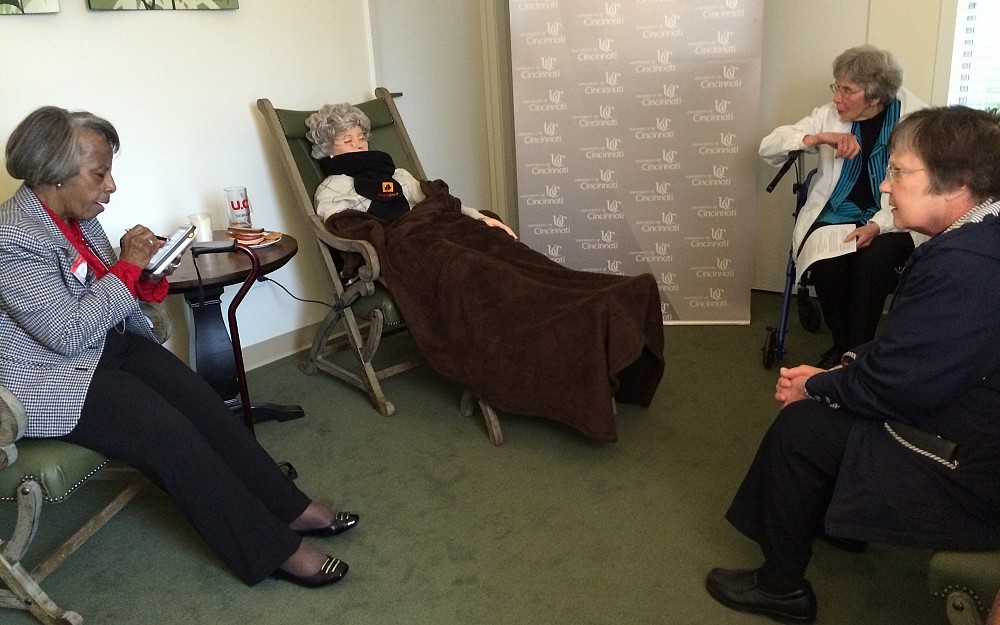
Initially, Sampsel says, the "model home will be occupied by a human patient simulator that, through computerized programs, can manifest a range of normal or abnormal physical conditions, including extreme distress. The conditions can then be assessed by student nurses, who are able to perform invasive procedures, such as starting IVs, giving injections, inserting a nasal gastric tube and many other hands-on procedures.
Patient simulators are routinely found in health sciences laboratories, but to have one living in its own house is a valuable learning experience across many academic disciplines where the focus is to assist with maximizing independence in the comfort of a home setting, says Sampsel.
Not only will the on-site training introduce students to geriatric care, a field lacking in clinicians, but the house will expose students to the concepts of telehealth, the use of technology from both the patient/provider sides for remote access. For example, the colleges two telehealth robotsnamed "Flo-bot and "Little Botwill regularly be at the village and utilized in patient education or telehealth research by UC nursing and engineering students and faculty.
From the engineering/technology side, there are already plans in the works to study predictability states of falling with innovative equipment that will notify a person that they are about to fall. The residents were able to see this fall awareness equipment working at the house during tours last week. Home tracking sensor systems were explained during the tours.
Testing equipment that makes the house "smart and enables older adults to have increased "aging in place opportunities is part of the research projects the colleges of engineering and nursing will explore down the pike, says associate professor Daniel Humpert, who coordinates the UC College of Engineering and Applied Sciences portion of the collaboration.
The ultimate goal is to have both the health care provider and the resident engaged in technology that extends the reach of services without travel, says Sampsel.
Maple Knoll resident Emmet White says he is ready to participate: "I consider myself tech savvy and I am excited to see how the new technology being brought forth by UC will improve our health care. I have already seen how the technology here allows me to constantly stay in contact with my four children, who all live out of state. If I was not here, I do not think I would easily have these services available to me.
"Our residents are very excited to be a part of this project. Most of them have tablets, Netflix, they Skype. We have to change the mindset that older adults are afraid of change, adds Megan Gresham, director of communications for Maple Knoll Communities, Inc.
Gresham says that nearly 200 Maple Knoll residents and their guests toured the house, many of whom shared Simon Strongs forward-thinking approach to the project: "It makes you wonder what its going to be like a hundred years from now.
Related Stories
Cancer Center plays key role in lab research, clinical trials for new pancreatic cancer drug
September 1, 2026

WLWT and WCPO highlighted the contributions of University of Cincinnati Cancer Center researchers that helped lead to the recent FDA approval of daraxonrasib, a new treatment for pancreatic cancer.
Cancer Center physician receives $150,000 New Investigator Research Grant to study treatment-resistant leukemia
September 1, 2026
The University of Cincinnati Cancer Center’s Sarah Skuli, MD, PhD, received a two‑year, $150,000 Leukemia Research Foundation New Investigator Grant to study TP53‑mutated leukemia, a treatment‑resistant subtype with very poor outcomes.
Engineering professor named KEEN Fellow
August 31, 2026
Dhuree Seth, assistant professor educator in the Department of Aerospace Engineering, is one of 30 engineering faculty members nationwide who were named 2026 KEEN Engineering Unleashed Fellows. The University of Cincinnati College of Engineering and Applied Science has been a partner of the Kern Entrepreneurial Engineering Network (KEEN) since 2024. Seth has been part of KEEN since she was a PhD student more than 10 years ago.