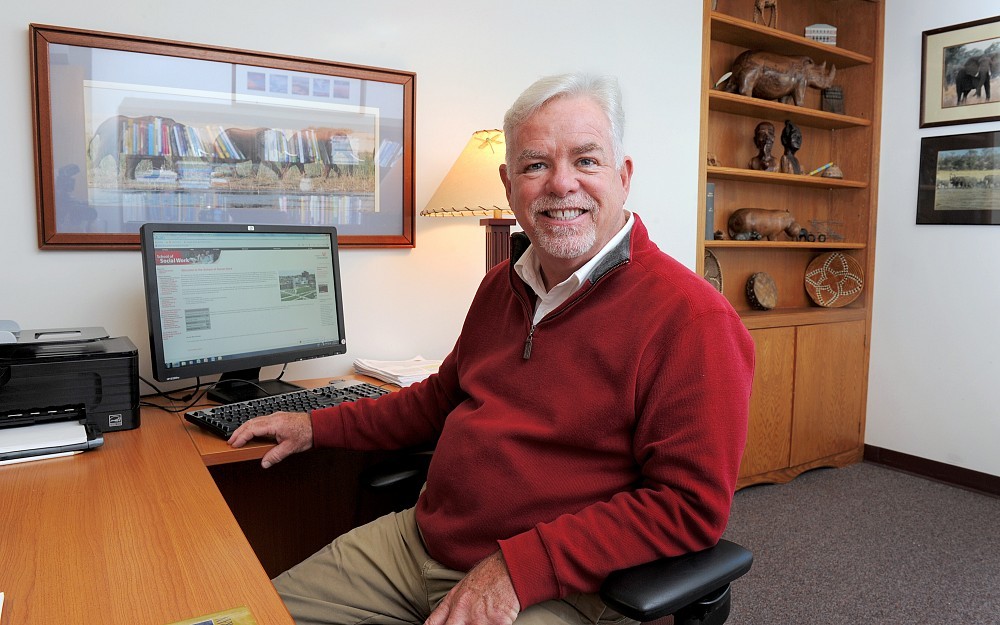
Social Work Professor Focuses on Veteran Population in New Book

This Veterans Day, associate professor of social work Gary Dick, PhD, is focusing on preparing social workers to better serve the need of the millions of veterans and military families across the country.
Dicks new textbook, Social Work Practice with Veterans, has just gone to production, with an anticipated release date in early 2014.
He hopes the text will contribute to a larger trend in social work across the country, as more undergraduate and masters level programs offer concentrations in social work practice with veterans, and the job field continues to grow.
The U.S. Labor Department predicts a 25 percent increase in jobs for social workers between 2010 and 2020, and the National Association of Social Worker (NASW) predicts the biggest populations for social workers in the future will be veterans, military families, and the aging population.
Dick, a faculty member in UC's College of Allied Health Sciences, says the book first takes a historical approach towards Americas military conflicts.
"We study each war in the history of America, what were the causes behind them and how the service members were treated, he says. "Additionally, I felt it was important to help social workers take a look at recent conflicts especially within the current social and historical contextthey are different than other conflicts in our history.
The main text covers two topics in social work practice with veterans: "Stressful Transitions and "Complicated Adjustments.
In "Stressful Transitions, Dick and coauthors outlines the deployment process and its impact on service members and their families. The section also address theoretical perspectives on what motivates individuals to serve in the military.
In "Complicated Adjustments, they explore the multistage process of returning from deployment, including the transition from the tight bonds of a military unit and its sense of purpose to fitting back in with civilian society and searching for employment. The text also covers what can happen when adjustment does not go well: post-traumatic stress disorder, substance abuse, homelessness, incarceration and suicide.
Dicks research focus into fatherhood and parenting also contributed to the text, as he added a focus on what happens to parents and their relationship with their children once they go oversea.
"Service members who go on multiple deployments can miss out on significant part of their childrens growth, he says, "They may come back and want to pick up where they left offbut their child isnt 12 anymore, they are 15.
The text also includes a section on gays and lesbians in the military, including the history of their service, the law "Dont Ask, Dont Tell, and its recent repeal.
Dick says that writing process was a lesson in revision: "While we were writing that chapter, the entire culture changed.
He edited the book and wrote portions alongside collaborators from other universities and local health care providers, including the Cincinnati Department of Veterans Affairs Medical Center. Seven alumni from the UC School of Social Work contributed chapters, based on their experience working with veteran clients in the field.
Dick also has a personal interest in studying veteran well-being. Starting from the Revolutionary War, when his ancestor John Dick served as a scout (and later Sergeant) and was briefly captured by the British, hes had at least one family member serve in every American conflict since.
"At one time, during World War II, my grandmother had four children all serving in the war effort, three boys and one girl, he says.
Related Stories
Cancer Center plays key role in lab research, clinical trials for new pancreatic cancer drug
September 1, 2026

WLWT and WCPO highlighted the contributions of University of Cincinnati Cancer Center researchers that helped lead to the recent FDA approval of daraxonrasib, a new treatment for pancreatic cancer.
Cancer Center physician receives $150,000 New Investigator Research Grant to study treatment-resistant leukemia
September 1, 2026
The University of Cincinnati Cancer Center’s Sarah Skuli, MD, PhD, received a two‑year, $150,000 Leukemia Research Foundation New Investigator Grant to study TP53‑mutated leukemia, a treatment‑resistant subtype with very poor outcomes.
Heavy social media use linked to depression
August 31, 2026

U.S. News and World Report, Yahoo! News, MSN, USA Today and other national media highlight a new study by the University of Cincinnati and Northwestern University that found a correlation between heavy social media use and depression in adults.