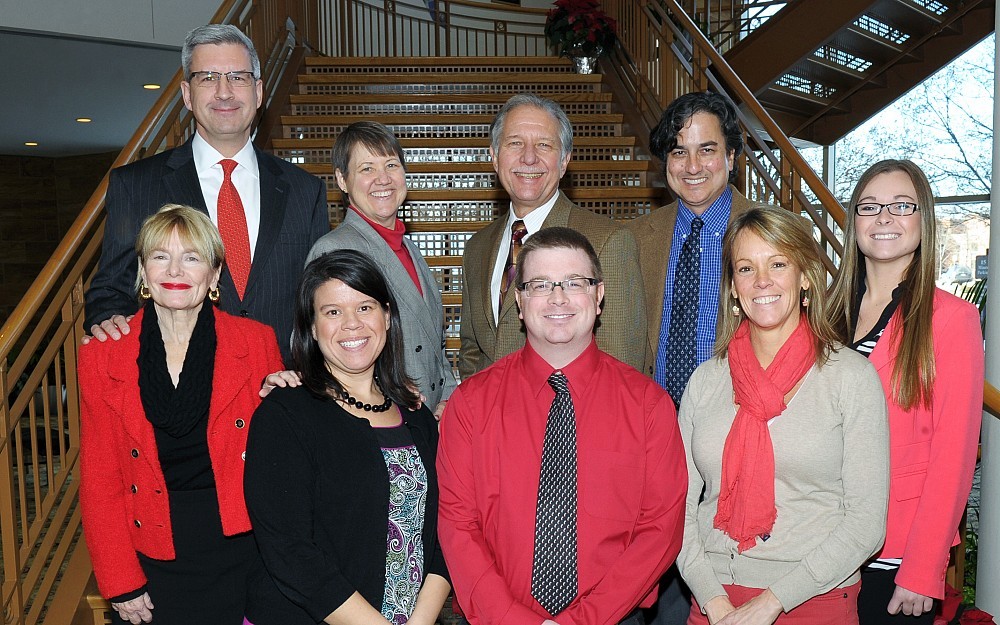
Health Administration Program Graduates First Class

This month, the College of Allied Health Sciences awarded degrees to the first class of its new Master of Health Administration (MHA) program, with eight graduates receiving diplomas.
The MHA program started in 2011 as a distance learning degree program created to train professionals for administrative and managerial roles in health care settings.
Program director Joan Murdock, PhD, says the new program has grown quickly in that short timecurrently, it contains more than 130 students from 20 states and three countries. Twenty-six new students will start in January.
"The students are just excellent, says Murdock. "They are very hard-working, professional and very committed to their goals. Since they all come from different backgrounds, weve found that students in each cohort are willing to share their own experiences within their peer group.
Graduate Kelly Lyle started in the programs very first class in the summer of 2011. Though she worked on campus at the UC Neuroscience Institute at the time, she found the programs mix of set courses and live online lectures and discussions useful.
The two and a half year program includes instruction from UC professors in the colleges of allied health sciences, medicine and business, as well as outside experts.
"It was fairly easy to get used to the online classes, she says. "I found the group chats particularly helpful. Overall, it was great for mevery flexible around my kids and my job.
Lyle is now the Academic Health Centers health affairs program officer and says the masters program helped with career advancement.
Murdock says MHA students arrive at the program from a variety of backgrounds, with masters, doctoral and law degrees as well as new students out of undergraduate training.
"Most of our students have spent some time in the health care system and see this as a way to advance their career, she adds. "Since health care is so diverse, there are many different settings where a health administration degree can be appliedwhether in a large health care system or a smaller community setting.
"Teaching all of them, she says, "Ive really seen transformational experiences. Ive seen a large amount of growth from the students.
Related Stories
UC radiation oncologist speaks with Local 12 news about clinical trial for head and neck cancer treatment
August 10, 2026

Dr. Sara Medek, a UC radiation oncology professor, speaks with Local 12 news about a new clinical trial aimed at reducing radiation in certain areas while still treating cancer effectively but with fewer painful side effects.
Cancer Center director charts future based on collaboration, AI
August 10, 2026

David Gius, MD, PhD, was featured in a Cincinnati Business Courier article and The Cancer Letter’s “The Directors" podcast discussing his priorities and goals as he recently took the helm as director of the University of Cincinnati Cancer Center.
UC graduates cross finish line at commencement
August 7, 2026
The University of Cincinnati recognized 2,125 graduates in two ceremonies at summer commencement Friday on campus at Fifth Third Arena.