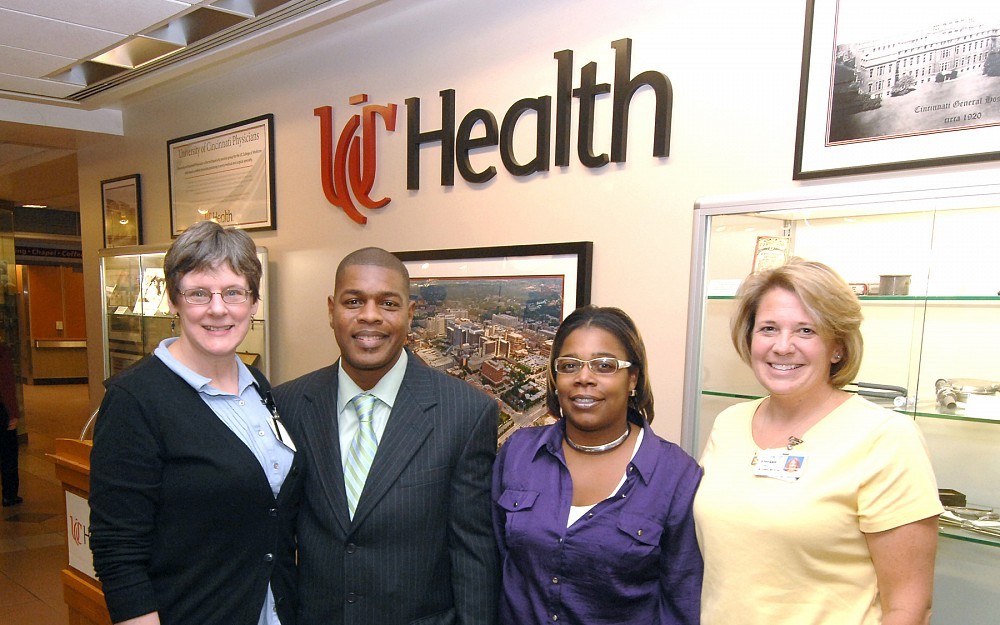
After Successful Transplant, Patient Returns To His Passion

Jamil Hill received his first kidney transplant in 1993six years after learning he had a rare kidney disorder called Focal Segmental Glomerulosclerosis, a condition that attacks the kidneys ability to properly perform its filtering function.
In 2006, 13 years after transplant, that kidney failed and Hill was put back on the transplant waiting list and began regular dialysis treatments.
Despite the exhaustion of dialysis, Hill stayed active with his passion: work with local at-risk teens through Cincinnatis Community Action Agency. In addition to training teens at his construction firm each summer, he coaches them in football, basketball and baseball at Shroeder Jr High.
Hill balanced dialysis with his community work for six yearsuntil a partnership with UC Health transplant surgeon E. Steve Woodle, MD, and participation in new research protocols, finally got him to transplantation.
"There are 80,000 patients waiting for kidney transplant in the U.S., says Woodle. "About 20,000 of those are basically un-transplantable because they have so much immunity to other peoples kidneys. That immunity usually manifests itself in the form of high antibody levels.
While Hill was on dialysis, more than 30 of his friends and family were tested to donate a kidney, but none matched. Hills antibodies were far too high and were at risk of rejecting most organs.
To enable a kidney transplant, Hills antibodies would have to be reduced via a treatment called desensitization. However, Hills antibody levels were so high that common therapy would likely fail.
Tags
Related Stories
On-site training in Speech & Hearing Clinic sets UC’s programs apart
August 27, 2026
At the University of Cincinnati’s Speech & Hearing Clinic, Doctor of Audiology and Speech-Language Pathology graduate students gain real-world experience while providing free speech and hearing services to the community.
Funding expands UC research into weight gain side effects of bipolar medication
August 26, 2026
University of Cincinnati researchers have been approved for funding by the Patient-Centered Outcomes Research Institute (PCORI) to expand the implementation of healthy lifestyle interventions and metformin prescription to help manage weight gain in overweight or obese youth taking second-generation antipsychotic medications.
One in four NFL players had CTE at death
August 25, 2026

Forbes cites research on concussions and football helmets by the University of Cincinnati in a report that found one in four NFL players had brain damage at death.