New UC Health Leader Boosts Ties With Academic Health Center

As a veteran administrator in the field of health care delivery, Richard (Rick) Lofgren, MD, knows his way around an academic medical center. But he sensed something different the first time he visited the University of Cincinnati (UC) medical campus.
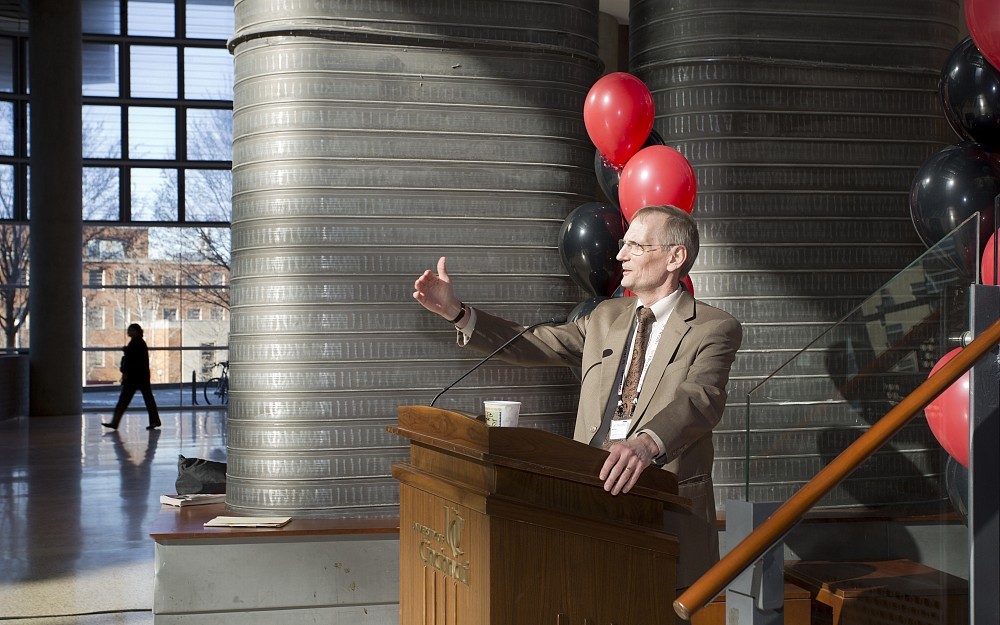
Lofgren, who became president and chief executive officer of UC Health Dec. 2, 2013, spoke to about 100 people at a town hall meeting Dec. 18 in the atrium of the CARE/Crawley Building, just steps from the Deans Suite at the UC College of Medicine.
He said he sees anxiety and "doom and gloom at many academic health centers these days, but not at UCs.
"When it came to UC Health and the University of Cincinnati, it was completely different, he said. "The excitement and energy around here is incredibly palpable.
Lofgren, who has made a series of town hall appearances since replacing the recently retired Jim Kingsbury, was introduced by College of Medicine Dean and UC Vice President for Health Affairs Thomas Boat, MD. Boat noted Lofgrens extensive resume with such institutions as UK HealthCare, the University of Kentuckys health system, and the University Healthsystem Consortium in Chicago, an alliance of 120 academic medical centers and 299 of their affiliated hospitals.
"Were very, very fortunate to have Rick with us, said Boat, who also serves as president and chairman of the board of UC Health University of Cincinnati Physicians. "He has been a consultant to a lot of academic health centers and he has really been able to see what works and what doesnt work across the country in these settings.
"We have a lot to celebrate, but theres nothing greater to celebrate right now than his arrival and the partnership of the College of Medicine and UC Health to move forward and do even greater things in the future.
Lofgren paid tribute to the College of Medicine, whose roots go back to 1819, by citing its "incredibly rich history.
"The idea that this has been an academic medical center and has been serving the community for nearly 200 years is daunting, he said. "Through all my time and travels throughout the country, Ive always admired what has happened here at the University of Cincinnati medical schoolits commitment to education, its commitment to the community, the research that it brings forwardits really quite remarkable. And really, its exciting to be part of that whole history.
Lofgren, who also holds a masters of public health, said he was also impressed with UC Healths recent history since it was formed in 2010 following the breakup of the Health Alliance. (It now includes UC Medical Center, University of Cincinnati Physicians, West Chester Hospital, the Daniel Drake Center for Post-Acute Care and the Lindner Center of HOPE, co-owned by the Lindner Family Foundation.)
"I think the moves this leadership has made in creating UC Health and positioning this organization really have led it into a place where it can make an enormous impact in the community that ensures its future success.
Returning to UC Healths relationship with the College of Medicine, Lofgren said, "As the only academic medical center in this region, I think we have both the opportunity andI would arguethe obligation to provide the leadership in transforming and truly revolutionizing how we deliver care.
Lofgren said his immediate priority would be listening, "to understand the UC community in its fullest sense, and added that he would be working closely with Boat and UC President Santa Ono, PhD, "really leveraging what is unique about the University of Cincinnati.
In a question-and-answer period that followed his talk, Lofgren said UC Health is "financially strong, adding, "I think were extremely well positioned to generate the kinds of resources to feed all of our ambitions. He also said hed be taking a close look at all of UC Healths systems of care and putting a priority on metrics to improve the quality of care.
"I think theres a great foundation here, he concluded, "but still theres always the continuous improvement process thats a never-ending processand that will be important.
Related Stories
UC invests in the next generation of graduate leaders through fellowships focused on mentorship and research
September 3, 2026
The Next Lives Here Presidential Fellowship supports the recruitment of top doctoral students through competitive funding, mentorship and professional development.
Cancer Center plays key role in lab research, clinical trials for new pancreatic cancer drug
September 1, 2026

WLWT and WCPO highlighted the contributions of University of Cincinnati Cancer Center researchers that helped lead to the recent FDA approval of daraxonrasib, a new treatment for pancreatic cancer.
Cancer Center physician receives $150,000 New Investigator Research Grant to study treatment-resistant leukemia
September 1, 2026
The University of Cincinnati Cancer Center’s Sarah Skuli, MD, PhD, received a two‑year, $150,000 Leukemia Research Foundation New Investigator Grant to study TP53‑mutated leukemia, a treatment‑resistant subtype with very poor outcomes.