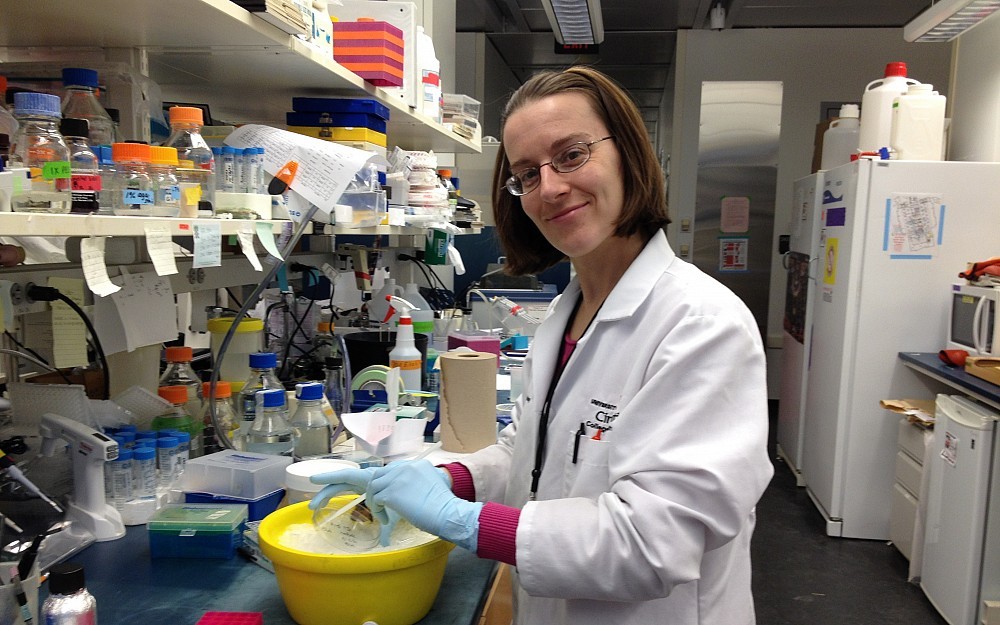
Focus On Fellows With Nancy Benight, PhD

Nancy Benight, PhD, a postdoctoral fellow in the department of cancer biology, is a Cincinnati native who had her first experience at the University of Cincinnati through the Summer Undergraduate Research Fellowship (SURF) Program, sponsored by UC and Cincinnati Childrens Hospital Medical Center. She earned her doctorate degree from Baylor Universitys College of Medicine but decided to turn her sites closer to home after completing her training.
What made you come to UC?
"I was very impressed with the training I received during my summer experience in the SURF program and continued to work in the lab for the next nine months as a research associate. After completing my graduate training in the interdepartmental program in Translational Biology and Molecular Medicine at Baylor College of Medicine in December 2011, I decided to look for positions at UC so I could return to the strong research environment I had experienced during my early training. Upon my return to Cincinnati, I switched from investigating gastrointestinal diseases to studying breast cancer biology. I am currently a postdoctoral fellow on the Cancer Therapeutics T32 training grant.
What do you study?
"Currently, I study the Ron receptor tyrosine kinase and its ligand hepatocyte growth factor-like protein (HGFL). The Ron receptor is well known in cancer biology, and many groups have shown that overexpression of Ron is associated with poor clinical outcomes. HGFL is the only known liganda factor that binds to a receptor to activate itfor Ron, so its expression is required for many of Rons activities that drive tumor formation and metastasis. I am studying how loss of HGFL impacts the different facets of breast cancer development, including tumor initiation, development and metastatic dissemination.
How might or research impact patient care?
"My research has a tremendous potential to impact patient care. Currently, there are several multi-spectrum kinase inhibiting drugs that can inhibit Ron in clinical trials. However, we dont know the impact of Rons ligand, HGFL, on its biology in breast cancer. Understanding the importance of ligand-dependent Ron signaling in breast cancer will allow us to interpret the results of these clinical trials. Further, as the only known target for HGFL is the Ron receptor, it represents a specific target that can be examined for therapeutic benefit. Finally, we know that Ron and HGFL overexpression in breast cancer is correlated with poor prognosis. As HGFL has no other known biological targets, it can be investigated for its use as a biomarker of disease severity, which may guide oncologists in making treatment decisions for patients.
What do you like about being a researcher? What are your plans after completing your training?
"I love the challenges that come with biomedical research. Every day, I get to test new hypotheses and interpret results. Cancer cells are incredibly adept at evading therapy, and getting to study them on a molecular level is exciting and challenging. I hope to take the knowledge I am gaining here and start my own laboratory, where I can continue to study the cellular mechanisms of breast cancer establishment, immune cell evasion and metastasis.
What do you like to do in your spare time?
"As a Cincinnati native, one of the best parts of returning to Cincinnati is being able to spend time with my family. I spend the majority of my free time with them. I also enjoy hiking and cycling when weather permits.
Related Stories
On-site training in Speech & Hearing Clinic sets UC’s programs apart
August 27, 2026
At the University of Cincinnati’s Speech & Hearing Clinic, Doctor of Audiology and Speech-Language Pathology graduate students gain real-world experience while providing free speech and hearing services to the community.
Designing with cancer patients' needs in focus
August 27, 2026
Kristina Shin is designing garments that prioritize the comfort, function and confidence of breast cancer patients, addressing a need often overlooked by traditional fashion.
UC, NKU renew longstanding partnership supporting Army ROTC cadets
August 26, 2026
The University of Cincinnati Army ROTC and Northern Kentucky University (NKU) have renewed a longstanding partnership that supports students preparing to become Army officers and leaders in their communities. The universities formalized the renewed agreement during a signing event Aug. 11 at NKU.