Researchers Identify Susceptibility Locus for Intracerebral Hemorrhage

CINCINNATIResearch led by a University of Cincinnati (UC) neurologist has identified and replicated a genomic susceptibility locus for intracerebral hemorrhage, raising the possibility of targeting a new risk factor for the most deadly subtype of stroke.
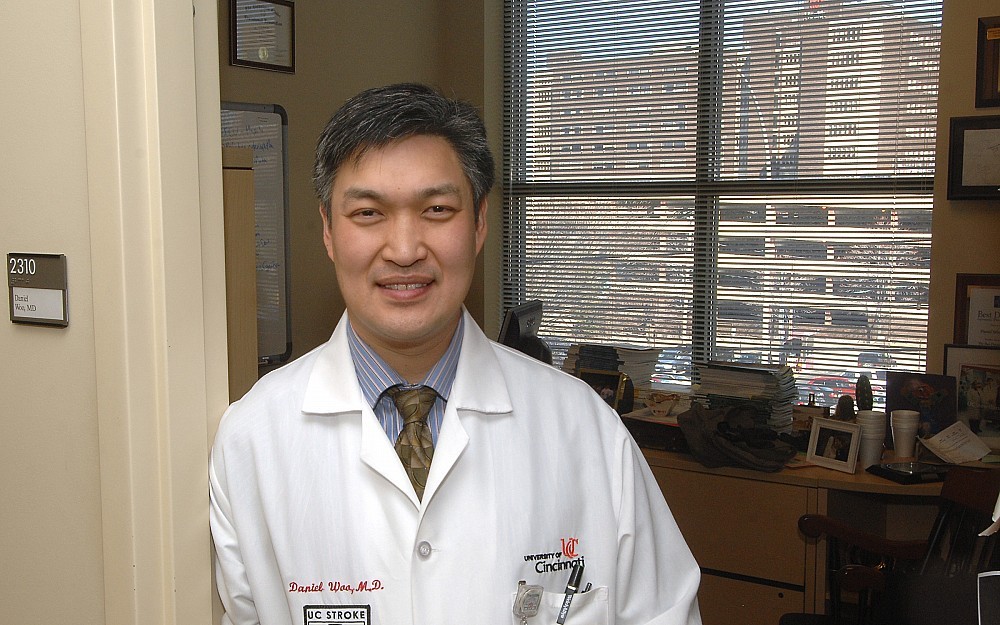
Results were published Thursday, March 20, in the American Journal of Human Genetics, a peer-reviewed scientific journal. Daniel Woo, MD, professor and vice chair of clinical research in the UC Department of Neurology and Rehabilitation Medicine and a member of the UC Neuroscience Institute, was first author of the study.
"Intracerebral hemorrhage (ICH) occurs when a blood vessel ruptures within the brain and is the subtype of stroke with the highest mortality rate, says Woo. "But in almost 40 percent of ICH cases, we dont know what caused it.
"So prevention is really of paramount importanceits imperative that we find new risk factors in addition to the current ones, which include alcohol use and hypertension.
Woo and an international network of colleagues set out to find genetic variations that play a substantial role in risk of ICH. To accomplish that, they meta-analyzed data from six previously unpublished genome-wide association studies of ICH that enrolled subjects of European ancestry in the United States and Europe.
Finding two locations of interest from that analysis, chromosomal regions 1q22 and 12q21.1, the researchers then set out to replicate the results in an independent cohort from 19 U.S. centers that included Hispanic and African-American subjects in addition to subjects of European ancestry. They successfully replicated the results for a susceptibility locus on chromosomal region 1q22 for subjects of European and African-American ancestry, but not for Hispanics. (The susceptibility locus for 12q21.1 was not replicated.)
Woo notes that the 1q22 locus contains PMF1, a gene that codes the protein called polyamine-modulated factor 1. Polyamines are known to disrupt the blood-brain barrier and have been linked to cerebrovascular disease by several studies.
"If these results hold up, this class of proteins could be a completely new risk factor for stroke, just like hypertension or smoking, says Woo.
"Once we understand that this could be a risk factor, then we can develop numerous other investigations that could lead to identification of biological pathways that could eventually be targeted by novel therapeutic strategies.
Primary funding for the research was provided by the National Institute of Neurological Disorders and Stroke, an institute of the National Institutes of Health.
Tags
Related Stories
Cancer Center plays key role in lab research, clinical trials for new pancreatic cancer drug
September 1, 2026

WLWT and WCPO highlighted the contributions of University of Cincinnati Cancer Center researchers that helped lead to the recent FDA approval of daraxonrasib, a new treatment for pancreatic cancer.
Cancer Center physician receives $150,000 New Investigator Research Grant to study treatment-resistant leukemia
September 1, 2026
The University of Cincinnati Cancer Center’s Sarah Skuli, MD, PhD, received a two‑year, $150,000 Leukemia Research Foundation New Investigator Grant to study TP53‑mutated leukemia, a treatment‑resistant subtype with very poor outcomes.
Heavy social media use linked to depression
August 31, 2026

U.S. News and World Report, Yahoo! News, MSN, USA Today and other national media highlight a new study by the University of Cincinnati and Northwestern University that found a correlation between heavy social media use and depression in adults.