Education Necessary to Capture Patient-Reported Outcomes, Researchers Find

CINCINNATIIn the data-driven world of medical outcomes, two streams of information are needed to produce accurate assessments of success: one from physicians and one from patients.
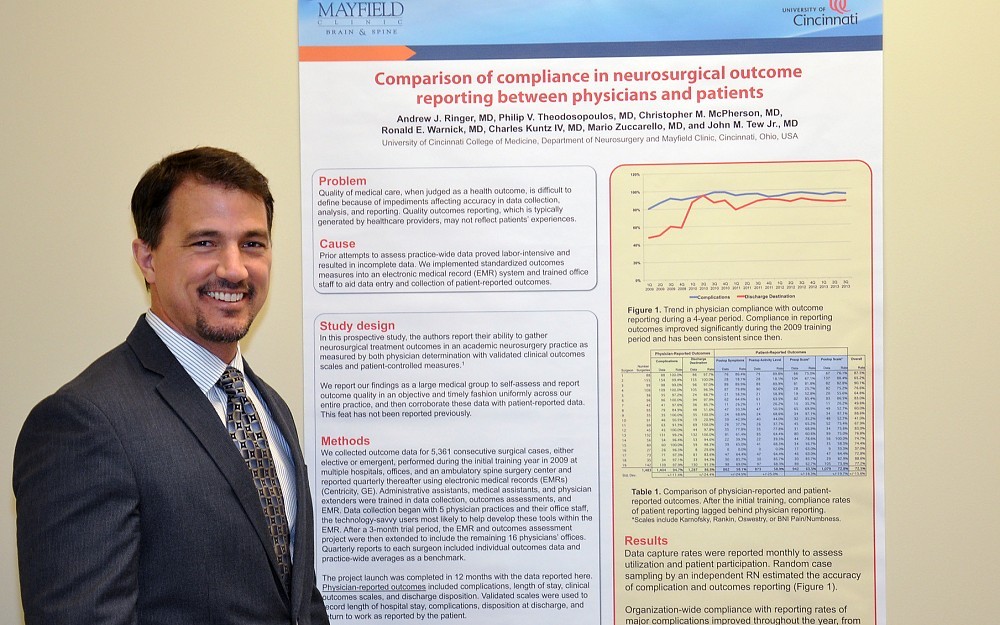
The patients side of the equation was the focus of a poster presentation by a University of Cincinnati (UC) College of Medicine faculty member today (Tuesday, April 8, 2014) at the International Forum on Quality and Safety in Health Care in Paris. The presentation served as an addendum to a 2009 study in which Andrew Ringer, MD, and colleagues published the outcomes of thousands of procedures collectively performed by 19 physicians.
"Outcomes reporting requires verification, and that means getting data from patients as well as physicians, says Ringer, a professor in the UC Department of Neurosurgery and a Mayfield Clinic neurosurgeon.
"Function and disability can be judged subjectively. An outcome that a physician considers highly successful may not reflect a patients own experience. We may say that a patient has recovered without disability, according to our standards, but the patient might consider himself moderately disabled. In this case, it is not right for me to say, Hes doing great, hes perfect, when he doesnt feel that way.
In 2009, amid a growing national focus on the role of patient outcomes in improving quality and containing costs, Ringer and his UC colleagues took a leadership role by publishing the outcomes of more than 5,000 consecutive procedures. The results were published in the Journal of Neurosurgery. http://thejns.org/doi/full/10.3171/2012.7.JNS111622?prevSearch=&searchHistoryKey.
In todays presentation, Ringer unveiled new outcomes data within the same neurosurgical practice. While the success of documentation by neurosurgeons continued to surpass 90 percent, capturing of patient reporting lagged at 64.4 percent for 1,483 surgeries during a three-month period (third quarter) of 2013. It turns out that capturing functional outcomes reported by patients or their caretakers is the more challenging half of the outcomes equation.
"If you want the patients participation, you need a different type of effort or education than simple physician-entered data, Ringer says. "You need a two-pronged attack. You have to educate office staff to work with physicians and patients, and you have to educate patients.
Notably, the collection of patient-centered data varied widely among individual physician practices. Collection was far lower in practices where associates had not been trained to collect the information and in practices whose patients experienced greater disability (e.g., from stroke or brain trauma).
"The ability to have our patients tell us what our outcomes truly are is powerful data, Ringer says. "The message to me is that training for outcomes data collection cannot focus simply on the physicians and staff, but on our ability to encourage and educate patients in the process too.
One challenge, Ringer says, is that patients and physicians dont always use the same terminology when describing recovery or disability. "Both parties probably need to understand the goals of the other to understand the meaning of outcomes.
By tracking outcomes, the physicians hoped to promote quality of care and better decision-making while establishing data that would be helpful for patients, families, and healthcare providers. An electronic medical records system (EMR) helped facilitate the gathering, interpreting and reporting of data. Information gathered during each patient interaction was recorded into the EMR by physicians, nurses, medical secretaries and medical assistants.
Outcomes were based on the health and functional status of patients immediately after surgery and at later post-operative periods. Data was tracked in the following categories:
Length of hospital stay.
Major and minor complications.
Return to work.
Symptom severity.
Scores by validated scales (i.e., the Oswestry Disability Index for patients with spinal disease; the Karnofsky Performance Scale and Eastern Cooperative Oncology Group Performance Status for patients with tumors; and the modified Rankin Scale for patients with vascular conditions and trauma).
Ringers co-authors are Philip Theodosopoulos, MD, now at the University of California San Francisco; and Christopher McPherson, MD, Ronald Warnick, MD, Charles Kuntz IV, MD, Mario Zuccarello, MD, and John Tew Jr., MD, all faculty members at UC and members of the UC Neuroscience Institute, a partnership of the UC College of Medicine and UC Health.
The authors report no conflicts of interest.
Related Stories
Cancer Center plays key role in lab research, clinical trials for new pancreatic cancer drug
September 1, 2026

WLWT and WCPO highlighted the contributions of University of Cincinnati Cancer Center researchers that helped lead to the recent FDA approval of daraxonrasib, a new treatment for pancreatic cancer.
Cancer Center physician receives $150,000 New Investigator Research Grant to study treatment-resistant leukemia
September 1, 2026
The University of Cincinnati Cancer Center’s Sarah Skuli, MD, PhD, received a two‑year, $150,000 Leukemia Research Foundation New Investigator Grant to study TP53‑mutated leukemia, a treatment‑resistant subtype with very poor outcomes.
Heavy social media use linked to depression
August 31, 2026

U.S. News and World Report, Yahoo! News, MSN, USA Today and other national media highlight a new study by the University of Cincinnati and Northwestern University that found a correlation between heavy social media use and depression in adults.