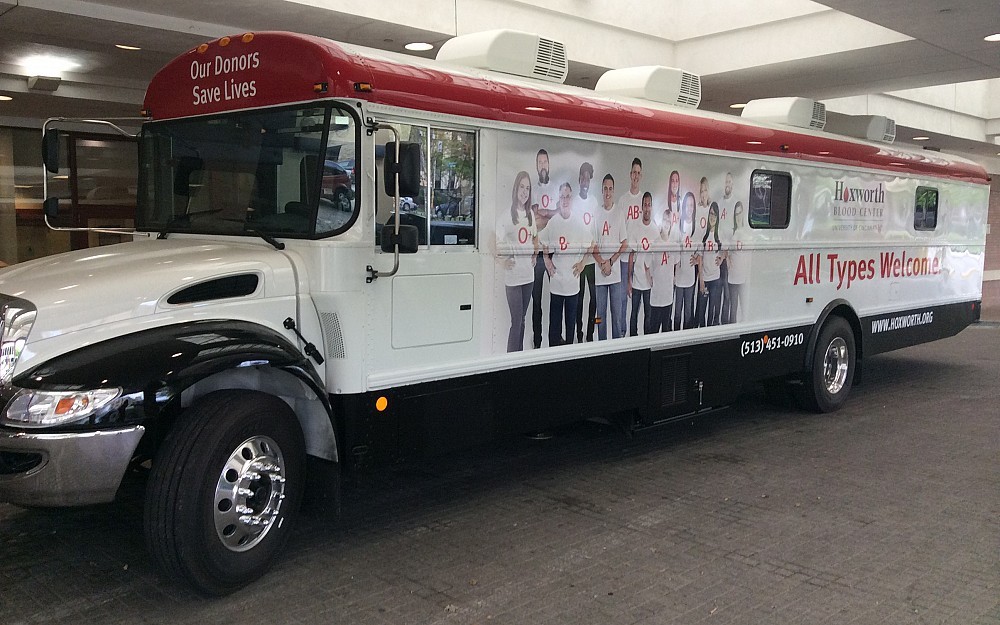
Hoxworth Dedicates New Bloodmobile

With a sound smack from a bottle in a nod to traditional ship launchings, the new Bloodmobile for Hoxworth Blood Center, University of Cincinnati, was dedicated Tuesday afternoon.
Hoxworths director, Ronald Sacher, MD, did the honors after an open house whose guests included donors who made the purchase of the $225,000 vehicle possible. It replaces a Bloodmobile that had been in service since 1982.
"It really is fabulous to have this new vehicle, said Sacher, a professor of medicine and pathology at the UC College of Medicine. He noted that it will play a role in saving thousands of lives per year.
The new Bloodmobile has two interview rooms and five beds for donors. It will be put to use immediately, with a potential schedule of about 200 drives per year collecting from an estimated 4,000 donors of blood products.
Hoxworth Blood Center was founded in December 1938 by Paul Hoxworth, MD, and serves 30 hospitals in 17 counties in Southwestern Ohio, Northern Kentucky and Southeastern Indiana.

Hoxworth Blood Center Director Ronald Sacher, MD, dedicated the new Bloodmobile April 29, 2014.
Related Stories
On-site training in Speech & Hearing Clinic sets UC’s programs apart
August 27, 2026
At the University of Cincinnati’s Speech & Hearing Clinic, Doctor of Audiology and Speech-Language Pathology graduate students gain real-world experience while providing free speech and hearing services to the community.
Designing with cancer patients' needs in focus
August 27, 2026
Kristina Shin is designing garments that prioritize the comfort, function and confidence of breast cancer patients, addressing a need often overlooked by traditional fashion.
UC, NKU renew longstanding partnership supporting Army ROTC cadets
August 26, 2026
The University of Cincinnati Army ROTC and Northern Kentucky University (NKU) have renewed a longstanding partnership that supports students preparing to become Army officers and leaders in their communities. The universities formalized the renewed agreement during a signing event Aug. 11 at NKU.