Research Examines Early Treatment, Recurrence of Breast Cancer Metastases

During a membership event April 29, the Cincinnati Cancer Center awarded over $200,000 in pilot grants to members and basic scientists who are collaborating to find out more about various cancers with hopes of generating more data and additional funding.
Three teams received Affinity Group Awards to encourage multidisciplinary research efforts and link CCC programs.
Cincinnati Cancer Center member Shao-Chun Wang, PhD, assistant professor in the department of cancer biology and member within the UC Cancer Institute, says there are two major challenges in treating breast cancer: determining how aggressively to treat the cancer in its early stages and overcoming the recurrence of cancer metastases after years of the cancer cells resting or remaining dormant after surgery or anti-cancer drug treatments.
These questions are the focus of Wangs project, funded by a $60,000 CCC affinity grant.
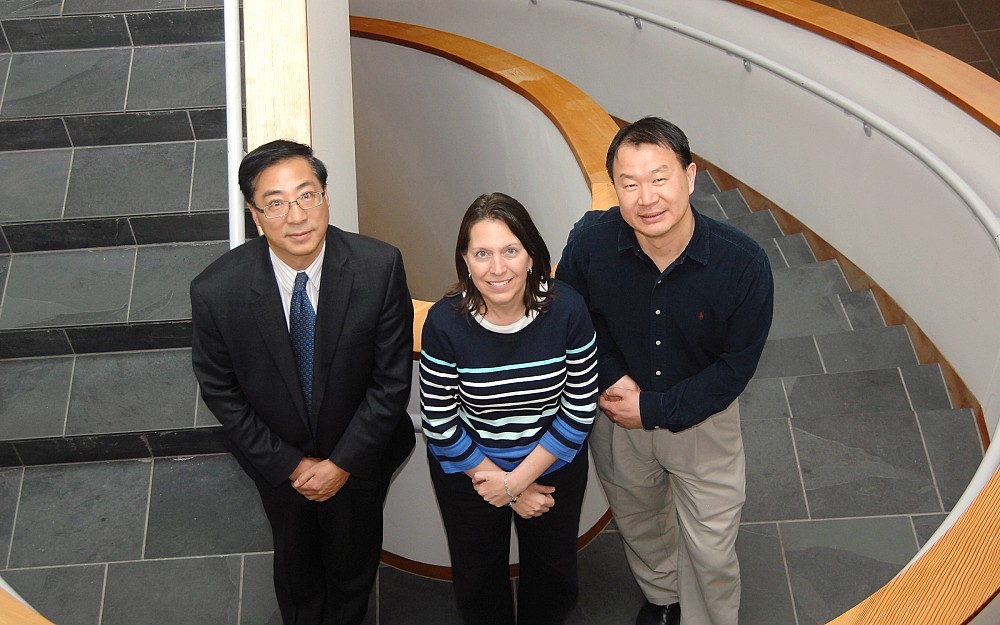
He along with CCC co-investigators Susan Waltz, PhD, professor in the department of cancer biology, and Jiang Wang, MD, PhD, associate professor in the department of pathology and laboratory medicine, who are also members in the UC Cancer Institute, are trying to understand the mechanisms that control the aggressiveness of early-stage tumors and that "wake up dormant tumor cells residing in distant organs throughout the cancer patients body.
Through this collaboration, the group has successfully identified a signaling pathway in which the Ron receptor tyrosine kinase, a cell surface protein frequently found activated in breast cancer, controls the activity of PCNA, a nuclear protein playing a key role for cancer cells to spread. This work, which was just published in the journal Oncogene, together with other unpublished results of the team, points to the potential importance of the Ron-PCNA pathway in determining the aggressiveness of breast cancer at both the primary and the metastatic sites.
"The PCNA protein can easily be regulated by cancer-causing pathways to enhance cancer cell growth, Wang says. "These pathways can be exploited as treatment targets to prevent tumor recurrence and as biomarkers to help physicians assess how aggressively to treat early stage breast cancer.
In addition to using animal models, Jiang Wang of the team is providing pathological expertise so that they can also investigate the activities of this pathway in human tumor tissues for its role in cancer development as well as patient outcomes.
"This project is extremely relevant to the current problems in the therapy of breast cancer, Waltz says. "With this funding, we can build preliminary data to gain funding for a larger research project that could help us one day provide better outcomes for patients with recurrent breast cancer.
The University of Cincinnati, Cincinnati Childrens Hospital Medical Center and UC Health have created the Cincinnati Cancer Centera joint effort designed to leverage the strengths of all three organizations in order to provide the best possible cancer diagnostics, research, treatment, and care for individuals in the Tristate region and the nation. To learn more, visit cincinnaticancercenter.org.
Tags
Related Stories
Why can it get so hot at times?
September 3, 2026

Cincinnati is experiencing more days of extreme heat this summer than in previous decades, due in large part to warmer global temperatures. But explanations for these higher temperatures also relate to regional factors, including the city's location in a river valley and large proportion of built environment.
Cancer Center plays key role in lab research, clinical trials for new pancreatic cancer drug
September 1, 2026

WLWT and WCPO highlighted the contributions of University of Cincinnati Cancer Center researchers that helped lead to the recent FDA approval of daraxonrasib, a new treatment for pancreatic cancer.
Cancer Center physician receives $150,000 New Investigator Research Grant to study treatment-resistant leukemia
September 1, 2026
The University of Cincinnati Cancer Center’s Sarah Skuli, MD, PhD, received a two‑year, $150,000 Leukemia Research Foundation New Investigator Grant to study TP53‑mutated leukemia, a treatment‑resistant subtype with very poor outcomes.