SapC-DOPS Technology May Help With Imaging Brain Tumors, Research Shows

Just because you cant see something doesnt mean its not there.
Brain tumors are an extremely serious example of this and are not only difficult to treatboth adult and pediatric patients have a five-year survival rate of only 30 percentbut also have even been difficult to image, which could provide important information for deciding next steps in the treatment process.
However, Cincinnati Cancer Center research studies published in an April online issue of the Journal of Magnetic Resonance Imaging and a May issue of the Journal of Visualized Experiments (JoVE), an online peer-reviewed scientific journal that publishes experimental methods in video format, reveal possibly new ways to image glioblastoma multiforme tumorsa form of brain tumorusing the SapC-DOPS technology.
A lysosomal protein saposin C (SapC), and a phospholipid, known as dioleoylphosphatidylserine (DOPS), can be combined and assembled into tiny cavities, or nanovesicles, to target and kill many forms of cancer cells.
Lysosomes are membrane-enclosed organelles that contain enzymes capable of breaking down all types of biological components; phospholipids are major components of all cell membranes and form lipid bilayersor cell membranes.
Xiaoyang Qi, PhD, member of the CCC, associate professor in the division of hematology oncology at the UC College of Medicine, a member of the UC Cancer and Neuroscience Institutes and the Brain Tumor Center, says his lab and collaborators have previously found that the combination of two natural cellular components, called SapC-DOPS, caused cell death in cancer cell types, including brain, lung, skin, prostate, blood and breast cancer, while sparing normal cells and tissues.
"We used this knowledge to gain assistance from our collaborators Kati LaSance, Vontz Core Imaging Lab (VCIL) director, and Patrick Winter, PhD, in the Imaging Research Center (IRC) at Cincinnati Childrens Hospital Medical Center. We used SapC-DOPS as a transport vesicle to deliver bio-fluorescence agents and gadolinium-labeled contrast agents directly to brain tumors which provided visualization using optical imaging and MRI, Qi says.
"There are two things lacking when it comes to brain tumors: getting a good picture of them and treating them effectively, says LaSance. "With this discovery, there are possibilities to improve both. With good visualization of the tumor, physicians might one day be able to better determine which form of treatmentchemotherapy, radiation or surgerywould be best for a patient and can image a tumor at its smallest stages with hopes of intervening much earlier.
Qi says this is preclinical research, as the studies were done using animal models that were injected with the SapC-DOPS vesicle assembled with illuminating agents, but is translational in nature and could be tested soon in human populations.
"While optical imaging is not applicable to a patient population, both MRI and PET imaging are, he says. "The bio-fluorescent molecule used in the JoVE study can be substituted for a PET molecule and fortunately, PET imaging is widely used by doctors and hospitals in current cancer patients.
"This research has the potential to make a large impact in treatment of brain tumors, and most importantly, it would not have been impossible without support and collaboration from the VCIL and the IRC.
These studies were funded by the Mayfield Education and Research Foundation, a New Drug State Key Project (009ZX09102-205) and the National Institutes of Health/National Cancer Institute (1R01CA158372-01). Researchers cite no conflicts of interest.

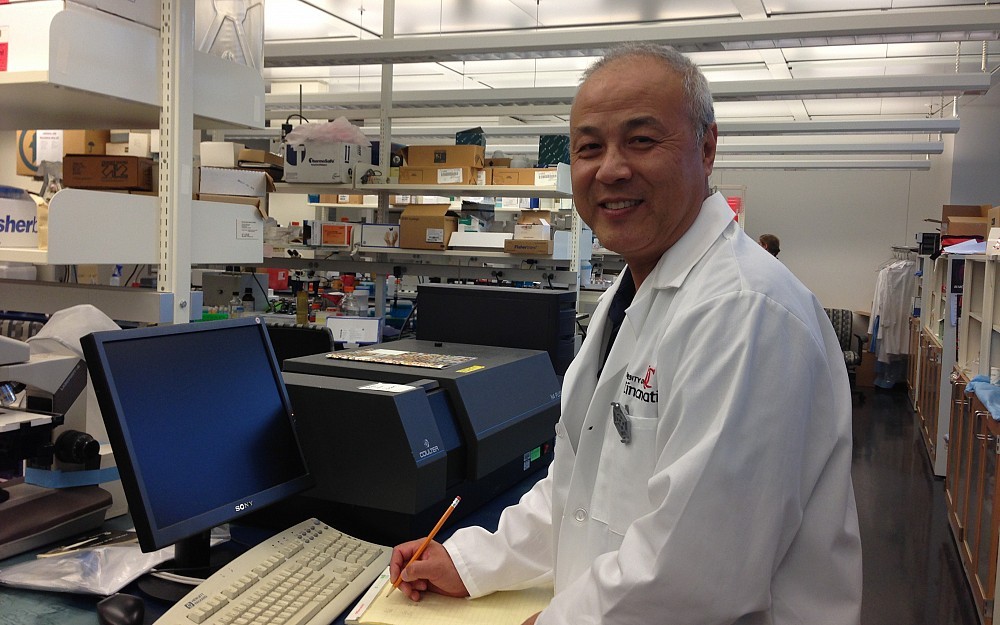
Kati LaSance
Related Stories
On-site training in Speech & Hearing Clinic sets UC’s programs apart
August 27, 2026
At the University of Cincinnati’s Speech & Hearing Clinic, Doctor of Audiology and Speech-Language Pathology graduate students gain real-world experience while providing free speech and hearing services to the community.
Designing with cancer patients' needs in focus
August 27, 2026
Kristina Shin is designing garments that prioritize the comfort, function and confidence of breast cancer patients, addressing a need often overlooked by traditional fashion.
UC, NKU renew longstanding partnership supporting Army ROTC cadets
August 26, 2026
The University of Cincinnati Army ROTC and Northern Kentucky University (NKU) have renewed a longstanding partnership that supports students preparing to become Army officers and leaders in their communities. The universities formalized the renewed agreement during a signing event Aug. 11 at NKU.