'Shark Tank' Retreat Grants $100,000 for Novel Breast Cancer Research

On June 7, multidisciplinary researchers from across UC campuses came together at the Kingsgate Marriott Conference Center to develop new collaborations and research ideas in a unique competition.
The goal: come up with an idea to wow their peers and win $100,000 to complete the cancer-based project.
In a format resembling the hit television show "Shark Tank, researchers came together at 8 a.m. to hear introductory presentations from the 10 centers and programs, and then split into groups to begin brainstorming ideas to initiate a project that they hoped would impact the prevention, detection or treatment of cancer.
"Every group is an all-star cast, said host William Barrett, MD, director of the UC Cancer Institute, chair of the department of radiation oncology and medical director for UC Healths Barrett Center, in opening remarks. "Today really isnt about the $100,000its about new collaborations and meeting people who can enhance the way we do our work to impact the field of cancer.
Eleven teamsnamed for the 1985 and 1987 Daniel Drake Medal Award recipientswere formed based on a drawing that was done previously by Barrett. He took names from three buckets: clinicians, College of Medicine researchers and scientists from university colleges to create the teams that were made up of seven to nine members.
After only a few hours, each team presented its idea during five-minute timed presentations, and the entire group of participants voted.
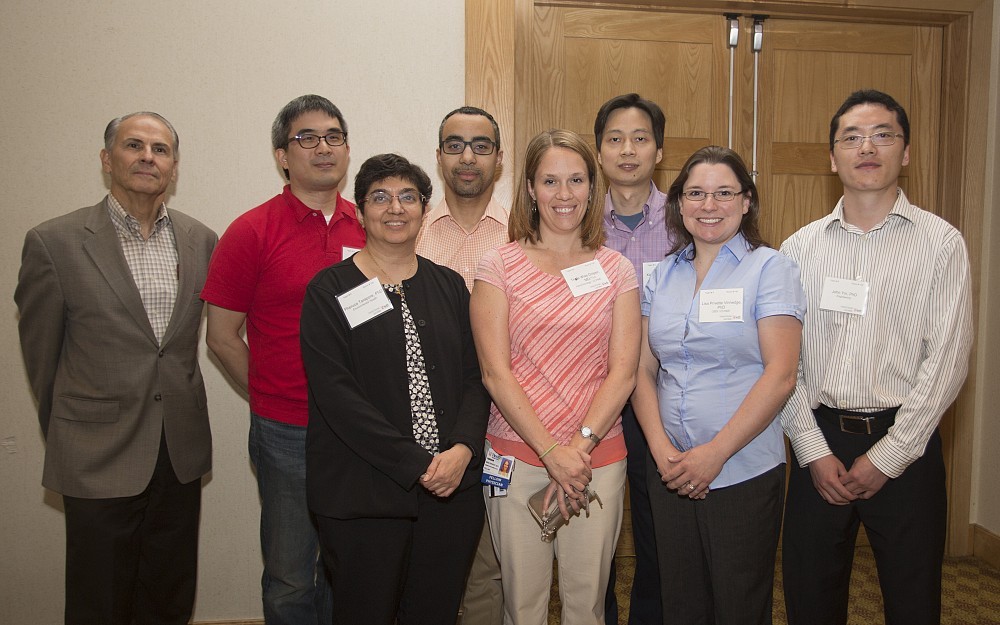
The Josef Warkany, MD, Team, co-chaired by Radiation Oncologist Kris Huang, MD, PhD, and UC and Cincinnati Childrens Hospital Medical Center researcher Lisa Privette Vinnedge, PhD, came out on top for their proposal which focuses on the use of radiotherapy and nanoparticles to diagnose and treat breast cancer and shorten therapy.
"Our proposal involves adapting nanoparticles to be able to label where cancers are in the body and eventually use those same particles to not only see the tumor but also treat it at the same time so that we can identify the tumor and know that the medication is getting there," Privette Vinnedge says.
The team now has one month to formalize their proposal and an additional year to bring it to fruition.
"It was the ultimate in collaboration, bringing together enormously talented people who are working day and night to fight cancer, says Barrett, who revealed at the event that the prize money came from the late Carl Linder, Jr., who asked Barrett to use the money for collaboration and education. Lindner died in 2011.
"This was an exciting event, and I feel that we helped to generate internal and external enthusiasm for the cancer program and its research strengths. We are just getting started and it is going to be a great ride.
Related Stories
Cancer Center plays key role in lab research, clinical trials for new pancreatic cancer drug
September 1, 2026

WLWT and WCPO highlighted the contributions of University of Cincinnati Cancer Center researchers that helped lead to the recent FDA approval of daraxonrasib, a new treatment for pancreatic cancer.
Cancer Center physician receives $150,000 New Investigator Research Grant to study treatment-resistant leukemia
September 1, 2026
The University of Cincinnati Cancer Center’s Sarah Skuli, MD, PhD, received a two‑year, $150,000 Leukemia Research Foundation New Investigator Grant to study TP53‑mutated leukemia, a treatment‑resistant subtype with very poor outcomes.
Heavy social media use linked to depression
August 31, 2026

U.S. News and World Report, Yahoo! News, MSN, USA Today and other national media highlight a new study by the University of Cincinnati and Northwestern University that found a correlation between heavy social media use and depression in adults.