Technology to the Rescue for Aging Populations

CINCINNATIA villa on the campus of Maple Knoll Village, a continuing care retirement community in Springdale, has been transformed into a learning and test environment for the development of technologies aimed at keeping seniors in their own homes or communities longer.
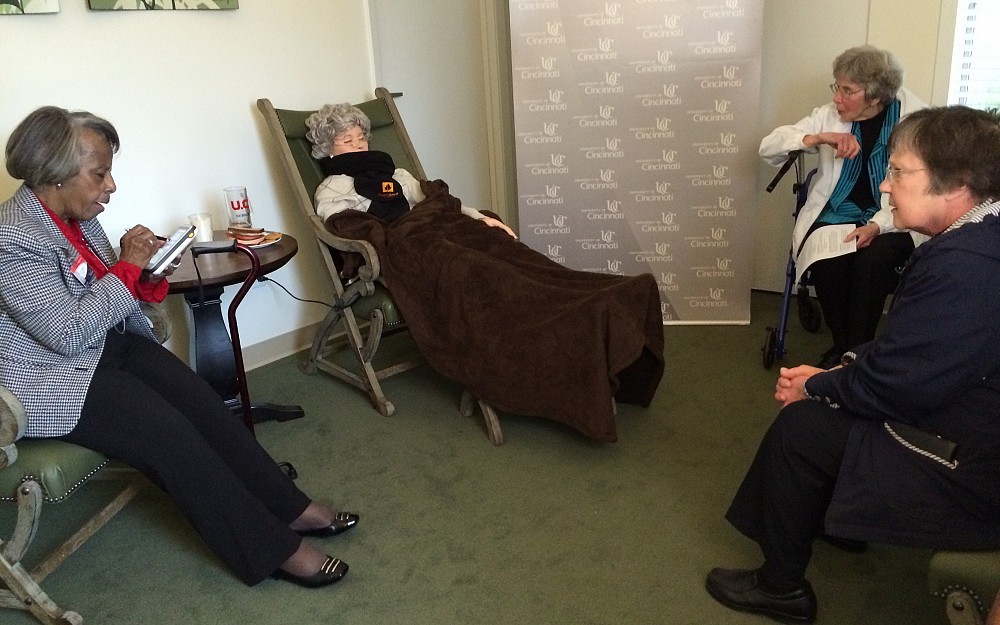
Known as the Innovation Collaboratory House, the villa is a partnership between several University of Cincinnati (UC) colleges and Maple Knoll Village. Its home to telehealth robots and patient simulators, and is now the testing ground for innovative student projects aimed at detecting falls, preventing medication errors and making life easier for an aging population.
UC and Maple Knoll Village will host a public open house and ribbon cutting to showcase this innovative partnership and "smart villa on Thursday, June 26, from 10 a.m. to noon, on the campus of Maple Knoll Village, 11100 Springfield Pike.
"An ever-growing population of older adults need health care, says Jim Formal, CEO of Maple Knoll Village. "Every month, more than a quarter million Americans turn 65, and Ohio ranks sixth in the nation in the sheer size of this age population.
"Its imperative that we develop technologies that allow people to age in their homes or communities for longer periods, leaving long-term care placement as a last resort.
Debi Sampsel, who holds a doctor of nursing practice degree and is chief officer of innovation and entrepreneurship at the UC College of Nursing, has spearheaded the creation of the Innovation Collaboratory House. She says that without innovations like the ones being developed there through collaboration with UCs colleges of nursing, medicine and engineering and applied science, Ohio Medicaid expenditures will consume half of the state budget by 2020 and continue to increase in subsequent years.
But aside from financial reasons, Sampsel agrees that, for many, aging in place can improve quality of life.
"Weve all heard stories of family members and friends who believe their loved ones would have been better off if they were able to remain in their own homes or communities to live out their final years, says Sampsel. "The Innovation Collaboratory House at Maple Knoll Village allows us to work directly with an aging population to find out what kinds of technologies would make aging in place a real possibility.
But, Sampsel says, because aging in place isnt a solution that will work for those with more serious health needs, the Innovation Collaboratory House also gives UC and Maple Knoll Village the opportunity to train future health care providers in the care of geriatric populations.
Projects currently under development at the Innovation Collaboratory House include:
- A fall detection system that uses technology many already have in their homesthe Microsoft X-Box "Kinect video game system.
- The use of exoskeleton technology to assist the elderly with sitting and standing.
- Development of systems and sensors that monitor the opening and closing of things like refrigerators and even medication dispensers.
Nursing students along with other health care professionals, are teaming together, with the asistance of Maple Knoll residents, to train for a future of health care interactions that will take place via telehealth technologies.
UC and Maple Knoll Village have a 30-year history of working together in nursing, medicine and pharmacy education and practice.

UC nursing students demonstrate how Flo-Bot can listen to a heartbeat

Chief officer of innovation and entrepreneurship
Tags
Related Stories
Cancer Center plays key role in lab research, clinical trials for new pancreatic cancer drug
September 1, 2026

WLWT and WCPO highlighted the contributions of University of Cincinnati Cancer Center researchers that helped lead to the recent FDA approval of daraxonrasib, a new treatment for pancreatic cancer.
Cancer Center physician receives $150,000 New Investigator Research Grant to study treatment-resistant leukemia
September 1, 2026
The University of Cincinnati Cancer Center’s Sarah Skuli, MD, PhD, received a two‑year, $150,000 Leukemia Research Foundation New Investigator Grant to study TP53‑mutated leukemia, a treatment‑resistant subtype with very poor outcomes.
Heavy social media use linked to depression
August 31, 2026

U.S. News and World Report, Yahoo! News, MSN, USA Today and other national media highlight a new study by the University of Cincinnati and Northwestern University that found a correlation between heavy social media use and depression in adults.