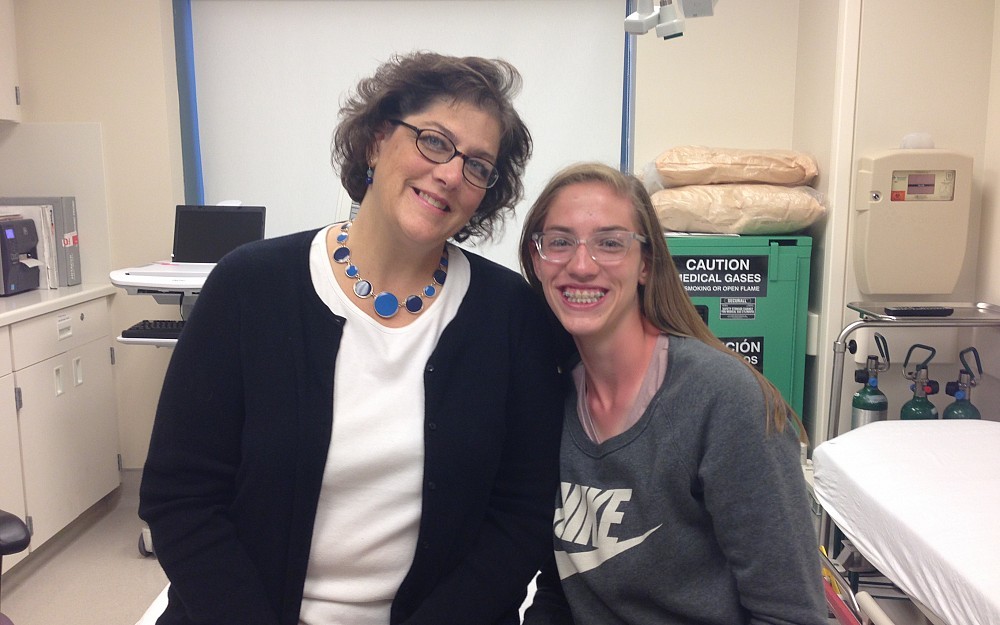
Patient Overcomes Advanced Melanoma With Rare IL-2 Treatment

Cosmetic reasonsand a desire to spend the leftover money in her health savings accountwere behind Julie Sheltons decision to remove a mole behind her right leg that she said she "always remembered having.
"Its something that I always monitored and asked my doctors to check, but it never changed in shape or color, so they told me I didnt have to worry, she says, adding that she always wore sunscreen and didnt sunbathe. "I was just tired of people always telling me I had dirt on my leg!
She went in that day expecting a simple biopsy and removal procedure but instead received news that changed her world as she knew it.
"They told me that theyd never seen anything turn cancerous so fast, says the 47-year-old. "They set up an appointment for me to see an oncologist the next day where I was told it was (advanced) melanoma and that not many people survive when theyre as far along as I was.
With small children at home and a full life ahead of her, Shelton told them to do whatever they needed to try to treat it.
The UC Cancer Institutes Jeffrey Sussman, MD, who is chief of the division of surgical oncology at the UC College of Medicine and a UC Health surgical oncologist, performed surgery on Shelton to remove a large amount of tissue from her leg. The surgery appeared to be successful, and Shelton continued chemotherapy treatments following the removal.
However, about a month into chemotherapy, she noticed some small moles appearing in her groin area.
"The cancer had metastasized and spread to my lymph nodes, she says, adding that the chemotherapy treatment suppressed any signs that the cancer had spread. "Again, I told them to do whatever they could. I had no choice; I would do anything to fight for my life.
Medical oncologists at the UC Cancer Institute had just started offering interleukin 2, or IL-2, treatment and thought this might be an option for Shelton.
IL-2 is a protein that regulates the activities of white blood cells that are responsible for immunity; it is part of the body's natural response to microbial infection and in discriminating between foreign and the bodys own cells. IL-2 treatment involves using a patients own immune system to fight cancer and is marketed as a protein therapeutic. It has been approved by the Food and Drug Administration (FDA) for the treatment of cancers including malignant melanoma, and renal cell cancer in large intermittent toxic doses.
The UC Cancer Institute was and remains one of only a few institutions nationally and the only institution locally to offer this rare treatment. Many patients are not eligible for the treatment because it is so aggressive.
"It was tough, but it was a do or die situation, she says. "I spent one week in the hospital, taking IL-2 every eight hours, then a week off, followed by another week in the hospital and four weeks off with testing and scans to see if the IL-2 was working. Then, the cycle was repeated.
"Doctors never told me that most people don't make it through the first couple of treatments. They just told me the more treatments I could take, the better my chances would be of survival, so I kept going.
"I think the most important part isn't that I still have two legs because I would have gotten rid of one if that's what was needed to survive and make sure the cancer wasn't going to spread to the vital organsalways choose life before vanity. The important part is that IL-2 was available and worked for me, and now six years later, I still test negative and show no signs of the melanoma coming back.
Shelton says she loves her UC Cancer Institute physicians Nagla Karim, MD, PhD, the medical oncologist who now sees her for checkup appointments, and Sussman, and attributes her success in part to their expertise and quick, efficient treatment.
"They were also always supportive and kind to me and my family, she says. "These physicians are part of the reason my now 15-year-old daughter Maddy is thinking about going to school to be a doctor.
However, she also gives credit to her family and to her own will to live.
"I never gave up hope, and I neverand still dontlet cancer define who I am, she says.

Jeffrey Sussman, MD, is a professor and chief of surgical oncology at UC.

Nagla Karim, MD, a member of the UC Cancer Institute and assistant professor in the division of hematology oncology at the UC College of Medicine
Related Stories
Cancer Center plays key role in lab research, clinical trials for new pancreatic cancer drug
September 1, 2026

WLWT and WCPO highlighted the contributions of University of Cincinnati Cancer Center researchers that helped lead to the recent FDA approval of daraxonrasib, a new treatment for pancreatic cancer.
Cancer Center physician receives $150,000 New Investigator Research Grant to study treatment-resistant leukemia
September 1, 2026
The University of Cincinnati Cancer Center’s Sarah Skuli, MD, PhD, received a two‑year, $150,000 Leukemia Research Foundation New Investigator Grant to study TP53‑mutated leukemia, a treatment‑resistant subtype with very poor outcomes.
Heavy social media use linked to depression
August 31, 2026

U.S. News and World Report, Yahoo! News, MSN, USA Today and other national media highlight a new study by the University of Cincinnati and Northwestern University that found a correlation between heavy social media use and depression in adults.