Researchers Testing Possible Benefits of Brain Stimulation in Stroke Rehab

CINCINNATIResearchers on the University of Cincinnati medical campus are testing the possible benefits of brain stimulation on hand and arm function for stroke recovery patients.
The clinical trial, known as NICHE (for Navigated Inhibitory rTMS to Contralesional Hemisphere), is recruiting participants who have had a stroke in the past year. It involves a combination of occupational therapy and a method of non-invasive brain stimulation called transcranial magnetic stimulation (TMS). (rTMS is repetitive transcranial magnetic stimulation.)
UC is one of 12 sites for the study, all in the United States. Principal investigators for the UC site are Kari Dunning, PT, PhD, an associate professor and epidemiologist in the College of Allied Healths Department of Rehabilitation Sciences and director of the Neural Excitability, Therapeutics and Recovery (NET Recovery) lab, and Brett Kissela, MD, MS, Albert Barnes Voorheis Professor and Chair of Neurology and Rehabilitation Medicine in the College of Medicine and a member of the UC Neuroscience Institute.
"There is evidence that people who have sustained a stroke can improve arm movement following stimulation to the brain using TMS, says Dunning. "Our aim is to test this approach and quantify the results.
Dunning explains that TMS can reduce or increase brain activity. By using it to reduce brain activity on the uninjured side of the brain, she says, the injured side is forced to work harder and might have a better chance of recovering.
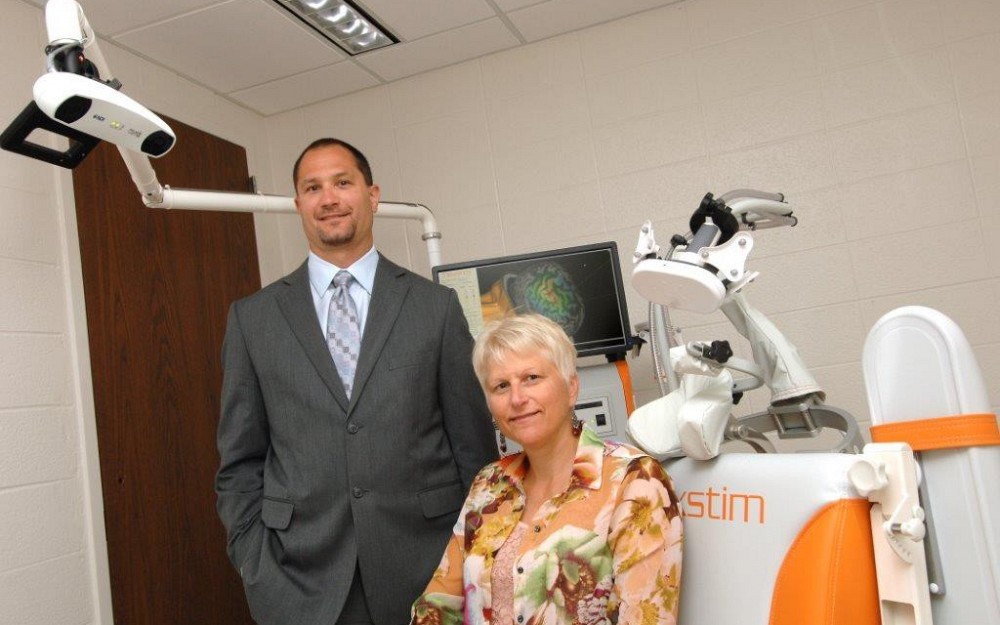
The study will use a navigated brain stimulation device manufactured by Nexstim Ltd., which is funding the trial. Dunning and Kissela report no conflicts.
Participants will be divided into two groups, one of which will receive rTMS treatment and the other receiving sham (placebo) rTMS. Both groups will receive task-oriented rehabilitation from a licensed therapist. It is a randomized, controlled, double-blinded study, which means that neither participants nor investigators know which treatment is being used.
The therapy will be provided for six weeks, and primary outcomes assessed six months later.
To qualify, participants must be 18 or older, have had their stroke three to 12 months prior to enrollment in the study and have hand and arm weakness on one side of their body. Exclusion criteria include implanted devices such as pacemakers or defibrillators, pregnancy, depression and active alcohol abuse.
The therapy and treatments are free of charge. Participants will be compensated over the follow-up period.
Related Stories
Cancer Center plays key role in lab research, clinical trials for new pancreatic cancer drug
September 1, 2026

WLWT and WCPO highlighted the contributions of University of Cincinnati Cancer Center researchers that helped lead to the recent FDA approval of daraxonrasib, a new treatment for pancreatic cancer.
Cancer Center physician receives $150,000 New Investigator Research Grant to study treatment-resistant leukemia
September 1, 2026
The University of Cincinnati Cancer Center’s Sarah Skuli, MD, PhD, received a two‑year, $150,000 Leukemia Research Foundation New Investigator Grant to study TP53‑mutated leukemia, a treatment‑resistant subtype with very poor outcomes.
Heavy social media use linked to depression
August 31, 2026

U.S. News and World Report, Yahoo! News, MSN, USA Today and other national media highlight a new study by the University of Cincinnati and Northwestern University that found a correlation between heavy social media use and depression in adults.