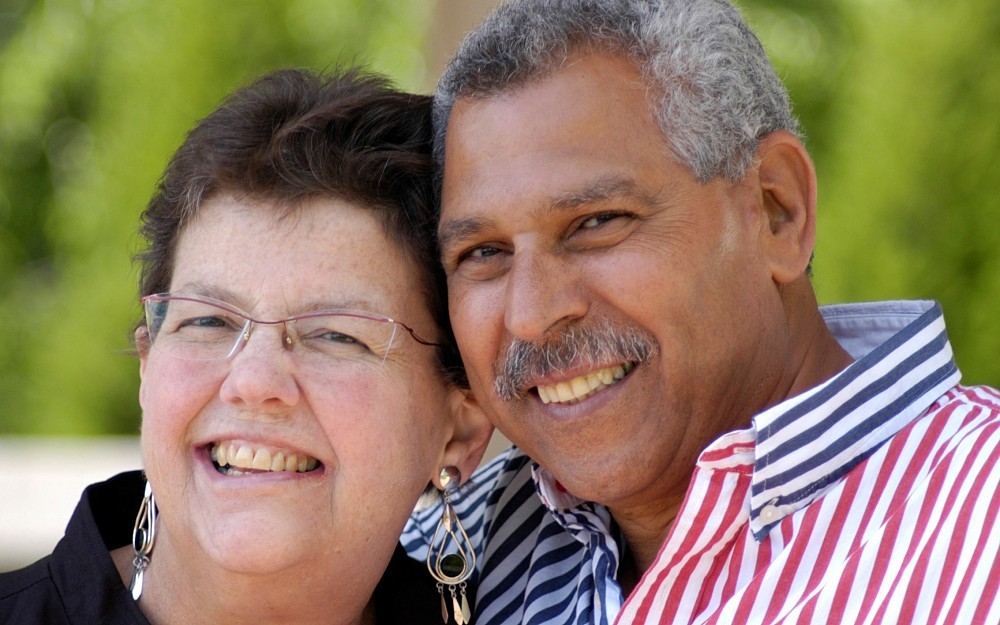
Survivor Says Cancer Screenings Are Important for Quicker Treatment

It all started with a broken tooth.
Lisa Williams, 56, says after beating Non-Hodgkins lymphoma and enduring bouts of bronchitis and pneumonia off and on afterward, she thought she may finally be on the mend.
"However, in spring 2012, I noticed my hearing was getting worse, and I went to UC Health to have a CT scan done, she says. "They found an acoustic neuroma, which is a slow-growing tumor of the nerve that connects the ear to the brain, and they decided to give me three high doses of radiation to shrink the tumor.
Around the same time, Williams said one of the fillings in her teeth fell out, and she started to notice a painful spot on her tongue that she just attributed to her tooth and maybe even ear problems.
"I put off scheduling an appointment with my dentist, though, she says. "May and June of that year were very busy with one son graduating from college and another graduating from law school and moving.
In August, Williams says she felt like she was coming down with bronchitis again and went to see her primary care doctor. She asked him to look at the spot on her tongue and was given some alarming news.
"He told me it might be oral cancer and did a biopsy to confirm that it was, in fact, cancer. He then sent me to Dr. (Keith) Casper, an otolaryngologist with the UC Cancer Institute, she says. "Dr. Casper took one look at it and knew what it was, but he said, Well be able to cure you of this thing.
"So, as scary as that was, it was a relief to know that I would be cancer free and that I wouldnt lose my ability to speak or eat normally.
Casper, performing a procedure that involved going through the side of the neck, was able to remove the cancerous area and to reconstruct Williams tongue using muscle and arteries from her wrist. He was able to save 52 percent of her tongue.
"I was able to come home on Thanksgiving Day of 2012, Williams says. "Although I had to go through rehabilitation, and I had a swallowing coach, Im now able to eat normallyI always have my water with me, though.
"Im alive and improving, and I have a very high chance of full recovery.
Williams says because of the help from Dr. Casper, the nurses and other staff within the institute, shes able to get back to the things she enjoysspending time with her family (she just celebrated her 33rd wedding anniversary with her husband, Ahmed El-Sawaf, gardening and enjoying local festivals. Shes also works at Childrens Hospital Medical Center as a monitor technician.
But she cant forget that with a few additional months notice, her outcomes might have been even better.
"I should have scheduled an appointment with my dentist or doctor immediately after noticing the spot on my tongue, she says. "Its so important to get your teeth cleaned and to get a regular oral exam. Dont assume its nothing. Im thankful that I had such wonderful support that helped make my story successful. I feel blessed.

Keith Casper, MD
Tags
Related Stories
Why can it get so hot at times?
September 3, 2026

Cincinnati is experiencing more days of extreme heat this summer than in previous decades, due in large part to warmer global temperatures. But explanations for these higher temperatures also relate to regional factors, including the city's location in a river valley and large proportion of built environment.
Cancer Center plays key role in lab research, clinical trials for new pancreatic cancer drug
September 1, 2026

WLWT and WCPO highlighted the contributions of University of Cincinnati Cancer Center researchers that helped lead to the recent FDA approval of daraxonrasib, a new treatment for pancreatic cancer.
Cancer Center physician receives $150,000 New Investigator Research Grant to study treatment-resistant leukemia
September 1, 2026
The University of Cincinnati Cancer Center’s Sarah Skuli, MD, PhD, received a two‑year, $150,000 Leukemia Research Foundation New Investigator Grant to study TP53‑mutated leukemia, a treatment‑resistant subtype with very poor outcomes.