First-Year Medical Students Learn the Importance of Being a First Responder

When Nathaniel Harris moved into his new apartment earlier this month he noticed a man curled up next to a dumpster.
The second-year medical student jogged over to check on the gentlemens condition and found he was unresponsive. Thats when Harris training as a first-responder kicked in.
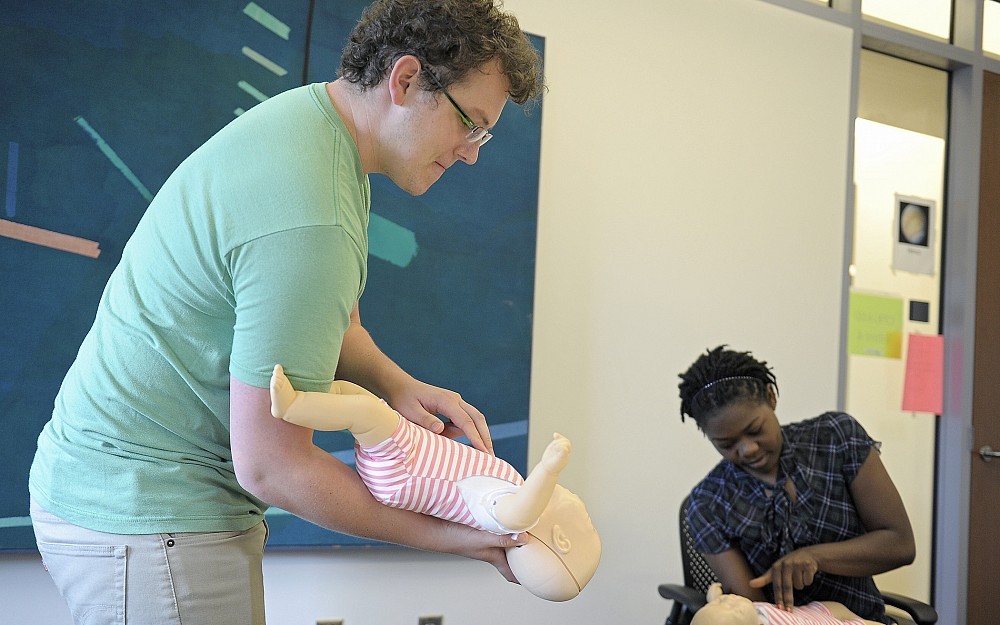
Every first-year student in the College of Medicine is required to complete a two-week first responder course and this years incoming class has just completed the life-saving skill-based training, which is now in its fourth year as part of the medical school curriculum.
"After turning him over I noticed he was severely cyanotic (bluish discoloration of the skin) and didnt seem to be breathing, said Harris, who asked his roommates to call 911.
Harris performed a jaw thrust to open the mans airway, which temporarily helped the individual to breathe. While Harris and his roommates waited for a dispatcher to answer their call, the man they assisted again stopped breathing.
Harris spoke to the dispatcher and described what he saw. She asked if the man had any syringes on his bodyhe did notand instructed Harris to give him a breath every five seconds because his breathing was failing.
He followed the dispatchers instruction and waited for an ambulance. After emergency medical services arrived, crews took over respiratory recitation and administered Narcan, a drug used to reverse opiate overdose in individuals.
"He regained his color and became conscious in a matter of moments; it was unreal, said Harris. "Although first responder seems like a distant memory, I was readily able to recall some of the basic things that I learned. I really think that I wouldnt have been able to help this man if this course had not been offered.
Harris actions were remarkable, but not unheard of among College of Medicine students thanks to the first responder course, says Kay Vonderschmidt, assistant director in the division of emergency medical services special operations institute in the Department of Emergency Medicine.
"We have had students stop at auto accidents and attend football games where people have been injured and they were able to talk to the patient, do an assessment and begin basic treatment until EMS arrived," says Vonderschmidt.
The first responder training is part of a new curriculum the College of Medicine implemented in 2011. The college added the course to allow earlier exposure to the clinical setting for students and to better equip them to respond when someone is critically ill, says Donald Locasto, MD, director of the EMS division in the UC Department of Emergency Medicine.
Because 90 percent of the incoming class had no prior medical training, the skill-based course is important in teaching basic procedures, says Vonderschmidt.
As part of the new curriculum first-year medical school students receive physician mentors and start clerkships in doctors offices. "Within their first year they will need to be able to recognize a stable versus a non-stable patient.
If a patient is unstable, the first-year medical students now have the needed skills to assist the patient. The first responder course offers training in CPR, how to open an airway and take vital signs, and helps students do a medical assessment and a trauma assessment, says Vonderschmidt.
"Many of our medical students have stopped to help others in the past three years, says Locasto. "They are excited to share their stories and they also appreciate knowing what to do in an emergency.
Even first-year medical students are considered "doctors by friends and family and the community from the day they arrive on campus, says Arthur Pancioli, MD, professor and Richard C. Levy Chair for Emergency Medicine in the College of Medicine.
"That being the case it is critical that we supply them with the skills to handle the multitude of emergencies that they could be called upon to manage, says Pancioli. "This course, provided at the very beginning of the first year, does exactly that.
Mildrede Bonglack, a first-year medical student, says she feels good about the training offered by the colleges first responder course.
"Its just so you know what to do if you are faced with an emergency situation, says Bonglack. "In Cincinnati, bystander CPR numbers are really low. The goal is to try and change that.
"Those first minutes are crucial for you to get started on CPR and if bystanders dont help, when the paramedics get there so much time has gone by and the individual has likely suffered irreversible damage.
"In CPR training we had so many skills sessions. We had hands-on training every day and I think that was part of the goal just to get us comfortable doing it. Even if you freak out when you see a terrible accident you can always just go back to, what did we learn? Lets do chest compressions. You can go back to rote memorizations even if you are freaking out.

Second-year medical student Nathaniel Harris used his first responder training to assist a local man.
Related Stories
Cancer Center plays key role in lab research, clinical trials for new pancreatic cancer drug
September 1, 2026

WLWT and WCPO highlighted the contributions of University of Cincinnati Cancer Center researchers that helped lead to the recent FDA approval of daraxonrasib, a new treatment for pancreatic cancer.
Cancer Center physician receives $150,000 New Investigator Research Grant to study treatment-resistant leukemia
September 1, 2026
The University of Cincinnati Cancer Center’s Sarah Skuli, MD, PhD, received a two‑year, $150,000 Leukemia Research Foundation New Investigator Grant to study TP53‑mutated leukemia, a treatment‑resistant subtype with very poor outcomes.
Heavy social media use linked to depression
August 31, 2026

U.S. News and World Report, Yahoo! News, MSN, USA Today and other national media highlight a new study by the University of Cincinnati and Northwestern University that found a correlation between heavy social media use and depression in adults.