UC Begins to Look at Breast Cancer Drugs to Treat Certain Brain Tumors

University of Cincinnati (UC) researchers hope to repurpose commonly used breast cancer medicines for the treatment of malignant primary brain tumors such as gliomas.
"We have an early discovery with the tremendous potential to cure, says Pankaj Desai, PhD, a professor of pharmacokinetics and drug metabolism at the UC James L. Winkle College of Pharmacy who is leading the effort at UC to repurpose aromatase inhibitors, a class of drugs extensively used in the treatment of breast cancer in post-menopausal women.
Ongoing research in brain tumor tissue samples suggests that these agents could be "strikingly effective on brain tumors, says Desai, a member of the UC Cancer Institute with over 20 years experience in oncology drug development.
The current efforts are focused on the lead compound letrozole, an orally administered drug with an outstanding record of safe use.
"There is a desperate need for a breakthrough in the treatment of primary brain tumors as they have high rates of morbidity and mortality, says Desai.
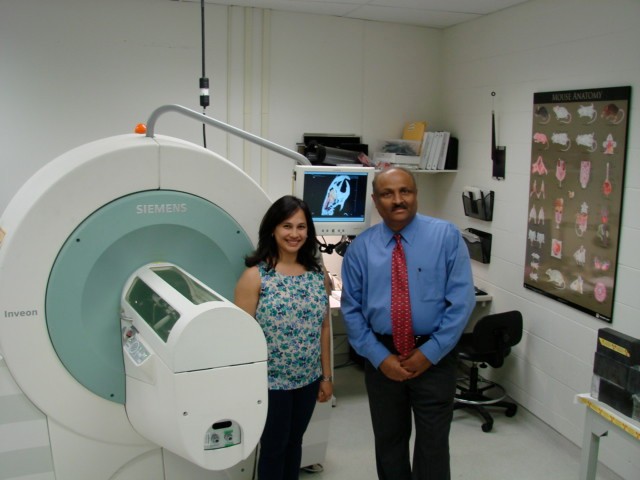
The study started as a dissertation research project of Nimita Dave, who completed her PhD at the Winkle College of Pharmacy in April 2014 under Dr. Desai and has continued her work with him as a postdoctoral fellow. Their research project is so promising that the UC Intellectual Property office has filed a patent application and Desai and his team were recently awarded a $40,000 incubator grant from the University of Cincinnati Technology Commercialization Accelerator in order to develop the administrative protocol to take letrozole to clinical trial.
The team is also working closely with neuro-oncologists Lionel Chow, MD, PhD, Cincinnati Childrens Hospital Medical Center, Richard Curry, MD, and John Morris, MD, UC College of Medicine, on designing early clinical trials.
According to Desai, who is the director of the colleges masters program in drug development, because the project involves the repurposing an existing drug, with additional funding a clinical trial could start as early as 2015and if proven effective the drug could go to market in as few as two to three years.
The University of Cincinnati Technology Commercialization Accelerator, created in 2012, serves to address technologies that are regularly too early stage to generate interest by those with investment dollars. Serving as a hub for innovation and commercialization activity at UC, the accelerator puts a focus on identifying promising technologies and furthering those projects and ideas so that they can attract interest from outside funding sources.
Technologies submitted for the accelerator are assessed to determine viable startup company opportunities, with the most promising selected for funding. Entrepreneurs-in-Residence facilitate the work needed to develop commercialization strategies and advance the commercial potential of the technologies. To date, 13 projects have been awarded funding through three rounds of applications to UCs Technology Commercialization Accelerator.
Funding for the Accelerator comes from Ohios Third Frontier Entrepreneur Signature Program, UCs partnership with CincyTech, the universitys 2019 Entrepreneur Grant funds and additional external sources.
Related Stories
Cancer Center plays key role in lab research, clinical trials for new pancreatic cancer drug
September 1, 2026

WLWT and WCPO highlighted the contributions of University of Cincinnati Cancer Center researchers that helped lead to the recent FDA approval of daraxonrasib, a new treatment for pancreatic cancer.
Cancer Center physician receives $150,000 New Investigator Research Grant to study treatment-resistant leukemia
September 1, 2026
The University of Cincinnati Cancer Center’s Sarah Skuli, MD, PhD, received a two‑year, $150,000 Leukemia Research Foundation New Investigator Grant to study TP53‑mutated leukemia, a treatment‑resistant subtype with very poor outcomes.
Heavy social media use linked to depression
August 31, 2026

U.S. News and World Report, Yahoo! News, MSN, USA Today and other national media highlight a new study by the University of Cincinnati and Northwestern University that found a correlation between heavy social media use and depression in adults.