With NIEHS Grant, Researcher Focuses on Eyelid Development

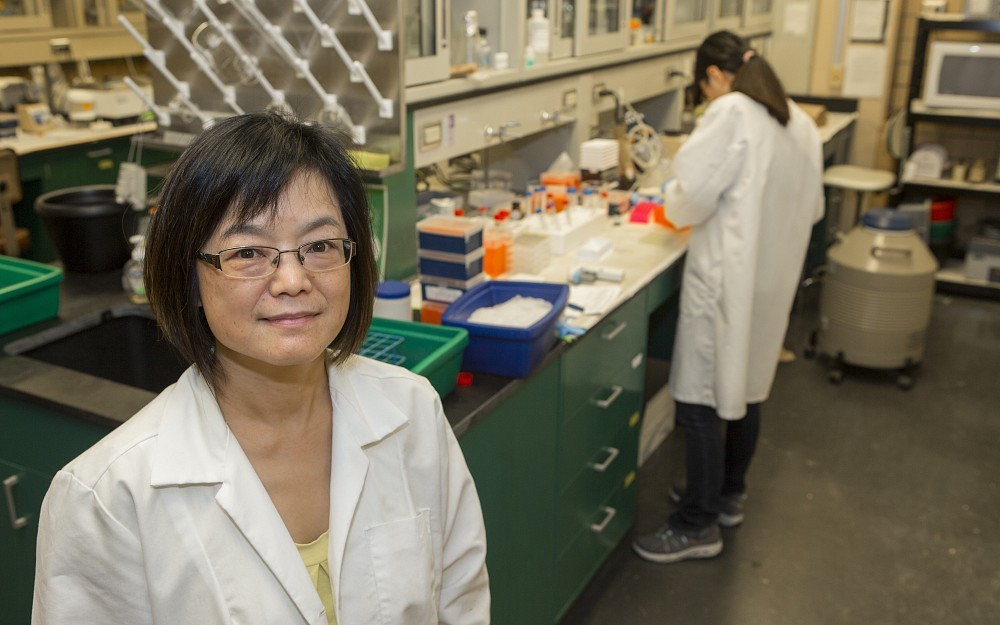
Most humans blink thousands of times a day, but rarely give a thought to the mechanics of blinking. Ying Xia, PhD, an associate professor in the UC Department of Environmental Health, gives it her fullunblinking, you might sayattention as a researcher.
Specifically, Xia and members of her team on the fourth floor of Kettering Lab study gene-environment interaction in eyelid development. She recently received a $237,500 grant from the National Institutes of Healths National Institute for Environmental Health Sciences (NIEHS) to continue her studies of the factors behind eyelid closure defects.
These defects, Xia says, may be the underlying causes of congenital ptosis, a drooping of the upper eyelid, and strabismus, a misalignment of the eyes (either horizontal or vertical).
"For a long time we have been focusing on the genetic aspect of eyelid development and trying to figure out how the process is regulated through cell signaling mechanisms, says Xia, a UC faculty member since 2000. "It turns out there are hundreds of genes that regulate this process, and were still trying to understand how those components are interacting.
"But many defects cant be explained simply by genetic lesions, and thats where environmental concerns also come into play. This is based on the idea that most birth or developmental defects are due to the interaction between genetic factors and environmental exposure where the exposure could disrupt the indigenous developmental program.
Xia is an affiliate member of the UC Center for Environmental Genetics, which is funded by NIEHS and housed in the environmental health department under the direction of Shuk-Mei Ho, PhD, Jacob G. Schmidlapp Professor and Chair of Environmental Health. The grant will enable Xia to test the idea that in utero chemical exposure is a risk factor for developmental defects in conjunction with pre-existing genetic conditions.
"Well be using genetic mouse models and TCDD (2,3,7,8-Tetrachlorodibenzo-p-dioxin), an important environmental pollutant, to investigate gene-environment interaction in embryonic eyelid development, says Xia. "Mouse embryonic eyelid closurean important developmental milestonewill serve as a functional readout to identify the environmental factors and gene-environment interactions as a basic root of birth defects.
Xias two collaborators for the study, Ho and Alvaro Puga, PhD, who is a professor in the environmental health department and an associate director of the CEG, are experts in molecular toxicology, specializing in dioxin toxicity and in environmental developmental and cancer biology.
"Our study has broader implications, Xia says, "because embryonic eyelid closure is a significant model for fundamental development processes such as palate fusion and neural tube closure. So this study may reveal mechanistic etiologies of many forms of birth defects in which an opening has failed to close.
Tags
Related Stories
On-site training in Speech & Hearing Clinic sets UC’s programs apart
August 27, 2026
At the University of Cincinnati’s Speech & Hearing Clinic, Doctor of Audiology and Speech-Language Pathology graduate students gain real-world experience while providing free speech and hearing services to the community.
Funding expands UC research into weight gain side effects of bipolar medication
August 26, 2026
University of Cincinnati researchers have been approved for funding by the Patient-Centered Outcomes Research Institute (PCORI) to expand the implementation of healthy lifestyle interventions and metformin prescription to help manage weight gain in overweight or obese youth taking second-generation antipsychotic medications.
One in four NFL players had CTE at death
August 25, 2026

Forbes cites research on concussions and football helmets by the University of Cincinnati in a report that found one in four NFL players had brain damage at death.