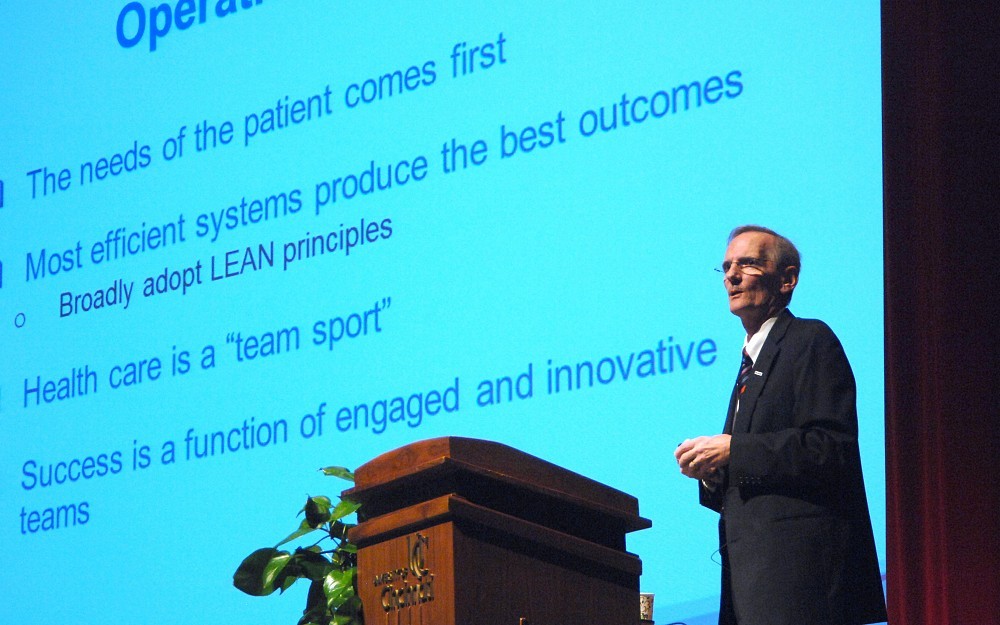
Lofgren: Quality, Safety and Efficiency Are UC Health Goals

Amid a shifting marketplace and changing health care landscape, Richard Lofgren, MD, is confident of one thing: UC Health can control its own fate by designing its systems around the patient.
"If we provide high-touch, high-service care that is accessible and demonstrates outstanding results, in the most efficient way by constantly eliminating waste, then well be successful regardless of what happens in the market, regardless of what happens in Columbus and regardless of what happens in Washington, D.C., Lofgren said Tuesday, Sept. 9, in a presentation titled, "UC Health Update: In Context.
"These goals are well within our control as we move forward.
Lofgren, president and CEO of UC Health since Dec. 1, 2013, was giving the first in this academic years monthly UC College of Medicine leadership presentations. He was introduced by Thomas Boat, MD, University of Cincinnatis vice president for health affairs and Christian R. Holmes professor and dean, College of Medicine.
"Health care is a team sport, Lofgren said. "No individual, no department, no discipline, no one element of this organization can unilaterally improve our performance in terms of quality, safety and efficiency. Its a complex organization that requires everybody to work together to make it happen.
UC Health (the region's only academic health system), with $1.3 billion in revenue for fiscal year 2014, includes UC Medical Center, West Chester Hospital, University of Cincinnati Physicians, Daniel Drake Center for Post-Acute Care, Lindner Center of HOPE (a joint venture with the Lindner Family Foundation) and the UC Health Foundation. UC Health serves as the clinical engine to support education and research missions of UC and its health sciences colleges.
Lofgren began the presentation by reminding the audience of UC Healths vision, which includes being the first-to-mind referral center for highly specialized, complex care within 75 miles of Cincinnati.
As an academic medical center, Lofgren said, "the financial reality is that we rely on the margins for complex care. The sickest 5 percent of the population, he noted, is classified as "high risk/high cost and spends 50 times as much per person as the healthy majority.
That 5 percent, Lofgren said, requires complex care, "the kinds of things that we are uniquely positioned to provide here at UC Health with institutes such as the UC Neuroscience Institute, the UC Cancer Institute and the UC Heart, Lung and Vascular Institute.
Turning his attention to the Affordable Care Act, Lofgren said the operative word in the debate about its passage and implementation has been affordabilityand he offered a caveat.
"Theres been a lot of talk about the fact that were going to reduce health care costs by making the population healthier, he said. "Despite wishful thinking to the contrary, the overwhelming majority of health care spending is not all that preventablebut much of it is manageable.
As the population ages, Lofgren said, the prevelance of complex disease will increase. "But the ability for us to take care of these complex patients really is the greatest opportunity to make health care affordable, he said. "Its really about how we provide complex care in a meaningful way.
UC Healths role in the regional health care market, Lofgren said, is to be the preferred provider of advanced specialty care by "leveraging our academic backbone.
"We need to be a magnet, a destination center he said. "Our core business is really a function of transfers, referrals (from primary care physicians) and referrals from subspecialists, so we have to create a culture of simply saying 'yes.'
"All care that can remain local should remain local. But if patients need a higher level of care, we need to be prepared to take them quickly. We need to be viewed as the region's complex care partner.
Lofgren said enterprise-wide goals in such domains as quality, safety and efficiency will be set and tracked, and posted throughout the organization. Above all, he said, UC Health associates should never lose sight of the fact that serving the people of Greater Cincinnati is a privilege.
"Despite the remarkable technology and wizardry that we use, he said, "health care in fact remains a very human endeavor.
Lofgrens leadership presentation is viewable online at med.uc.edu/about/deanscorner/presentations.
Related Stories
Cancer Center plays key role in lab research, clinical trials for new pancreatic cancer drug
September 1, 2026

WLWT and WCPO highlighted the contributions of University of Cincinnati Cancer Center researchers that helped lead to the recent FDA approval of daraxonrasib, a new treatment for pancreatic cancer.
Cancer Center physician receives $150,000 New Investigator Research Grant to study treatment-resistant leukemia
September 1, 2026
The University of Cincinnati Cancer Center’s Sarah Skuli, MD, PhD, received a two‑year, $150,000 Leukemia Research Foundation New Investigator Grant to study TP53‑mutated leukemia, a treatment‑resistant subtype with very poor outcomes.
Heavy social media use linked to depression
August 31, 2026

U.S. News and World Report, Yahoo! News, MSN, USA Today and other national media highlight a new study by the University of Cincinnati and Northwestern University that found a correlation between heavy social media use and depression in adults.