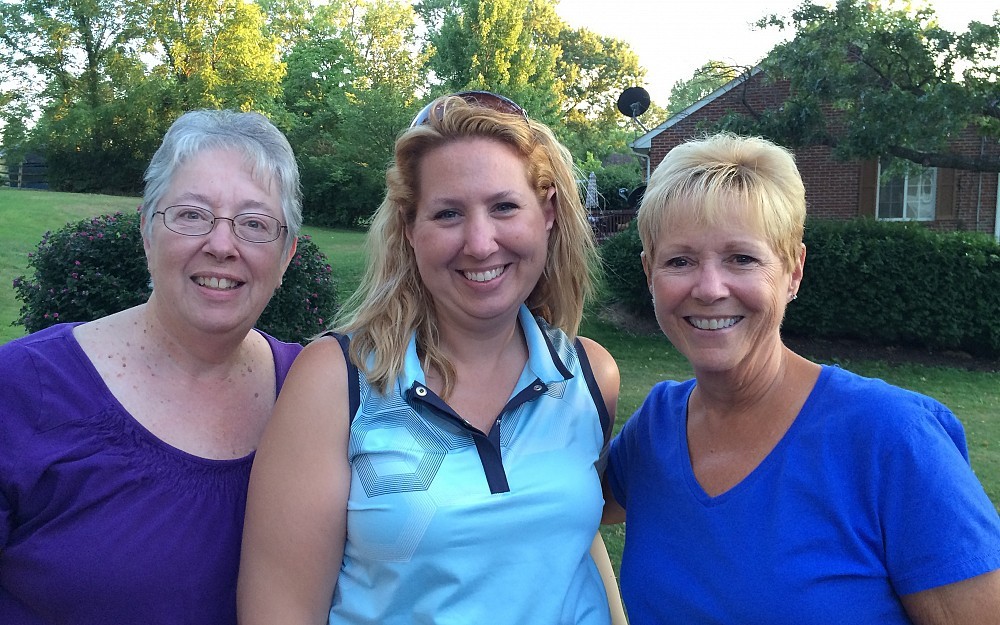
Young Breast Cancer Survivor Says, 'It's Better to Be Safe Than Sorry'

Colleen Murray never expected to be a metastatic breast cancer survivor at the young age of 36.
However, the lump on the upper part of her chest, which she discovered in January 2008 at the age of 33, turned out to be more than the benign fibrous tissue physicians thought it was.
"I had noticed the lump in 2008 but was told several times it was only fibrous tissue, which is normal for someone my age who has not had any pregnancies, so theres nothing to be concerned about. At my yearly exam in December 2009, wmy gynecologist wrote an order to get a screening mammogram, she says, adding that nothing suspicious was detected and that physicians continued to say she was probably OK.
However, a trip to buy a new bra the following year set off warning bells for Murray.
"I noticed that that skin was oddly tugging around the area of the lump, and I made my yearly exam to see my gynecologist, she says, adding that her doctor decided to refer her to UC Cancer Institute surgeon Elizabeth Shaughnessy, MD, PhD, although she didnt think anything was wrong. "Dr. Shaughnessy did a biopsy, and I got a call from hertwo days after Christmastelling me that it was cancer.
Murray says she scheduled a follow-up appointment with Dr. Shaughnessy, and this time, her mother and aunt, who is a breast cancer survivor, accompanied her.
"My aunt said my treatment experiences were completely different than hers, she says. "I had a team of multidisciplinary physicians from the start that communicated with one another and spoke about my care regularly to provide the best treatment plan for me. It was all laid out for meI didnt have to guess about which physician to see or my next steps to take like she did.
Murray had an additional diagnostic mammogram and MRI because her breast tissue was so dense and hard to image; physicians found seven additional tumorsthree on her left side, three on her right and one underneath her left breast. Additionally, they found that the cancer had spread to her breast bone and spine.
"They found out that I did not have the BRCA1 or BRCA2 gene mutation, which is responsible for causing many breast cancer cases, and Dr. (Elyse) Lower, my oncologist (and director of the Comprehensive Breast Cancer Center), began a treatment plan for me which included chemotherapy, surgery, radiation and reconstruction.
She says the initial chemotherapy eliminated the cancer in her spine and breast bone and allowed the double mastectomy surgery, conducted by Shaughnessy, and reconstruction to take place. She continued with radiation, Herceptin infusions and hormone therapy, standard treatment for metastatic breast cancer.
There was a setback in July 2012 when a follow-up CT scan for activity-induced asthma revealed that the lesion on her spine had grown back.
Targeted radiation therapy was administered immediately by John Breneman, MD, and by February 2013 scans showed no evidence of cancer.
"Im still undergoing maintenance treatment, but so far, so good, she says. "Thanks to my care team, I always knew what to expect. Dr. Lower never just threw out information and expected me to act on my own.
"I thought I was going to die, but Dr. Lower explained it as dealing with a chronic illness: First, we needed to get the cancer under control, and then, we treat it like diabetes or heart disease with ongoing maintenance treatments. I couldnt ask for a better experience.
Murray, who said she never felt sick or experienced any symptoms, says its important to tell young women to push care providers if something isnt quite right.
"Even if it is just fibrous tissue, its better safe than sorrysee a surgical oncologist; Im glad I did, she says.
Tags
Related Stories
Cancer Center plays key role in lab research, clinical trials for new pancreatic cancer drug
September 1, 2026

WLWT and WCPO highlighted the contributions of University of Cincinnati Cancer Center researchers that helped lead to the recent FDA approval of daraxonrasib, a new treatment for pancreatic cancer.
Cancer Center physician receives $150,000 New Investigator Research Grant to study treatment-resistant leukemia
September 1, 2026
The University of Cincinnati Cancer Center’s Sarah Skuli, MD, PhD, received a two‑year, $150,000 Leukemia Research Foundation New Investigator Grant to study TP53‑mutated leukemia, a treatment‑resistant subtype with very poor outcomes.
Heavy social media use linked to depression
August 31, 2026

U.S. News and World Report, Yahoo! News, MSN, USA Today and other national media highlight a new study by the University of Cincinnati and Northwestern University that found a correlation between heavy social media use and depression in adults.