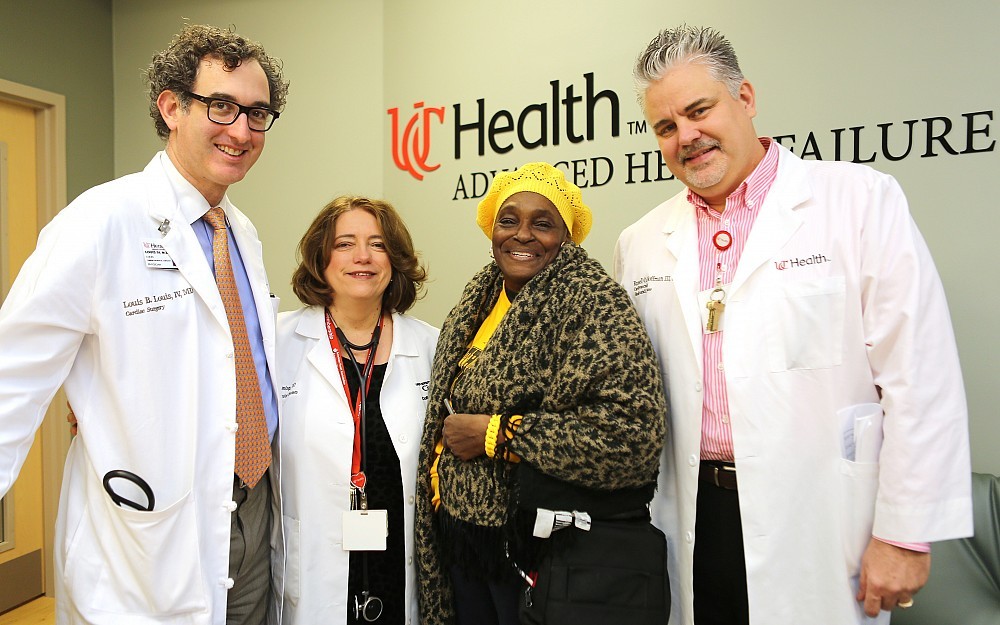
To Help Others, LVAD Patient Tells How Her Device 'Saved My Life'

Arnetta Profit-Greer has a left ventricular assist device known simply as an LVAD implanted in her chest and a story she will share with anyone who listens.
"I pretty much do everything I want to do," explains Profit-Greer, a retired Cincinnati resident. "I shop, I clean and I go to the grocery store. I've had good days and bad days and I always say if I had to do it again, I would because the LVAD saved my life."
Two years ago, Profit-Greer had an LVAD, a mechanical pump designed to help the left ventricle pump blood to the aorta, implanted by UC Health heart surgeon Louis Louis, MD, who is also a professor of medicine at UC. It can be used as a bridge while some patients wait for a heart transplant, but for Profit-Greer and others, the LVAD is a permanent therapy to correct a malfunctioning heart.
The LVAD is connected to an external control unit which needs a power sourcetypically mobile batteries or a power base unitto function. Patients often use carrying bags to transport the mobile batteries. Profit-Greer remembers that she didn't always warm to the idea of an LVAD.
Initially she hated it, but after an 82-day hospital stay leading up to LVAD surgery, her views on the device and life began to change.
"I know tomorrow is not promised to me," says Profit-Greer. "I live each day as if its the last. The whole operation made me look at life differently. I wake up happy, I go to bed happy. I am a jokester. I just like to be funny so that I feel good about myself. I had a good team of doctors, a good team of nurses because everybody cared about me."
Today, Profit-Greer offers support to other patients who are candidates for the LVAD. She visits them in the hospital to offer pep talks, speaks with their families and offers her phone number if they need to talk to someone for encouragement. She is currently seen by Stephanie Dunlap, DO, medical director at the UC Health Advanced Heart Failure Treatment Center and associate professor in the UC College of Medicine.
"I tell them about my beginning, what's happening now and how I was able to overcome a bad situation and how my body was really messed up," says Profit-Greer. "I talk to them about the LVAD and carrying the bag. I understand how they feel when they ask, Why do I have to carry this bag all the time?
"I have to do this and that with it. That was depressing for me, but it is what it is," she explains. "I had to accept it. It becomes normal, a part of you. Ive told other patients Ive been there, but you have to overcome it. I couldnt just let that bog me down because I would end up depressed."
Jennifer Lukes, advanced heart failure nurse clinician at UC Health, says Profit-Greer also accompanies medical staff to training sessions with firefighters, police and emergency workers who may have to respond to LVAD patients in their jurisdictions.
Profit-Greer makes the training session much more useful because fire, police and emergency workers can interact with an actual LVAD patient, ask questions and better understand why some emergency procedures aren't helpful, says Lukes.
"If an LVAD patient comes in or if they collapse we really dont want them to do CPR on LVAD patients," says Lukes. "We educate them on the logistics of the pump and what to do with it.
"We hit the jackpot with Arnetta," says Lukes. "It is one thing for us to sit and tell patients you are going to come through this and you are going to do great, but she has walked in their shoes. She is very good at putting patients at ease and getting them comfortable with the concept of having an LVAD."
To reach the UC Health Advanced Heart Failure Treatment Center call 513-584-7217.
Related Stories
Cancer Center plays key role in lab research, clinical trials for new pancreatic cancer drug
September 1, 2026

WLWT and WCPO highlighted the contributions of University of Cincinnati Cancer Center researchers that helped lead to the recent FDA approval of daraxonrasib, a new treatment for pancreatic cancer.
Cancer Center physician receives $150,000 New Investigator Research Grant to study treatment-resistant leukemia
September 1, 2026
The University of Cincinnati Cancer Center’s Sarah Skuli, MD, PhD, received a two‑year, $150,000 Leukemia Research Foundation New Investigator Grant to study TP53‑mutated leukemia, a treatment‑resistant subtype with very poor outcomes.
Heavy social media use linked to depression
August 31, 2026

U.S. News and World Report, Yahoo! News, MSN, USA Today and other national media highlight a new study by the University of Cincinnati and Northwestern University that found a correlation between heavy social media use and depression in adults.