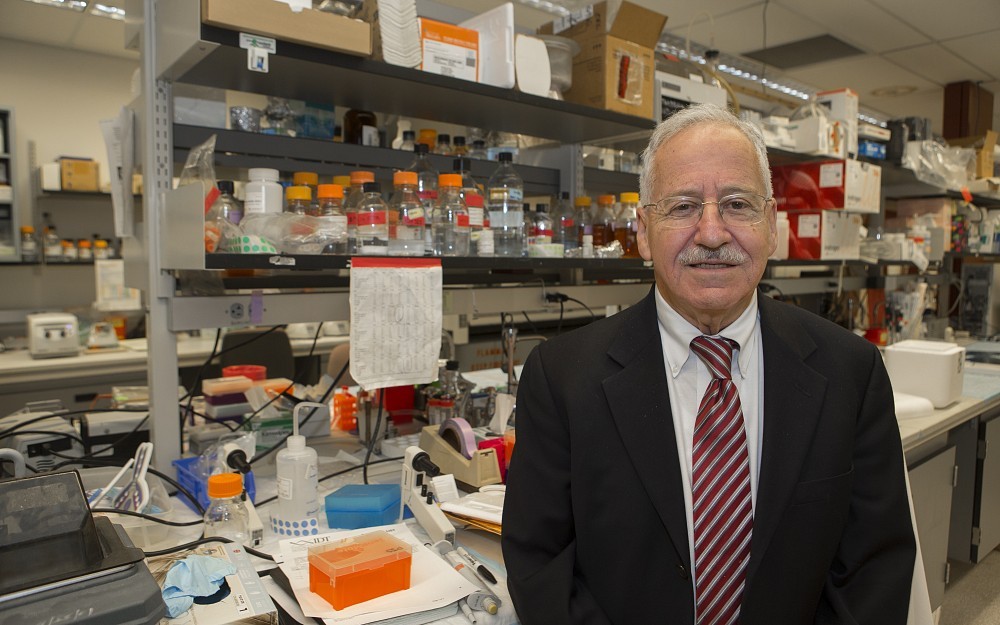
2015 Distinguished Research Professor

Peter Stambrook, PhD, joined the UC College of Medicine faculty in 1981 and served 28 years in what is now the Department of Cancer Biology, rising to become Francis Brunning Professor and Chairman in 1996. He stepped down after 12 years and became a professor of molecular genetics, biochemistry and microbiology.
He currently serves as co-leader of the UC Cancer Institutes Comprehensive Head and Neck Cancer Center. His research has resulted in numerous published articles showing how cells maintain and preserve their genetic makeup.
In 2007, he was elected as a Fellow of the American Association for the Advancement of Science. He subsequently was awarded UCs George Rieveschl Jr. Award for Distinguished Scientific Research (2013), the UC College of Medicines Daniel Drake Medal (2013), the Environmental Mutagenesis and Genomics Society Award for outstanding research contributions (2013) and the Distinguished Scientist Award from the Society for Experimental Biology and Medicine (2015).
Stambrook believes that if at first you dont succeed, celebratebecause you might be on the path to an exciting discovery.
"You design experiments to test hypotheses, he says, "and the results might initially prove disappointing because the data dont fit the hypotheses. But very often, those are the most exciting data and can lead you in new directions and help you break new ground.
Well into his fourth decade at UC, Stambrook has made a career out of disdaining conventional wisdom as he seeks insights into the mysteries of cancer.
He became interested in DNA replication and cell cycle regulation as a graduate student and was the first to show that, in a vertebrate organism, the temporal sequence with which DNA duplicates itself can change during embryogenesis. That finding "changed the thinking in the field, according to College of Medicine colleague Evangelia Kranis, PhD, who notes that Stambrooks work "places him at the forefront of investigators interested in understanding genomic instability, particularly as it relates to cancer.
His subsequent work at UC, Kranias says, "opened an entire field that is now being populated by numerous investigators. Stambrooks current research focuses on a critical signaling pathway that responds to DNA damage. He also has formed a collaboration with the UC Brain Tumor Center to develop novel cancer gene therapy approaches.
Related Stories
On-site training in Speech & Hearing Clinic sets UC’s programs apart
August 27, 2026
At the University of Cincinnati’s Speech & Hearing Clinic, Doctor of Audiology and Speech-Language Pathology graduate students gain real-world experience while providing free speech and hearing services to the community.
Designing with cancer patients' needs in focus
August 27, 2026
Kristina Shin is designing garments that prioritize the comfort, function and confidence of breast cancer patients, addressing a need often overlooked by traditional fashion.
UC, NKU renew longstanding partnership supporting Army ROTC cadets
August 26, 2026
The University of Cincinnati Army ROTC and Northern Kentucky University (NKU) have renewed a longstanding partnership that supports students preparing to become Army officers and leaders in their communities. The universities formalized the renewed agreement during a signing event Aug. 11 at NKU.