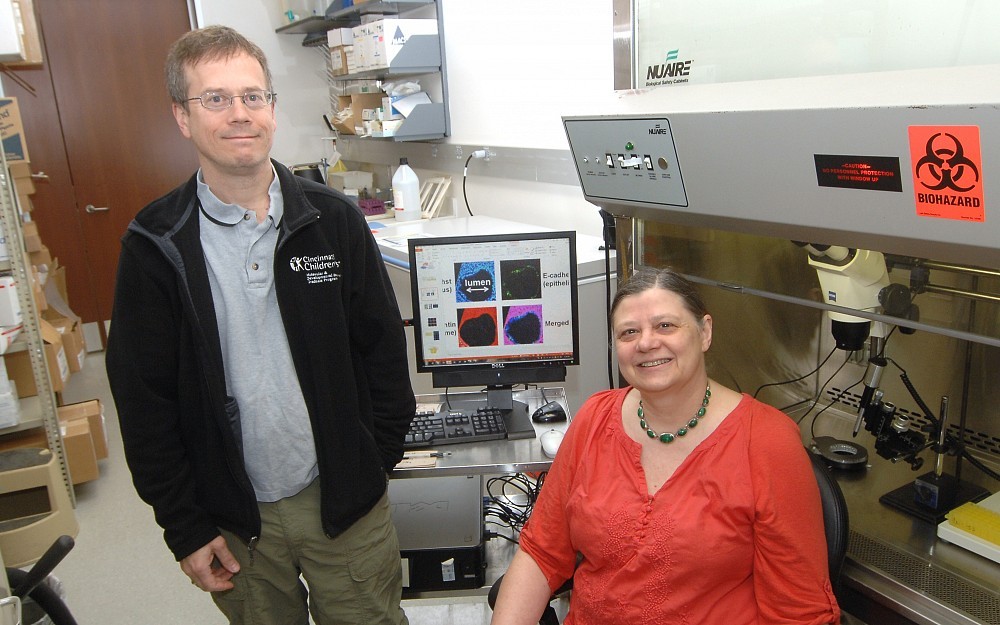
Research Team Wins $4.6M Grant to Study Diarrheal Disease Using Organoids

CINCINNATIAn interdisciplinary team of researchers and physicians at the University of Cincinnati and Cincinnati Childrens Hospital Medical Center has been awarded a $4.6 million multi-project grant from the National Institutes of Health (NIH) to study diarrheal disease using lab-developed human stomach and intestinal tissues known as organoids.
Alison Weiss, PhD, a professor in the UC College of Medicines Department of Molecular Genetics, Biochemistry and Microbiology, and James Wells, PhD, a professor in the UC Department of Pediatrics, co-director of the Pluripotent Stem Cell Center at Cincinnati Childrens and associate director of the Digestive Health Center, will serve as co-principal investigators for the grant, "Gastrointestinal Organoids as a model system for studying enteric disease.
Other team members include:
Gastrointestinal physiology experts Yana Zavros, PhD, a professor in the UC Department of Molecular and Cellular Physiology; Christian Hong, PhD, an assistant professor in the Department of Molecular and Cellular Physiology; and Marshall (Chip) Montrose, PhD, professor in the Department of Molecular and Cellular Physiology and dean of the Graduate School at UC.
Infectious disease specialist Sean Moore, MD, an assistant professor in the Department of Pediatrics and a member of the Division of Gastroenterology, Hepatology and Nutrition at Cincinnati Childrens.
Gastroenterologist Bruce Yacyshyn, MD, a professor in the UC Department of Internal Medicine, Division of Digestive Diseases, and Mary Beth Yacyshyn, PhD, an adjunct assistant professor in the Division of Digestive Diseases.
Surgeon and stem cell biologist Michael Helmrath, MD, a professor in the UC Department of Surgery and surgical director of the Intestinal Rehabilitation Program at Cincinnati Childrens.
Human microbiome expert Ardythe Morrow, PhD, a professor in the Department of Pediatrics and director of the Center for Interdisciplinary Research in Human Milk and Lactation at Cincinnati Childrens.
Stem cell expert Chris Mayhew, PhD, assistant professor in the Department of Pediatrics and co-director of the Pluripotent Stem Cell Center.
Globally, diarrheal disease is a leading cause of morbidity and the second-leading cause of death during the first year of life. In the United States, infection-associated chronic conditions are major sources of morbidity and mortality.
NIH U19 grants are intended to support a research program of multiple projects directed toward a specific major objective, basic theme or program goal, requiring a broadly based, multidisciplinary and often long-term approach. They typically involve a cooperative agreement among large groups.
Team members will use the cores and services of the Digestive Health Center at Cincinnati Childrens, a UC Academic Health Center resource and one of only 17 Silvio O. Conte Digestive Diseases Research Core Centers in the nation supported by the National Institutes of Diabetes and Digestive and Kidney Diseases.
"The goal of the research funded by this grant is to develop human gastrointestinal organoids as model systems to study gastrointestinal infectious diseases such as infections of Helicobacter pylori, E. coli 0157:H7 and Clostridium difficile, says Weiss, who adds, "The ability to access the cores and services of the Digestive Health Center was a critical factor in the success of this proposal.
In October 2014, scientists from UC and Cincinnati Childrens reported that they had created a model for studying diseases of the intestine by successfully transplanting organoids of functioning human intestinal tissue grown from pluripotent stem cells in a lab dish into mice. (The mice were genetically engineered so their immune systems would accept the introduction of human tissues.)
The scientists used induced pluripotent stem cells (iPSCs), which can become any tissue type in the body, to generate the intestinal organoids. The team converted adult cells drawn from skin and blood samples into "blank iPSCs, then placed the stem cells into a specific molecular cocktail so they would form intestinal organoids. The human organoids were then engrafted into the capsule of the kidney of a mouse, providing a necessary blood supply that allowed the organoid cells to grow into fully mature human intestinal tissue.
Researchers caution that it will take years of further research to translate lab-grown tissue replacement into medical practice. In the meantime, the discovery could have other, more immediate benefits by accelerating drug development and the concept of personalized medicine.
Related Stories
Heavy social media use linked to depression
August 31, 2026

U.S. News and World Report, Yahoo! News, MSN, USA Today and other national media highlight a new study by the University of Cincinnati and Northwestern University that found a correlation between heavy social media use and depression in adults.
Campus buzz returns as UC students experience their first week
August 27, 2026
Near-perfect weather, record first-year enrollment, Thrifty Move-In and a packed Involvement Fair mark the University of Cincinnati’s first week back as thousands of Bearcats move into campus housing.
On-site training in Speech & Hearing Clinic sets UC’s programs apart
August 27, 2026
At the University of Cincinnati’s Speech & Hearing Clinic, Doctor of Audiology and Speech-Language Pathology graduate students gain real-world experience while providing free speech and hearing services to the community.