Study: Co-infected HCV and HIV Patients Receive More Effective Treatments

CINCINNATIResearchers have found that using a combination of sofosbuvir and a new drug agent known as daclastasvir is highly successful in treating co-infected hepatitis C (HCV) and HIV patients.
A report in the July 21 edition of the New England Journal of Medicine shows HIV-HCV co-infected patients who had not previously been treated for hepatitis C, but received 12 weeks of treatment with sofosbuvir and daclastasvir achieved a 97 percent cure (sustained virologic response). Daclatasvir is a hepatitis C virus NS5A inhibitor and sofosuvir is an NS5B inhibitor.
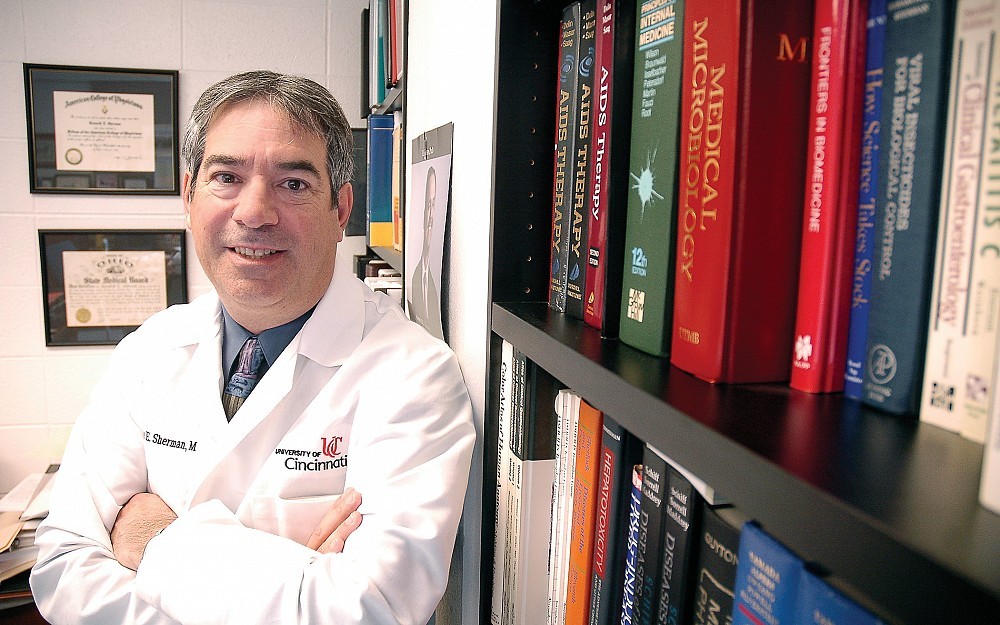
"This regimen was compatible with almost all HIV drug regimens and that made it relatively unique, explains Kenneth Sherman, MD, PhD, a co-author of the study and Director of the Division of Digestive Diseases in the University of Cincinnati (UC) College of Medicine.
"We are treating patients who have hepatitis C along with HIV, which have long been considered one of the most difficult groups of patients to treat and manage and in part thats because of drug interactions between the drugs used to treat HIV and the drugs used to treat hepatitis C, says Sherman, also a UC Health physician.
Its meant that co-infected HCV and HIV patients often had to change their HIV treatment before hepatitis C could be treated and that incurred its own risk, explains Sherman. In the United States, about 300,000 people are co-infected with HCV and HIV, he says.
The study reported in the Journal was sponsored by Bristol-Myers Squibb and included 151 patients who had not received HCV treatment along with 52 previously treated patients. At UC, six participants were part of this study. The studys lead author was David Wyles, MD, associate professor of medicine at the University of California San Diego.
Sherman says the study was open label in the sense all patients got the same treatment, but that treatment in the naïve arm (individuals who had never been treated for hepatitis C) was randomized but not blinded. The study was open to patients with all genotypes of the hepatitis C virus, he explains.
Treatment naïve patients also achieved a 76 percent cure (sustained virologic response) rate after just eight weeks of treatment with sofosbuvir and daclastasvir, according to the Journal study.
"The shortened therapy demonstrated had good results, says Sherman. "Two years ago this would have been regarded as excellent and nothing short of incredible. Now we were are looking for rates of 90 percent or better.
Sherman says the study shows that the treatment is well-tolerated in co-infected patients who already have an increased risk of drug interactions and pill burden issues. He says there are few side effects and that patients were asked to take two pills daily for an eight- or 12-week period.
If hepatitis C is not treated it leads to liver disease, cirrhosis and liver cancer. Untreated hepatitis C is the leading cause of death among HIV-infected patients living in western countries, Sherman says.
Sherman is an investigator for the Bristol-Myers Squibb clinical trial. He is also a consultant and advisory board member for Merck & Co. Inc.
To schedule an appointment with a liver expert at the University of Cincinnati, please call
513-475-7505
. Research studies for people with chronic hepatitis C may be available as well, and interested parties should call
513-584-2363
to determine their eligibility for participating in studies of new treatment agents.
Related Stories
Cancer Center plays key role in lab research, clinical trials for new pancreatic cancer drug
September 1, 2026

WLWT and WCPO highlighted the contributions of University of Cincinnati Cancer Center researchers that helped lead to the recent FDA approval of daraxonrasib, a new treatment for pancreatic cancer.
Cancer Center physician receives $150,000 New Investigator Research Grant to study treatment-resistant leukemia
September 1, 2026
The University of Cincinnati Cancer Center’s Sarah Skuli, MD, PhD, received a two‑year, $150,000 Leukemia Research Foundation New Investigator Grant to study TP53‑mutated leukemia, a treatment‑resistant subtype with very poor outcomes.
Heavy social media use linked to depression
August 31, 2026

U.S. News and World Report, Yahoo! News, MSN, USA Today and other national media highlight a new study by the University of Cincinnati and Northwestern University that found a correlation between heavy social media use and depression in adults.