Cutaneous Lymphoma Clinic Now Operating at Barrett Center

CINCINNATIExperts at the University of Cincinnati Cancer Institute are now offering a clinic for a rare form of cancer, providing cutting-edge care in a convenient location for cutaneous lymphoma patients in the Tristate.
The clinic, which is held from 1 to 5 p.m. every third Thursday of the month in the UC Health Barrett Cancer Centers Area E, will focus on treatment of this non-Hodgkin lymphoma, which is a type of cancer of the immune system. Unlike most non-Hodgkin's lymphomas, most cutaneous lymphomas are caused by a mutation of T-cells, which usually help maintain the immune system in the body.
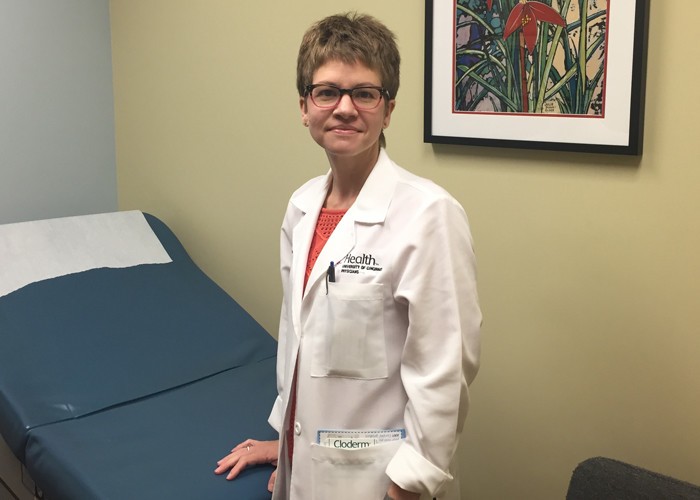
"This unique specialty clinic allows us to treat patients throughout Ohio, Kentucky and beyond in one dedicated location, says Kerith Spicknall, MD, adjunct assistant professor in the Department of Dermatology at the UC College of Medicine, UC Health dermatologist and a member of the institute. "While there are few patients with this diagnosis, our multidisciplinary program will allow experts in dermatology to work with oncologists and radiation oncologists to provide therapies closer to home.
Spicknall adds that adjunct UC faculty member Debra Breneman, MD, who is a nationally known expert in this lymphoma, will be seeing patients with her in the clinic.
"The patients cared for at the Barrett Center have access to extracorporeal photopheresis therapy provided by the experienced therapeutic apheresis staff at Hoxworth Blood Center. The Barrett Center also provides total skin electron beam therapy, which is a unique treatment only offered locally by UC Health, she says.
Photopheresis is a form of apheresisor blood separationin which white blood cells are collected, treated with a specific medication, exposed to ultraviolent light and given back to the patient. Total skin electron beam therapy involves treating the entire skin surface using low-energy electron beams generated by a linear accelerator. The electrons only penetrate the skin, sparing deeper tissues and organs from radiation.
"Being an educational institution also allows us to give fellows, residents and students the experience of working with and treating this subgroup of patients, Spicknall says, adding that she intends to offer clinical trials at the location in the future. "Were thrilled to offer these services to patients in a convenient location close to home.
Related Stories
Cancer Center plays key role in lab research, clinical trials for new pancreatic cancer drug
September 1, 2026

WLWT and WCPO highlighted the contributions of University of Cincinnati Cancer Center researchers that helped lead to the recent FDA approval of daraxonrasib, a new treatment for pancreatic cancer.
Cancer Center physician receives $150,000 New Investigator Research Grant to study treatment-resistant leukemia
September 1, 2026
The University of Cincinnati Cancer Center’s Sarah Skuli, MD, PhD, received a two‑year, $150,000 Leukemia Research Foundation New Investigator Grant to study TP53‑mutated leukemia, a treatment‑resistant subtype with very poor outcomes.
Heavy social media use linked to depression
August 31, 2026

U.S. News and World Report, Yahoo! News, MSN, USA Today and other national media highlight a new study by the University of Cincinnati and Northwestern University that found a correlation between heavy social media use and depression in adults.