UC Remembers Donors Who Gave Their Bodies For Medical Education

CINCINNATIThe annual memorial service for people who have donated their bodies for medical education will be held at 11 a.m. Saturday, Oct. 3, in Kresge Auditorium on the medical campus of the University of Cincinnati (UC).
The service will remember approximately 160 donors and honor their families. The donor bodies to be honored were recently cremated and interred at Spring Grove Cemetery. The service will include a performance by the College of Medicine student chorus and comments from current and emeriti faculty and medical students.
"The purpose of the service is to publicly thank the family and friends of our donors and acknowledge the importance and benefit that the donors are providing to the medical education curriculum at the University of Cincinnati, says Gina Burg, program director of the Body Donation Program at UC.
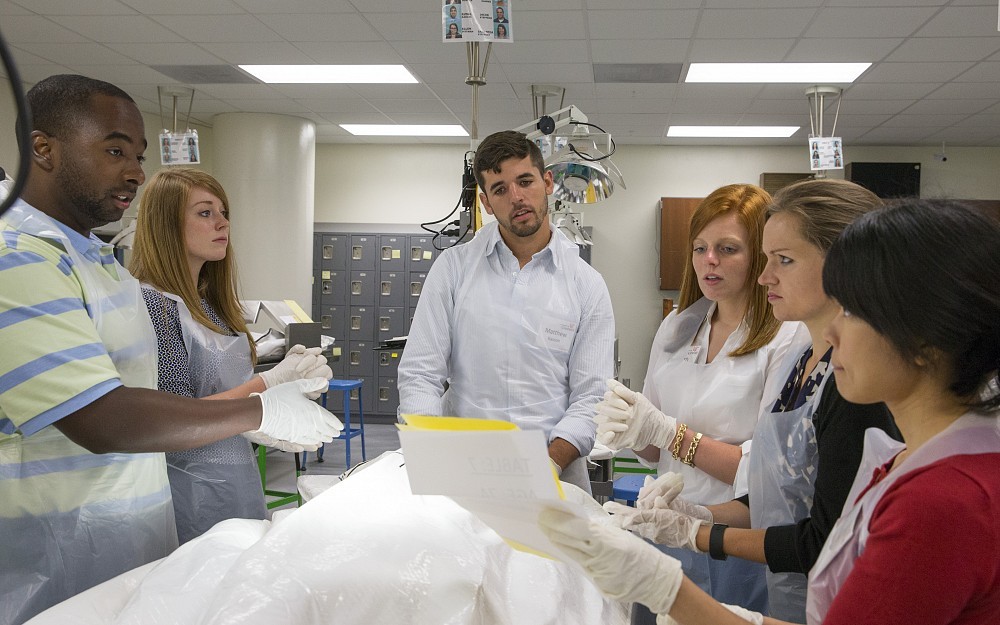
Each year, the College of Medicine receives more than 400 donor bodies, which are used to train medical students who will become a new generation of physicians, says Burg. Students study donor bodies throughout each year of their medical degree program, starting in year one with a gross anatomy course.
Four second-year medical studentsNisha Giridharan, Jefferson Li, Joey Tadros and Sarah Beck¬will offer remarks during the memorial service.
Sarah Beck says she spent more than a hundred hours with her donor during the past year. Her experiences with this body donor were key in her decision to become a pathologist.
"It was great to be able to bring my classmates over to her table to show them examples of what we learned in lecture. Even something like diverticulosisa condition in which small bulging pouches develop in the large intestineis very exciting when you see it right in front of you, explains Beck.
Nisha Giridharan says the hands-on learning through the use of live dissections in the College of Medicines gross anatomy lab has allowed her to better understand how structures in the human body fit together and to explore the natural variations that exist among patients.
Giridharan says she appreciates the generosity of donors and their families.
"Anatomy lab is one of the first exposures we have to surgical instruments and technique, says Giridharan. "For some students, dissections are a great initial way to explore their interest in surgery. I am certain we will all be better doctors for having this experience.
Faculty remind students to treat the bodies that have been donated with the utmost respect because they are "our first true patients and teachers, says Joseph Tadros.
"Anatomy is best learned not by looking at 2-D pictures and atlases, but by actually taking the time in lab to identify structures and visually reinforce concepts, says Tadros. "For example, it is much easier to remember the action of a muscle if one can picture where its fibers attach on a body in relation to other surrounding structures.
"Without the generous contribution from the donors and their families, I would not have the opportunity to further my training and solidify information enough to reach my full potential as a future physician.
UCs Body Donation Program supports medical education, not research. Burg explains to donors that the program is not researching specific illnesses or looking for cures for those ailments, but rather designed to train the next generation of physicians in understanding human anatomy.
She says interested donors are encouraged to talk with their family and stress their desire to make a donation upon death. To be accepted as a donor, pre-registration (with signature from next of kin) is required prior to a donors death.
For more information about UC Body Donation Program, visit http://med.uc.edu/bodydonation or call 513-558-5612.
Related Stories
Cancer Center plays key role in lab research, clinical trials for new pancreatic cancer drug
September 1, 2026

WLWT and WCPO highlighted the contributions of University of Cincinnati Cancer Center researchers that helped lead to the recent FDA approval of daraxonrasib, a new treatment for pancreatic cancer.
Cancer Center physician receives $150,000 New Investigator Research Grant to study treatment-resistant leukemia
September 1, 2026
The University of Cincinnati Cancer Center’s Sarah Skuli, MD, PhD, received a two‑year, $150,000 Leukemia Research Foundation New Investigator Grant to study TP53‑mutated leukemia, a treatment‑resistant subtype with very poor outcomes.
Heavy social media use linked to depression
August 31, 2026

U.S. News and World Report, Yahoo! News, MSN, USA Today and other national media highlight a new study by the University of Cincinnati and Northwestern University that found a correlation between heavy social media use and depression in adults.