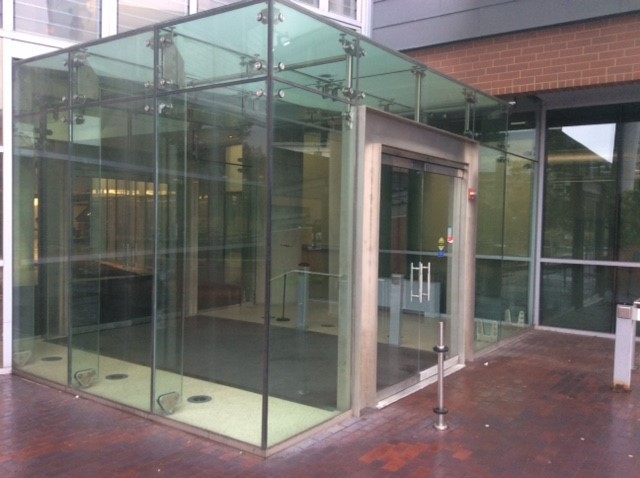
Work on Revolving Doors at Main CARE/Crawley Entrance Begins Monday, Nov. 2

Work to replace the current double glass doors at the main entrance to the CARE/Crawley Building with a revolving door will begin Monday, Nov. 2. Only the main entrance (adjacent to the Deans Suite) will be affected; access at that entrance will be maintained during construction. The work schedule will vary depending on the activity.
The revolving door will rectify issues that developed when wind sometimes forced open the existing doors. It also will help to better maintain temperature in the CARE/Crawley Atrium.
The work will be done in two phases. In the first phase, workers will install a new Americans with Disabilities Act (ADA)-compliant door on the north side of the entrance (on your left as you face the current doors entering from the staircase). In the second phase, the current double glass doors will be removed and replaced with a revolving door. The new ADA-compliant door will remain. Completion of the work is expected by the end of the year.
If you have questions, please contact Gary Wilkin, senior staff engineer with the Office of Planning, Design and Construction, at 513-910-6672 or gary.wilkin@uc.edu.
Tags
Related Stories
Cancer Center plays key role in lab research, clinical trials for new pancreatic cancer drug
September 1, 2026

WLWT and WCPO highlighted the contributions of University of Cincinnati Cancer Center researchers that helped lead to the recent FDA approval of daraxonrasib, a new treatment for pancreatic cancer.
Cancer Center physician receives $150,000 New Investigator Research Grant to study treatment-resistant leukemia
September 1, 2026
The University of Cincinnati Cancer Center’s Sarah Skuli, MD, PhD, received a two‑year, $150,000 Leukemia Research Foundation New Investigator Grant to study TP53‑mutated leukemia, a treatment‑resistant subtype with very poor outcomes.
Heavy social media use linked to depression
August 31, 2026

U.S. News and World Report, Yahoo! News, MSN, USA Today and other national media highlight a new study by the University of Cincinnati and Northwestern University that found a correlation between heavy social media use and depression in adults.