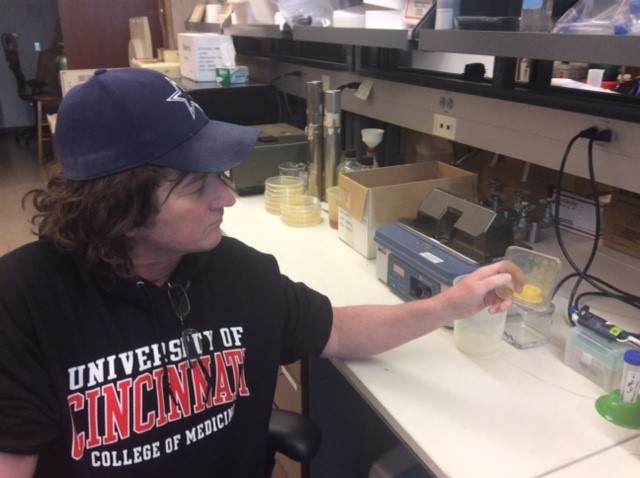
FDA Grants Orphan Drug Designation to Researcher's Potential CF Treatment

CINCINNATIA new, potential treatment for a pulmonary infection in patients with cystic fibrosis (CF) developed by a faculty member in the University of Cincinnati (UC) College of Medicine has been granted Orphan Drug Designation by the U.S. Food and Drug Administration (FDA), clearing the way for potential clinical trials.
The treatment, known as AB569, was developed in the lab of Daniel Hassett, PhD, a professor in the Department of Molecular Genetics, Biochemistry and Microbiology. AB569 is a potential treatment for Pseudomonas aeruginosa (P. aeruginosa) pulmonary infections in patients with CF.
Under the Orphan Drug Act of 1983, the FDA Office of Orphan Products Development grants Orphan Drug Designation to encourage the development of new medicines for rare diseases or disorders that affect less than 200,000 patients in the United States. Among other benefits, the designation allows for seven years of market exclusivity in the U.S. following FDA approval.
The Orphan Drug Designation was granted for the combination of two active ingredients of AB569: sodium nitrite and ethylenediaminetetraacetic acid. AB569 is to be administered to patients as a nebulized (inhaled) solution or powder.
Hassetts earlier work on CF found that P. aeruginosa was susceptible to destruction by slightly acidified sodium nitrite. In his continued effort to combat CF he discovered a synergistic effect by adding ethylenediaminetetraacetic acid, which led to the development of AB569.
Arch Biopartners, Inc., a Toronto-based publicly traded biotechnology company, is leading the commercialization efforts and currently has an exclusive option from UC to license the patents protecting AB569 for the purpose of performing a human trial to commercialize the technology. Hassett is a stockholder in Arch.
"We are pleased with the news; the Orphan Designation is an important milestone along the commercialization path for Dr. Hassetts technology. We look forward to more accomplishments in our partnership with Arch, said Geoffrey Pinski, director of the UC Technology Accelerator for Commercialization, the office charged with moving discoveries and inventions arising from UC research onto a product development path.
"The Orphan Drug Designation from the FDA supports our effort to advance AB569 as a potential treatment for P. aeruginosa lung infections in patients with CF, Richard Muruve, Archs chief executive officer, said in a news release. "We are currently finalizing the manufacturing and toxicology requirements for AB569 in order to prepare an investigational new drug application.
Added Hassett: "AB569 has a dramatic and synergistic effect at killing P. aeruginosa both in vitro and in vivo, including antibiotic-resistant strains. The individual active ingredients of the drug have been approved as safe for use in humans in the past.
"Our team at the University of Cincinnati looks forward to working with Arch to advance AB569 into clinical trials for CF patients who urgently need more effective treatments for their P. aeruginosa respiratory infections.
CF is a genetic disease that causes persistent lung infections and progressively limits the ability to breathe. In people with CF, a defective gene causes a buildup of thick, dehydrated mucus in the lungs, pancreas and other organs. There are about 40,000 cystic fibrosis patients in the U.S. and about 70,000 worldwide.
P. aeruginosa is a significant cause of bacterial respiratory infections in patients who have CF or chronic obstructive pulmonary disease (COPD). It is also a common cause of other pneumonias. Once patients have the antibiotic-resistant mucoid form of P. aeruginosa, however, their overall lung function precipitously declines, resulting in a poor clinical prognosis.
P. aeruginosa colonizes the airways of about 40 percent of CF patients between the ages of 6 and 10. By the age of 17, the frequency of infection increases to 60 percent and reaches approximately 70 percent of all cystic fibrosis patients between the ages of 25 and 34.
As Arch takes AB569 through the regulatory and human clinical trial process, the Orphan Drug Designation will provide an accelerated review and approval process, potential grant funding, tax benefits and an exemption from certain user fees.
Related Stories
Cancer Center plays key role in lab research, clinical trials for new pancreatic cancer drug
September 1, 2026

WLWT and WCPO highlighted the contributions of University of Cincinnati Cancer Center researchers that helped lead to the recent FDA approval of daraxonrasib, a new treatment for pancreatic cancer.
Cancer Center physician receives $150,000 New Investigator Research Grant to study treatment-resistant leukemia
September 1, 2026
The University of Cincinnati Cancer Center’s Sarah Skuli, MD, PhD, received a two‑year, $150,000 Leukemia Research Foundation New Investigator Grant to study TP53‑mutated leukemia, a treatment‑resistant subtype with very poor outcomes.
Heavy social media use linked to depression
August 31, 2026

U.S. News and World Report, Yahoo! News, MSN, USA Today and other national media highlight a new study by the University of Cincinnati and Northwestern University that found a correlation between heavy social media use and depression in adults.