Researchers Develop Model to Study, Find Ways to Target Rare Tumor

CINCINNATICancer researchers at the University of Cincinnati have found a new target that could lead to therapies for a rare type of tumor.
These findings are being reported in the Nov. 9 online edition of the journal Cancer Cell.
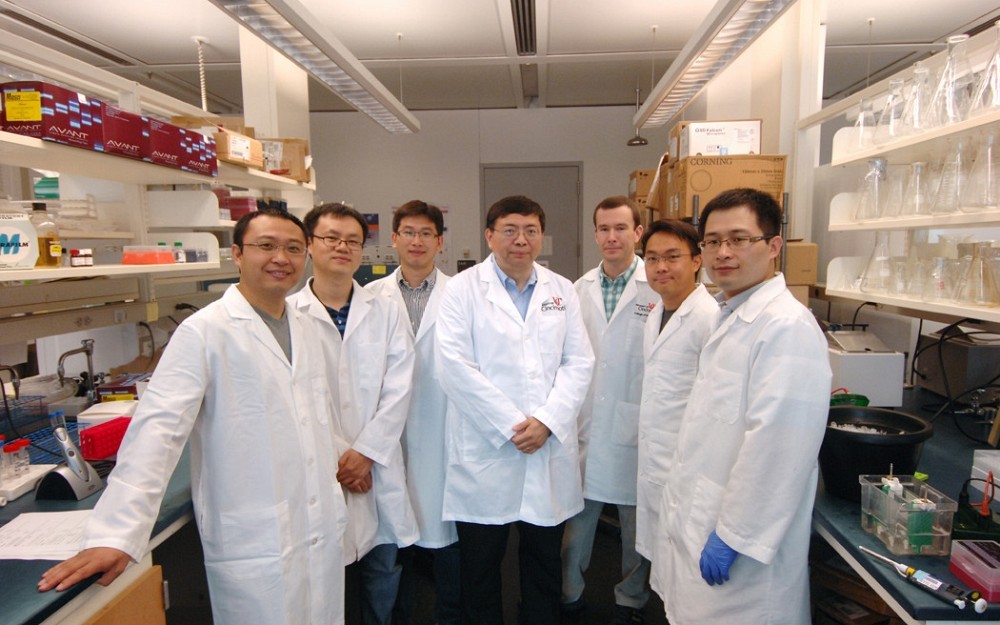
"Angiosarcoma or lymphangiosarcoma, a rare malignant tumor of the blood or lymphatic vessels, has no cure, says principal investigator Jun-Lin Guan, PhD, chair of the Department of Cancer Biology and a member of both the Cincinnati Cancer Center and UC Cancer Institute, adding that a multidisciplinary team including scientists at Cincinnati Childrens Hospital Medical Center and the University of Michigan was involved in the study. "In addition to spontaneous cases, angiosarcomas have been reported to develop in breast cancer patients undergoing radiation treatment. The mechanism of angiosarcoma development is largely unknown, and there is no animal model for the disease to help researchers molecularly define its development.
"In this study, we did develop an animal model for the disease by controlling the activity of mTORC1a multiprotein complex enzyme that coordinates many important cellular processes such as protein formationwhich resulted in lymphangiosarcoma development and progression and mimicked features of human tumors including invasion of cells and spread.
Guan says that to stop activities of mTORC1 causing angiosarcoma development and progression in the animal model, scientists found that blocking a number of its key targets, including the vascular endothelial growth factor, a protein that restores the oxygen supply to tissues when blood circulation is inadequate, effectively halted tumor development and growth.
"In addition to the animal model, we prepared tissue collections of multiple human angiosarcoma samples and checked signaling changes; mTORC1 signaling was highly active in human angiosarcomas. The majority of angiosarcoma samples71 percentshowed strong staining for phosphorylated S6, a protein marker for mTORC1 activity, whereas few inactive blood vessels in normal tissues were positivearound 12 percent. This data shows a correlation between mTORC1 signaling and the development of human angiosarcomas.
"Results from this study provide significant insight into potential future therapies for a previously poorly characterized but deadly cancer. The spontaneous and varied nature of the vascular tumors in our animal model also provide an opportunity for further investigation into the molecular and genetic mechanisms of vascular tumors as well as a powerful tool for testing therapeutic methods.
Co-authors on the study include Shaogang Sun, PhD, Song Chen, PhD, and Haige Wu, PhD, Department of Cancer Biology; Fei Liu, PhD, Jonathan McHugh, MD, and Ingrid Bergin, VMD, University of Michigan; and Anita Gupta, MD, and Denise Adams, MD, Cincinnati Childrens.
This research was funded by the National Institutes of Health (grants HL073394, CA163493 and CA150926 to Guan and AR062030 and DE021718 to Liu). Guan cites no conflict of interest.
Tags
Related Stories
Cancer Center plays key role in lab research, clinical trials for new pancreatic cancer drug
September 1, 2026

WLWT and WCPO highlighted the contributions of University of Cincinnati Cancer Center researchers that helped lead to the recent FDA approval of daraxonrasib, a new treatment for pancreatic cancer.
Cancer Center physician receives $150,000 New Investigator Research Grant to study treatment-resistant leukemia
September 1, 2026
The University of Cincinnati Cancer Center’s Sarah Skuli, MD, PhD, received a two‑year, $150,000 Leukemia Research Foundation New Investigator Grant to study TP53‑mutated leukemia, a treatment‑resistant subtype with very poor outcomes.
Heavy social media use linked to depression
August 31, 2026

U.S. News and World Report, Yahoo! News, MSN, USA Today and other national media highlight a new study by the University of Cincinnati and Northwestern University that found a correlation between heavy social media use and depression in adults.