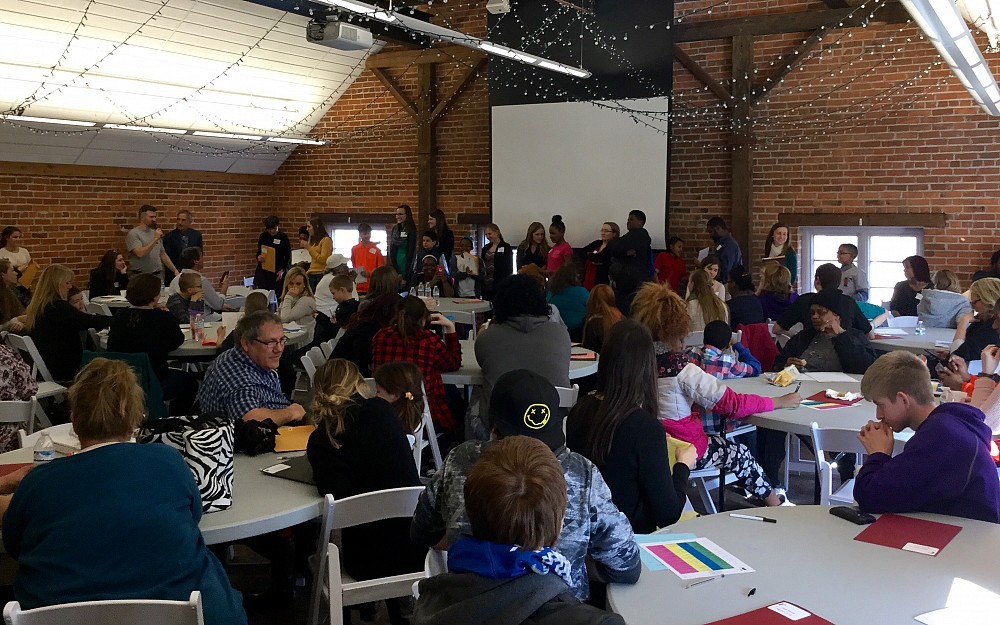
Fluency Friday Attendees Urged to Be Calm and Talk On

The way Kanaan Roetting sees it, his working relationship with his speech therapist is reciprocal. "Were kind of both teaching each other, he says. The 8-year-old was one of the students who took part in the one-day Fluency Friday workshop for children and teens who stutter.
Held at the Centennial Barn near the Drake Center in Cincinnati, 46 children and teens who stutter attended this years event, "Be Calm and Talk On. The workshop, first held in 2000, is a collaborative effort of the University of Cincinnati (UC) Communications Sciences and Disorders program at the College of Allied Health Sciences (CAHS), Cincinnati Childrens Hospital Medical Center and the Hamilton County Educational Service Center. At the event, each child and teen had the chance to practice speaking in a safe environment and in a variety of relaxed settings.
Phyllis Breen, adjunct assistant professor of communication sciences and disorders at CAHS, says many of the young people on hand this year have attended previous Fluency Friday events.
"They have so much fun, its almost like a reunion, she says. "Each of the participants is assigned a graduate student who is with them for the day. They are able to talk and plan activities with other students, so consequently they learn from one another.
Roetting first attended Fluency Friday in 2015. According to his mom Rouchelle Wessling, her son talked about it repeatedly leading up to this years event. "He just absolutely loves it, she says. "He likes being able to hang out all day with kids who have the same stuttering issues that he has.
Staci Maddox, a speech-language pathologist at Cincinnati Childrens, worked with Roetting at this years Fluency Friday and to her, hes a model patient. Maddox says Roetting has a tremendous attitude in that he realizes stuttering is not his fault, its just part of who he is, and she wishes more of her patients had that outlook. "I wish I could give that to some of the other kids that I see, because so many people who stutter have low self-confidence.
She says one of the reasons Roetting has such a positive outlook is his supportive family environment. "When kids come to me for therapy I like to have the parents right in the room because I want the parents to be involved in this, Maddox says. "I want the kids to talk to the parents about their stuttering. Its not me helping fix the kid by myself; the parents are a huge part of helping the child accept it.
Therapy for the students who stutter attending the event was provided by graduate students in speech language pathology from the Department of Communication Disorders in CAHS. Graduate student Megan Kaiser says, "Having a whole day gives us the chance to work on attitudes and their feelings toward stuttering, what they want in a therapist, what they want in a teacher. Its just a different perspective that you dont get in an everyday clinical experience.

White Board from Fluency Friday event where participants listed various strengths of stuttering

Centennial Barn sign
Related Stories
Heavy social media use linked to depression
August 31, 2026

U.S. News and World Report, Yahoo! News, MSN, USA Today and other national media highlight a new study by the University of Cincinnati and Northwestern University that found a correlation between heavy social media use and depression in adults.
On-site training in Speech & Hearing Clinic sets UC’s programs apart
August 27, 2026
At the University of Cincinnati’s Speech & Hearing Clinic, Doctor of Audiology and Speech-Language Pathology graduate students gain real-world experience while providing free speech and hearing services to the community.
UC, NKU renew longstanding partnership supporting Army ROTC cadets
August 26, 2026
The University of Cincinnati Army ROTC and Northern Kentucky University (NKU) have renewed a longstanding partnership that supports students preparing to become Army officers and leaders in their communities. The universities formalized the renewed agreement during a signing event Aug. 11 at NKU.