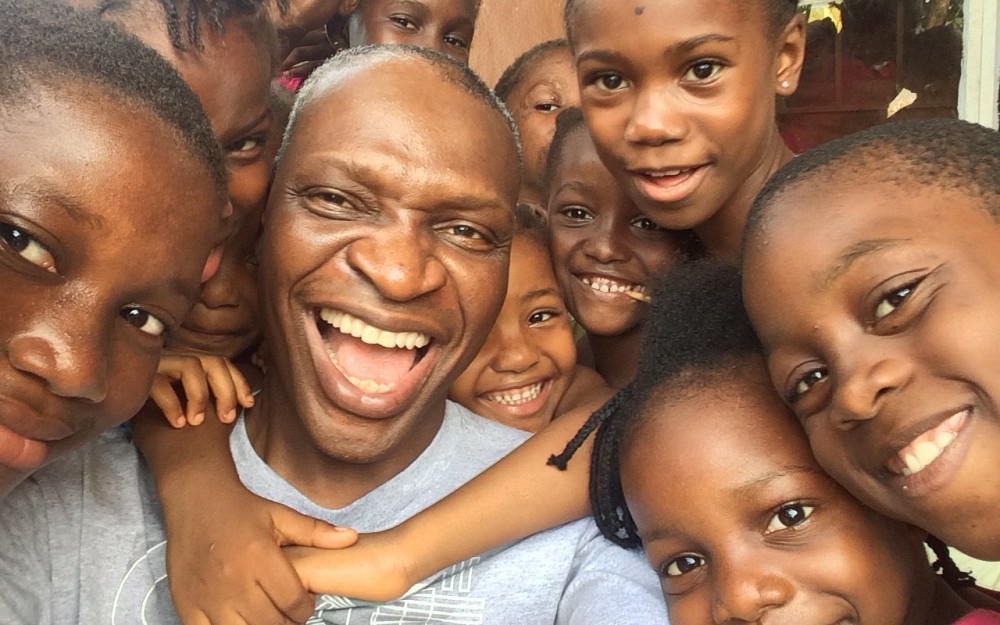
Professor Provides Means to Dream for Orphans in Africa

Some at the University of Cincinnati (UC) College of Nursing call him Dr. Jaja. Others know him as Professor Jaja. Twenty-two children living at an orphanage in Sierra Leone call him dad or Uncle Cheedy.
Regardless of his title, Cheedy Jaja, PhD, associate professor of research, continues to impact others lives at every opportunity. In response to the 2014 Ebola epidemic in West Africa, Jaja spent six weeks providing Ebola relief work to patients in his native country, Sierra Leone one of three African countries hit hardest by the deadly virus. Four months later, he returned to provide additional care during the summer months of 2015.
Although the World Health Organization declared Sierra Leone free of the 17-month outbreak on Nov. 7, 2015, Jaja realizes Ebola destroyed more than the nearly 4,000 Sierra Leone lives it ended. Thats why he got involved in Dream Home, an orphanage that cares for Sierra Leone children orphaned by Ebola.
"Were taking care of 22 kids right now, but there are literally thousands of kids in Sierra Leone who were made orphans because of Ebola, Jaja says. "These kids are the fortunate ones.
A report conducted by Street Child, a charity dedicated to creating educational opportunity for vulnerable children in West Africa, identified more than 12,000 Sierra Leone children who lost their primary caregiver to Ebola. Another 3,000 lost both parents.
"These are kids who life dealt them a very bad hand, and I just feel like I have an obligation to make a difference in their lives, Jaja says. "I dont think everybody gets this opportunity, and the fact that I have this opportunity, I want to make the best of it.
Jaja became involved in Dream Home during his first round of Ebola relief work in December of 2014, when he learned that Sylvester Renner, a long-time friend from college, planned to establish an orphanage for children who lost parents to Ebola through Develop Africaa nonprofit organization Renner created to facilitate meaningful and sustainable development in Africa that also provided Ebola relief aid during the crisis.
With help from community members and other nonprofit organizations such as GlobalGiving and Door of Hope, Dream Home opened its doors to its first residents in May of 2015. Located in Wellington in the eastern outskirts of Freetown, Sierra Leone, and Renners hometown, the orphanage houses children ages 2 to 17. The majority of children living in Dream Home lost both parents to Ebola. Three residents even contracted the virus and survived. A staff comprised of a foster mother and father, a part-time nurse, two cooks, two security personnel and an orphanage director and secretary ensure the children live in a supportive home that not only meets all of their needs but also fosters dreams.
"Even though theyve lost so much, we want them to dream againto believe that there is hope that they could be whatever they want to be, Jaja says.
Jajas efforts are bringing out the best in people. "People are calling in out of the blue to offer to help, he says. "For example, we got a call from a group called Plumbers Without Borders. They are going to donate a solar water pump for the orphanage.
Written by Katie Coburn with additional reporting by Amanda Chalifoux and Bill Bangert
Tags
Related Stories
Cancer Center plays key role in lab research, clinical trials for new pancreatic cancer drug
September 1, 2026

WLWT and WCPO highlighted the contributions of University of Cincinnati Cancer Center researchers that helped lead to the recent FDA approval of daraxonrasib, a new treatment for pancreatic cancer.
Cancer Center physician receives $150,000 New Investigator Research Grant to study treatment-resistant leukemia
September 1, 2026
The University of Cincinnati Cancer Center’s Sarah Skuli, MD, PhD, received a two‑year, $150,000 Leukemia Research Foundation New Investigator Grant to study TP53‑mutated leukemia, a treatment‑resistant subtype with very poor outcomes.
Heavy social media use linked to depression
August 31, 2026

U.S. News and World Report, Yahoo! News, MSN, USA Today and other national media highlight a new study by the University of Cincinnati and Northwestern University that found a correlation between heavy social media use and depression in adults.