Shorter Times to Blood Transfusion Reduce Death Risk in Trauma Patients

CINCINNATIPatients who get blood quickly after severe injuries are less likely to die, according to researchers from the University of Cincinnati (UC) Department of Emergency Medicine.
The research was published in the April 2016 issue of The Journal of Trauma and Acute Care Surgery.
"More than 180,000 people die from trauma every year, says Elizabeth Powell, MD, assistant professor of emergency medicine in the UC Department of Medicine and lead author on the study. "Bleeding is the major cause of preventable death after trauma.
In this study, researchers tracked trauma patients taken from the scene of their injury by Air Care to the University of Cincinnati Medical Center (UCMC) who received at least one unit of blood within 24 hours of arriving at the hospital. "Air Care is the only helicopter in the area to carry blood (and plasma), so we had the research platform to study how early blood transfusions impact outcomes, explained Powell.
Most patients received their first blood transfusion from Air Care or within one hour of getting to UCMC. For these patients, each 10-minute delay in getting blood increased the chance of death.
"Delays in the time to blood transfusion are associated with increased chances of dying, says Powell. "Shortening the time to transfusion, including having blood available in the prehospital setting, may improve outcomes.
Powell says as the result of the research, she does not anticipate a change in ED protocols. "However, she says, "other critical care transport services may need to examine their protocols and consider the use of blood products in their practice. Few critical care transport services currently carry blood products, Powell noted.
Collaborators on the study include Jason McMullan, MD, William Hinckley, MD, Adam Gottula, BS, Kimberly Hart, MA and Christopher Lindsell, PhD, all of the UC Department of Emergency Medicine.
No grant funding was used in this research and the study authors report no conflicts of interest.

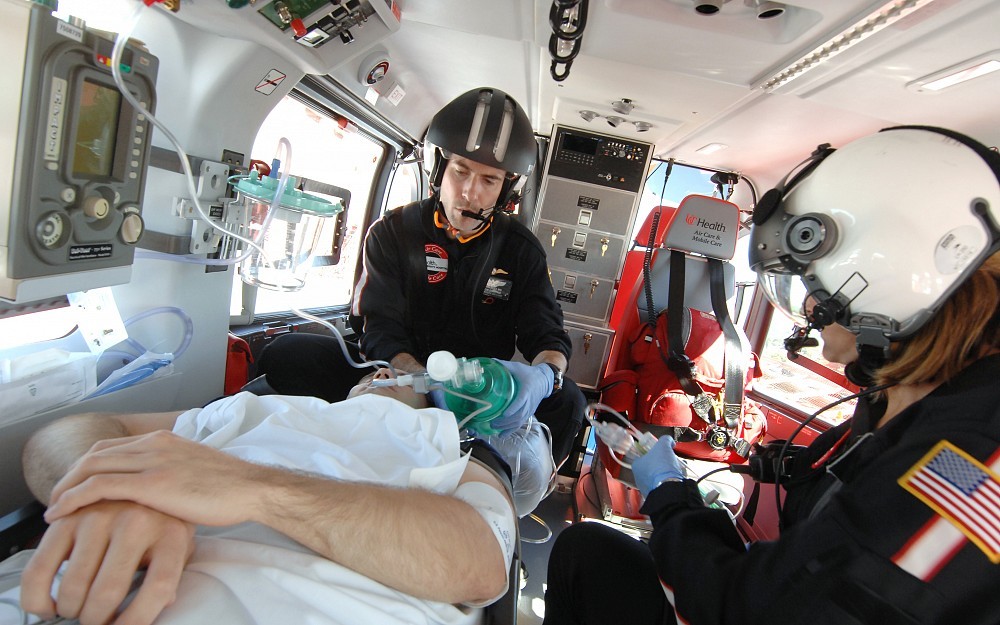
Air Care medical director William Hinckley, MD, and chief transport nurse Ruda Jenkins on board an Air Care helicopter. The program is one of a few in the country that has a physician on every flight.
Tags
Related Stories
Cancer Center plays key role in lab research, clinical trials for new pancreatic cancer drug
September 1, 2026

WLWT and WCPO highlighted the contributions of University of Cincinnati Cancer Center researchers that helped lead to the recent FDA approval of daraxonrasib, a new treatment for pancreatic cancer.
Cancer Center physician receives $150,000 New Investigator Research Grant to study treatment-resistant leukemia
September 1, 2026
The University of Cincinnati Cancer Center’s Sarah Skuli, MD, PhD, received a two‑year, $150,000 Leukemia Research Foundation New Investigator Grant to study TP53‑mutated leukemia, a treatment‑resistant subtype with very poor outcomes.
Heavy social media use linked to depression
August 31, 2026

U.S. News and World Report, Yahoo! News, MSN, USA Today and other national media highlight a new study by the University of Cincinnati and Northwestern University that found a correlation between heavy social media use and depression in adults.