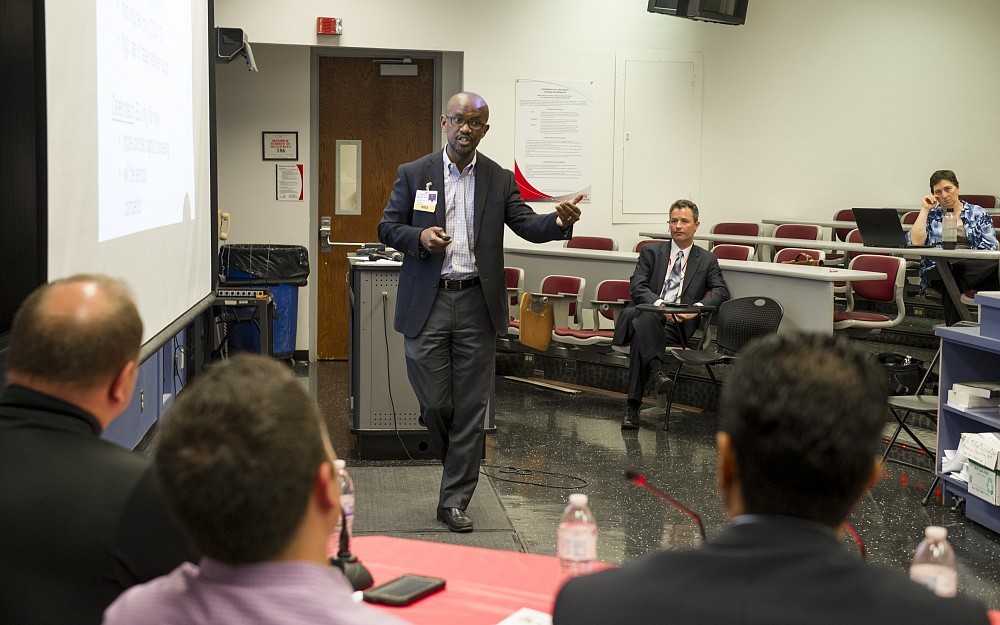
UC Emergency Medicine Physician Wins Research Week Shark Tank

CINCINNATIOpeolu Adeoye, MD, associate professor of Emergency Medicine and Neurosurgery, University of Cincinnati (UC) College of Medicine, proved he could swim with the sharks by winning the College of Medicines Shark Tank competition.
As part of the annual Research Week events, April 18-22, a Shark Tank competition was held, with innovative medical researchers invited to pitch their ideas to Cincinnati investors and business experts. Adeoye beat out three other selected researchers to win $5,000 and the chance to springboard his pioneering research.
His winning project is called Sense, a non-invasive, disposable device which provides rapid detection of bleeding in the brain by continuously monitoring brain activity, primarily in the intensive care unit. He and his team say "time is brain early detection of neurological processes can save lives and improve outcomes.
The runner-up in the competition was Peng Zhang, PhD, associate professor of chemistry, UC McMicken College of Arts and Sciences. He is working on a new form of antibacterial treatment to prevent bacterial infection in acute and chronic wounds.
Related Stories
Cancer Center plays key role in lab research, clinical trials for new pancreatic cancer drug
September 1, 2026

WLWT and WCPO highlighted the contributions of University of Cincinnati Cancer Center researchers that helped lead to the recent FDA approval of daraxonrasib, a new treatment for pancreatic cancer.
An expert pieced together this Roman document like a puzzle
September 1, 2026

National media highlighted a new project by UC Classics Assistant Professor Matthijs Wibier to piece together and translate an ancient Roman text from fragments buried in the desert for more than 1,600 years.
Cancer Center physician receives $150,000 New Investigator Research Grant to study treatment-resistant leukemia
September 1, 2026
The University of Cincinnati Cancer Center’s Sarah Skuli, MD, PhD, received a two‑year, $150,000 Leukemia Research Foundation New Investigator Grant to study TP53‑mutated leukemia, a treatment‑resistant subtype with very poor outcomes.