Area Primary Care Physicians Can Tap Into UC's Pain Treatment Expertise

CINCINNATIOn the first Thursday of each month, a team of medical professionals from across nearly a dozen UC Health specialties come together at University of Cincinnatis (UC) medical campus to extend a virtual hand to primary care physicians (PCPs) interested in learning more about chronic pain management.
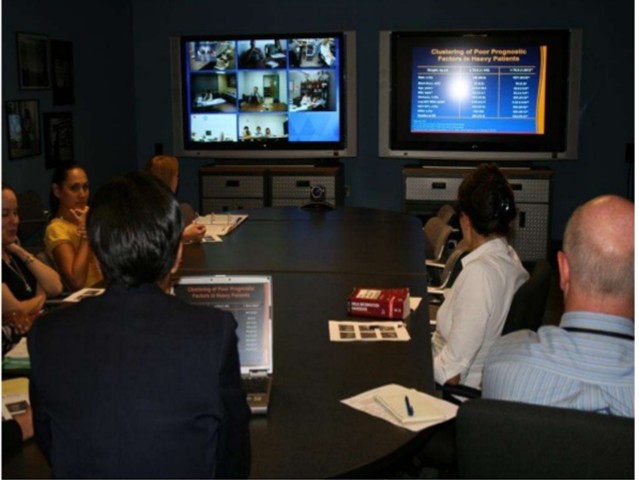
Situated in a large classroom, armed with video teleconferencing equipment, the groupmade up of experts from pain management, physical therapy, pharmacy, addiction medicine, integrative medicine and mental healthdiscusses one challenging case presented by a UC Health PCP. An unlimited number of providers can log in remotely, similar to video chat, listen to the discussion and ask questions on a message board.
The UC program, called Chronic PainTEAMS (Teleconference Education and Management Support)/ECHO, was developed as a way for PCPs to tap into, gratis, a wealth of pain management knowledge, and is supported by a $350,000 grant from the Consortium for Education and Research in Chronic Pain/Pfizer Independent Grant for Learning and Change.
"Our pain professionals are a diverse group of specialists, who share their expertise, advice, resources and wisdom to the PCPs caring for patients with chronic pain, says Nancy Elder, MD, a professor in the Department of Family Medicine at the UC College of Medicine.
Elder and Jill Boone, PharmD, a professor in UCs James L. Winkle College of Pharmacy, co-authored the grant and piloted the program in Feb. 2016, after learning that a similar model, Project ECHO, was in place at the University of New Mexico.
While the New Mexico model initially focused on Hepatitis C, Project ECHO has expanded to many areas. Boone says the UC model focuses specifically on chronic pain management due in part to new federal mandates overseeing prescription pain medications, specifically opioids; but for every patient of a primary care provider in Cincinnati who takes opioids from chronic pain, three patients deal with their chronic pain without opioids, she says.
Take, for example, the patient presented at the May 2016 session. A local PCP presented his case, where a patient, an unidentified male, was suffering debilitating headaches and had not asked for opioids to control the pain. The provider had run numerous tests, but had yet to determine the underlying cause of the pain or successful way to manage the pain.
"Have you sent him for ocular testing? asked the pain management specialist, citing the ocular nerve as a potential culprit and the psychiatrist inquired as to the patients emotional well-being. The specialists ended the session with multiple suggestions for treatment, ranging from acupuncture from an integrative medicine specialist, to a lesser known non-narcotic pain medication suggested by the PharmD.
This type of multidisciplinary approach, says team leader James Fortman, MD, a UC Health anesthesiologist and pain medicine specialist, gives primary care physicians a broader lens with which to look at their patients.
"Our focus is on the practitioners, providing resources and education to make the best decisions in providing the best patient care because when patients are in less pain then they can do more things that they want to do and enjoy their lives more, says Boone.
Initially, the "telementoring service was available to all UC Health PCPs and their staffs but now the program is available to all primary care physicians, providers and their office staffs throughout the greater Cincinnati region. Any PCP who wants to submit a patient case for telementoring, as well as to receive the call in/login information for anyone interested in joining in the monthly session, can contact the project manager, Sue McDonald, at 513-558-5999 or blockssn@uc.edu.
Related Stories
Cancer Center plays key role in lab research, clinical trials for new pancreatic cancer drug
September 1, 2026

WLWT and WCPO highlighted the contributions of University of Cincinnati Cancer Center researchers that helped lead to the recent FDA approval of daraxonrasib, a new treatment for pancreatic cancer.
Cancer Center physician receives $150,000 New Investigator Research Grant to study treatment-resistant leukemia
September 1, 2026
The University of Cincinnati Cancer Center’s Sarah Skuli, MD, PhD, received a two‑year, $150,000 Leukemia Research Foundation New Investigator Grant to study TP53‑mutated leukemia, a treatment‑resistant subtype with very poor outcomes.
Heavy social media use linked to depression
August 31, 2026

U.S. News and World Report, Yahoo! News, MSN, USA Today and other national media highlight a new study by the University of Cincinnati and Northwestern University that found a correlation between heavy social media use and depression in adults.