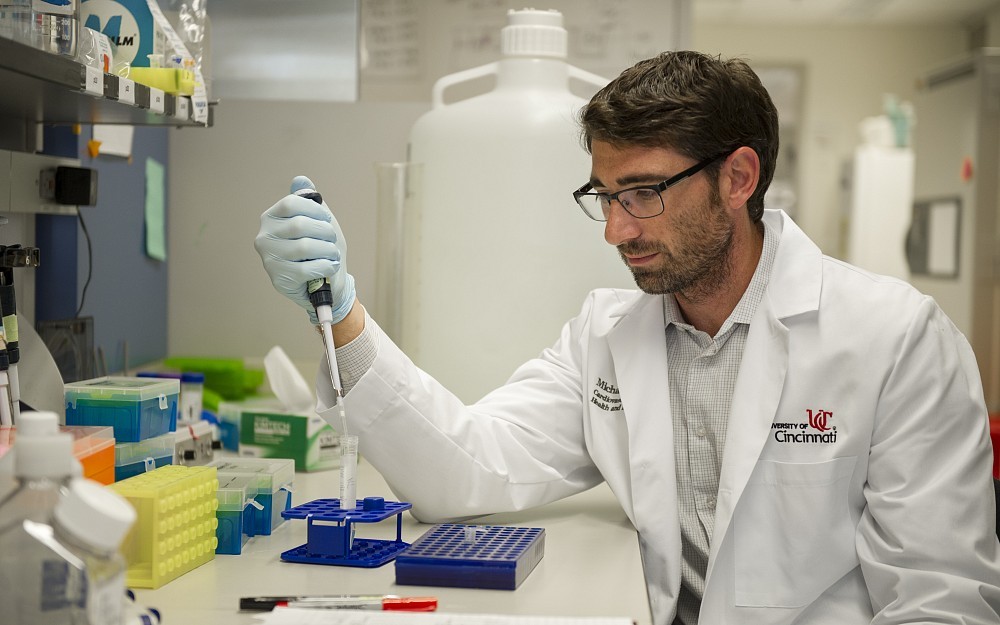
UC Researcher Receives $1.7 Million Grant to Study Cardiac Hypertrophy

CINCINNATIA new $1.7 million National Institutes of Health grant will help University of Cincinnati (UC) researchers continue their investigation of the protein Human Antigen R (HuR) and its possible role in cardiovascular disease, with the ultimate goal of translating this research to improve human health.
Using animal models of heart disease, researchers are able to surgically restrict the amount of blood flowing through the aorta resulting in an increase in the pressure the heart must pump against, causing cardiac muscle to enlarge, called hypertrophy. Cardiac hypertrophy often progresses to heart failure, and there are currently no treatments for the underlying cause of hypertrophy at the level of the myocyte, or cardiac muscle cell.
"What we have found is when we delete this protein in the myocytes, normal cardiac function is unaffected, but the mice lacking HuR are protected from hypertrophy and heart failure, explains Michael Tranter, assistant professor in the UC College of Medicines Division of Cardiovascular Health and Disease. "All of our evidence so far suggests that activation of HuR in the adult heart is only affecting the pathology, making it an ideal target.
Tranter, a researcher at the UC Heart, Lung and Vascular Institute, received a five-year grant (R01HL132111) from the NIHs National Heart, Lung and Blood Institute, to determine why and how the HuR protein is activated and how to duplicate the process. The grants principal investigator Tranter is also collaborating with co-investigator, Jack Rubinstein, MD, assistant professor in the UC College of Medicine and UC Health cardiologist.
Rubinstein says Tranters research will be very helpful in understanding how the heart reacts when subjected to high blood pressure.
"This line of research is particularly important as hundreds of thousands of people, especially older patients, develop heart problems, including heart failure as a result of suffering from high blood pressure, says Rubinstein. The American Heart Association estimates that roughly one in four Americans currently suffers from high blood pressure.
Tranter and Rubinstein, along with colleagues Phillip Owens, PhD, and Kevin Haworth, PhD, both also assistant professors in UC College of Medicines Division of Cardiovascular Health and Disease, are part of a recent investment in young investigators by the College of Medicine. While their average age is only 36, they have together already been awarded over $4 million in external research funding from sources such as the NIH and the American Heart Association. At age 34, Tranter is nearly a decade younger than the average first-time NIH R01 grant recipient.
Related Stories
Cancer Center plays key role in lab research, clinical trials for new pancreatic cancer drug
September 1, 2026

WLWT and WCPO highlighted the contributions of University of Cincinnati Cancer Center researchers that helped lead to the recent FDA approval of daraxonrasib, a new treatment for pancreatic cancer.
Cancer Center physician receives $150,000 New Investigator Research Grant to study treatment-resistant leukemia
September 1, 2026
The University of Cincinnati Cancer Center’s Sarah Skuli, MD, PhD, received a two‑year, $150,000 Leukemia Research Foundation New Investigator Grant to study TP53‑mutated leukemia, a treatment‑resistant subtype with very poor outcomes.
Heavy social media use linked to depression
August 31, 2026

U.S. News and World Report, Yahoo! News, MSN, USA Today and other national media highlight a new study by the University of Cincinnati and Northwestern University that found a correlation between heavy social media use and depression in adults.