New Teen Study for Non-Drug Alternative to Treatment-Resistant Depression

A trial at the University of Cincinnati (UC) is looking at how to treat depression for adolescents age 12 to 21 who have not responded to traditional antidepressant treatment.
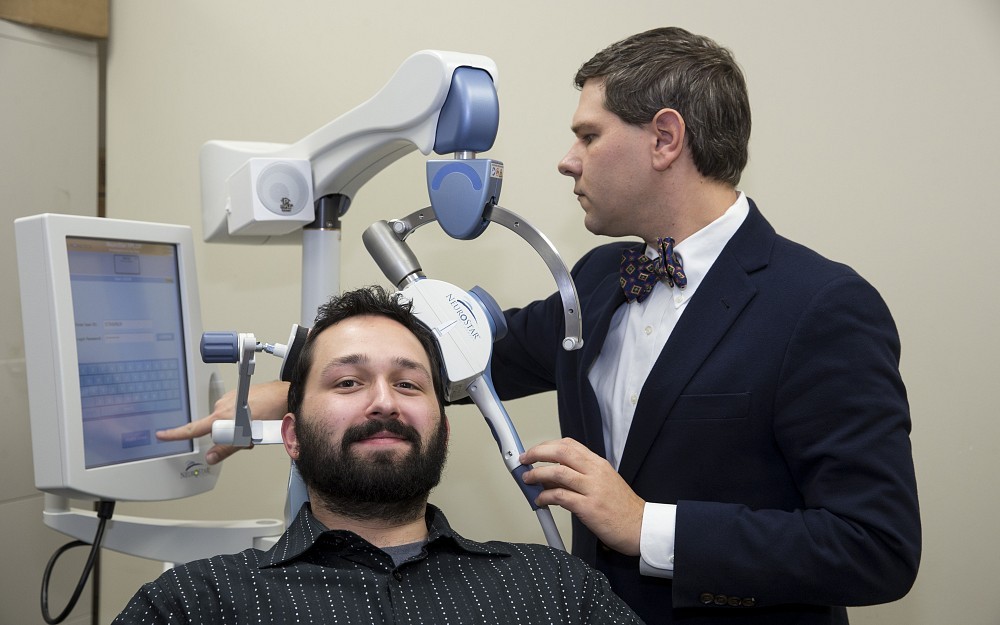
The study uses transcranial magnetic stimulation (TMS) on the patient, which has been approved by the Food and Drug Administration (FDA) in adults with treatment-resistant depression since 2008.
"The idea is that it uses a targeted magnetic field to stimulate areas of the brain that control mood and are thought to be underactive in patients with depression, says Jeffrey Strawn, MD, associate professor in the Department of Psychiatry and Behavioral Neuroscience at the UC College of Medicine.
"It does not involve administration of medication and is localized and non-invasive, unlike ECT (electroconvulsive therapy) where the patient is under general anesthesia that has to be administered in a hospital. In TMS therapy, patients are awake and can receive treatment in a doctors office, sitting in a chair with the device placed over the area of the brain that we are stimulating. He says patients can go back to their normal activities immediately after treatment.
Strawn, a child and adolescent psychiatrist with UC Health and Cincinnati Childrens Hospital Medical Center and director of the Anxiety Disorders Research program, says that the treatments last for about 40 minutes and may feel like a mild prickling sensation that not everyone notices. He adds that the machine itself makes a clicking or tapping noise as its discharging the magnetic pulse. The most common side effects of TMS therapy are relatively minorpain or discomfort around the treatment area, that normally resolves within a week.
The treatment uses a highly-focused, pulsed magnetic field, similar in type and strength to those produced by a magnetic resonance imaging (MRI) machine.
The UC study is an ongoing pediatric registration trial and is still accepting patients. For more information, contact Sara Varney at 513-558-2931.
This study is sponsored by Neuronetics, Inc. University of Cincinnati is a participating site and is reimbursed for study procedures. Strawn is the principal investigator and is not compensated by Neuronetics.
Related Stories
Cancer Center plays key role in lab research, clinical trials for new pancreatic cancer drug
September 1, 2026

WLWT and WCPO highlighted the contributions of University of Cincinnati Cancer Center researchers that helped lead to the recent FDA approval of daraxonrasib, a new treatment for pancreatic cancer.
Cancer Center physician receives $150,000 New Investigator Research Grant to study treatment-resistant leukemia
September 1, 2026
The University of Cincinnati Cancer Center’s Sarah Skuli, MD, PhD, received a two‑year, $150,000 Leukemia Research Foundation New Investigator Grant to study TP53‑mutated leukemia, a treatment‑resistant subtype with very poor outcomes.
Heavy social media use linked to depression
August 31, 2026

U.S. News and World Report, Yahoo! News, MSN, USA Today and other national media highlight a new study by the University of Cincinnati and Northwestern University that found a correlation between heavy social media use and depression in adults.