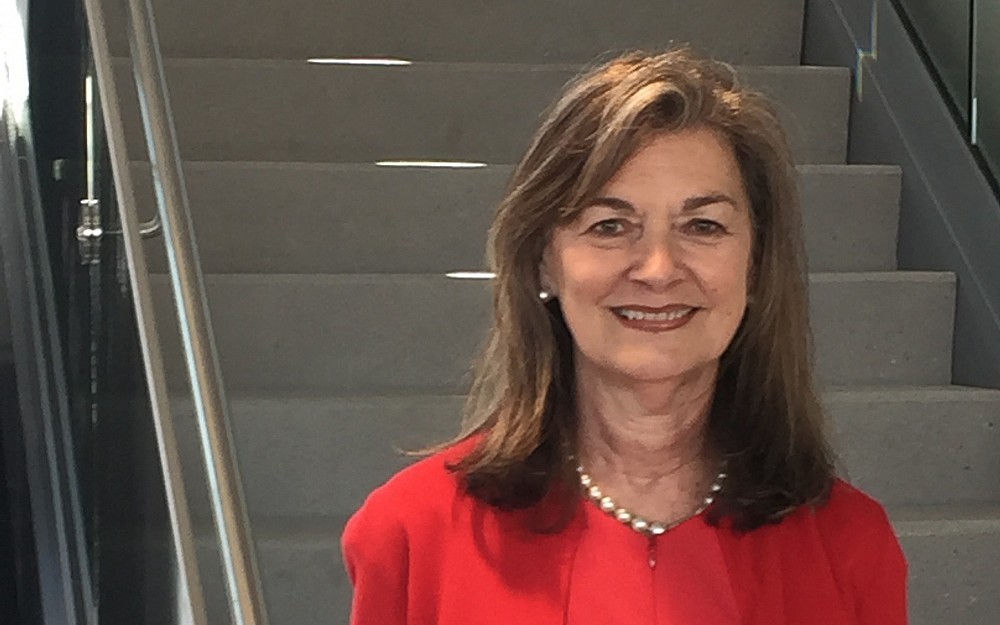
Marianne Ivey, PharmD, Retires and Leaves a Leadership Legacy

When Professor Emeritus Marianne Ivey, PharmD, enters a room full of pharmacists she casts a striking presence. However, its not because of her staturea graceful 5 feet 9 inches with perfect postureits because of her leadership prominence in the profession of pharmacy and continued support of her chosen profession.
"Oh, Ive been involved in leadership training and education for a quite a long time, Ivey jests, citing 1988 as the date of her faculty appointment at the University of Cincinnati James L. Winkle College of Pharmacy.
In April 2016 Ivey retired from UC and many years of hospital pharmacy executive leadership roles and charge of post-doctoral residency programs, but not without leaving an active legacy. Upon her retirement, Ivey seeded an endowment dedicated to the colleges online masters in pharmacy leadership program that to date has reached $18,000. Ivey has pledged $10,000 a year for five years.
"You have to have leadership in a complex health care environment and we recognized a gap that was created by past cycles of downsizing and reductions in middle management, she says of developing the online program that is aligned with the American Society of Health-System Pharmacists (ASHP) Foundation certificate program in order to give those students an option for a masters degree.
Jenelle Sobotka, PharmD, recently joined the college to serve as program director and says that the first cohort of students begins taking classes this fall.
"I certainly applaud Dr. Ivey and the UC team for their vision in creating a program to address the need for leadership development in our profession, says Sobotka.
Ivey says the curriculum, which draws from the pharmacy college, UCs Lindner College of Business and the College of Allied Health Sciences is a nice combination of financial and leadership classes with a focus specific to pharmacy.
"As the scope of practice of pharmacists increases, the need for pharmacist-specific leadership training has become apparent, says Dean Neil MacKinnon, PhD, adding that the online aspect of a graduate degree is an attractive post-doctoral choice for PharmDs who might not have the ability to travel or cut work hours to attend classes.
The online aspect is also attractive to those students right out of the PharmD program who know that they want to pursue a career in pharmacy management, says Ivey.
Ivey isnt hanging up her symbolic white coat though. She continues to be a guest lecturer for the ASHP and currently serves as the president of the hospital section for the Federation of International Pharmacy (FIP).
"Ive always enjoyed working with colleagues to create or improve pharmacy programs that benefit patients. Ive experienced the importance of change management including using good communication skills, getting the input of people who do the work and sharing a mission with stakeholders. All of these are in relation to providing expert pharmacy service to patients, physicians, administrators, insurers and many others. Its very satisfying to provide services accurately, efficiently and pleasantly. These are the skills well be passing on to the students of the online certificate and masters; program in pharmacy leadership. My husband, Tom, and I are engaged in supporting these programs through the endowment.

Marianne Ivey, PharmD
Related Stories
UC radiation oncologist speaks with Local 12 news about clinical trial for head and neck cancer treatment
August 10, 2026

Dr. Sara Medek, a UC radiation oncology professor, speaks with Local 12 news about a new clinical trial aimed at reducing radiation in certain areas while still treating cancer effectively but with fewer painful side effects.
Cancer Center director charts future based on collaboration, AI
August 10, 2026

David Gius, MD, PhD, was featured in a Cincinnati Business Courier article and The Cancer Letter’s “The Directors" podcast discussing his priorities and goals as he recently took the helm as director of the University of Cincinnati Cancer Center.
UC graduates cross finish line at commencement
August 7, 2026
The University of Cincinnati recognized 2,125 graduates in two ceremonies at summer commencement Friday on campus at Fifth Third Arena.