Schwartz s Research Remembered With an Award for Heart Investigators

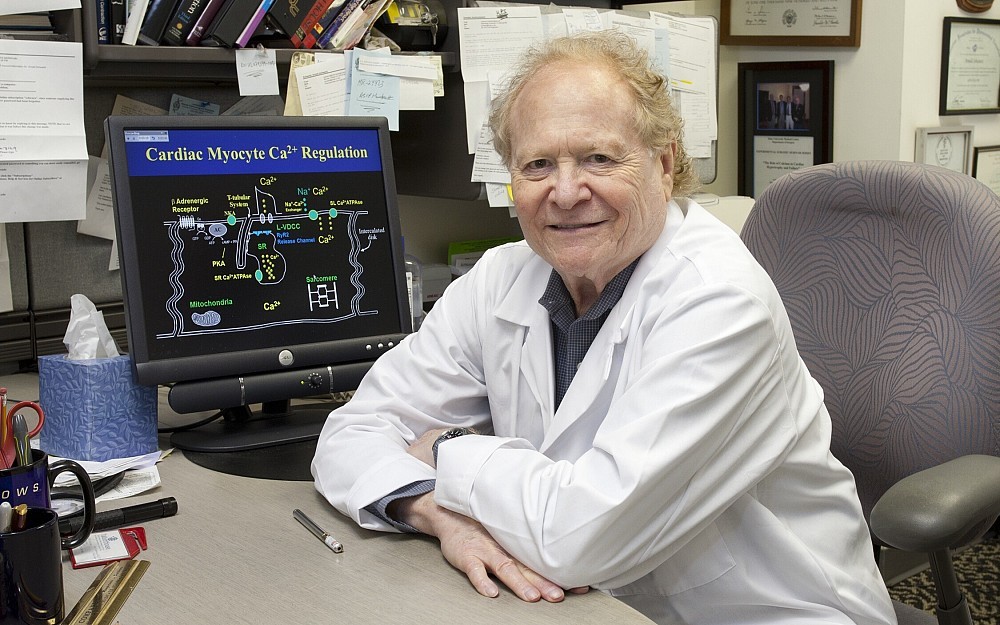
Walter Koch, PhD, remembers admiring Arnold Schwartz, PhD, a scientist who was doing cutting-edge molecular pharmacology in the mid-1980s, when molecular biology, was just starting to take off. Koch, a 1990 UC College of Medicine graduate who is now professor and chair of pharmacology at Temple Universitys Lewis Katz School of Medicine, was studying under the mentorship of Schwartz, distinguished university professor in the UC Department of Internal Medicine.
"His lab at the time was a leader in inotropic mechanisms of the failing heart and he had done seminal work in characterizing the dihydropyridine receptor (the L-type calcium channel), says Koch. "This channel and the dihydropyridine calcium channel blockers are mainstream drugs today because of the pioneering mechanistic work done by Dr. Schwartz and his laboratory at UC. In the late 80s, we were trying to clone the gene for this channel from the heart and vasculature and my thesis was cloning this channel from vascular smooth muscle. Dr. Schwartz also made seminal contributions to the sodium-potassium pump in the 70s before starting the calcium channel work.
Schwartzs pioneering work was something Koch always wanted to honor so, while serving as vice chair of the Basic Cardiovascular Council for the American Heart Association in 2011, he created a special prize known as the "Arnie Award. Schwartz, often referred to by friends as "Arnie, was actually the first recipient of this honor, meant to recognize scientists who have made a significant contribution to the field of cardiovascular research.
Since then four others have received the award, which will be bestowed again in November at a dinner during the AHAs Basic Cardiovascular Council meeting in Phoenix. Other luminaries in the field of cardiovascular research who have received the honor are Mark Sussman, PhD, professor of biology at San Diego State University, in 2012; Lorrie Kirshenbaum, PhD, professor of physiology and pharmacology and therapeutics at the University of Manitoba, in 2013; and Koch in 2014. Burns Blaxall, PhD, professor in the UC Department of Pediatrics and director of Translational Science at the Heart Institute at Cincinnati Childrens Hospital Medical Center, received the award last year.
"I had no idea this was going to happen, says Schwartz of the award. "Its given every year for the most exciting and dramatic research, not necessarily, but more than likely throughout the career of the individual.
The use of the word "dramatic to describe the honored research accomplishments also is a nod to one of Schwartz other passions; when hes not in the lab, he often can be found acting in or directing theatrical performances.
"I am humbled to have received this honor, Schwartz added. "Its gratifying to know other researchers who have spent much of their lives advancing medical research will also share in this tribute. I offer my thanks to Dr. Koch, my former student, and to others who helped create this wonderful award at the American Heart Association.
Schwartz, recipient earlier this year of the Daniel Drake Medal, the highest honor bestowed by the UC College of Medicine, was the first to clone and characterize a human heart calcium channel and identify the sites for the calcium channel blocking drugs diltiazem, verapamil and amlodipine, which are widely used to treat heart failure and hypertension.
Prior to that, he established the mechanism of action of digitalis, the oldest known drug. Schwartz earned his master's at Ohio State University and doctorate at SUNY Downstate College of Medicine in Brooklyn. Following postdoctoral fellowships in London and Aarhus, Denmark, he joined the faculty at Baylor College of Medicine.
Since joining the UC faculty in 1977, Schwartz has nurtured hundreds of graduate and medical students and young faculty at the College of Medicine as the principal investigator of a National Heart, Lung and Blood Institute training grant, which was funded for 38 years, and a Program Project grant for 28 years. Schwartz also received the 2012 George Rieveschl Jr. Award for Distinguished Scientific Research from the University of Cincinnati.
Related Stories
Cancer Center plays key role in lab research, clinical trials for new pancreatic cancer drug
September 1, 2026

WLWT and WCPO highlighted the contributions of University of Cincinnati Cancer Center researchers that helped lead to the recent FDA approval of daraxonrasib, a new treatment for pancreatic cancer.
Cancer Center physician receives $150,000 New Investigator Research Grant to study treatment-resistant leukemia
September 1, 2026
The University of Cincinnati Cancer Center’s Sarah Skuli, MD, PhD, received a two‑year, $150,000 Leukemia Research Foundation New Investigator Grant to study TP53‑mutated leukemia, a treatment‑resistant subtype with very poor outcomes.
Heavy social media use linked to depression
August 31, 2026

U.S. News and World Report, Yahoo! News, MSN, USA Today and other national media highlight a new study by the University of Cincinnati and Northwestern University that found a correlation between heavy social media use and depression in adults.