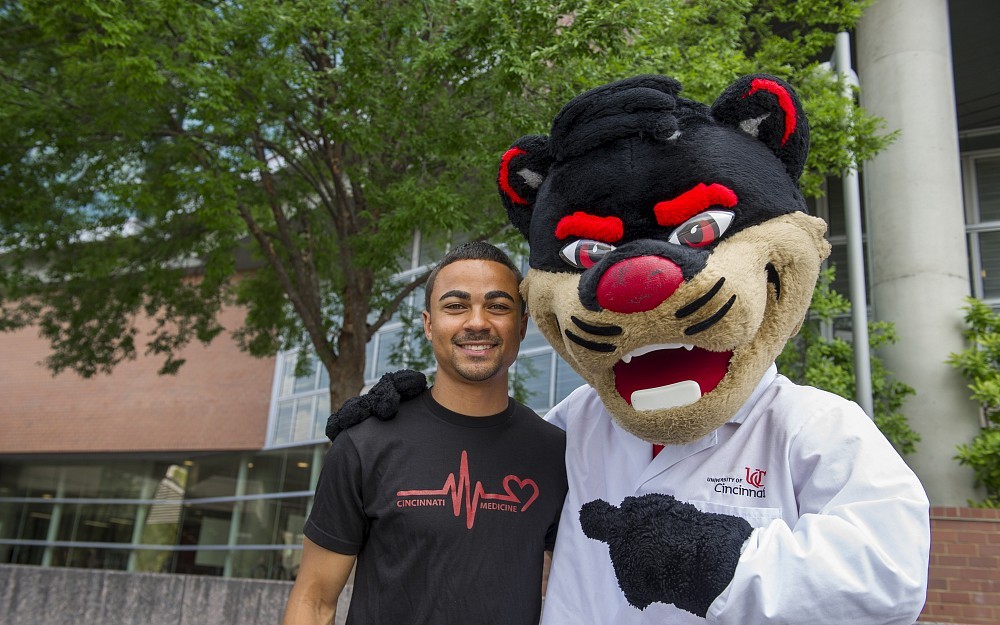
Roper Hears Medicine Calling Half-A-World Away

First-year University of Cincinnati medical student Theodore Roper was half-a-world away when he seriously envisioned a career as a physician. It was his junior year at the University of California, Berkeley, and Roper decided to take nearly a year to study abroad in the West African nation of Ghana. He was expected to do a service learning project and stumbled upon a program titled, "Save the Nations Sight.
"I was intrigued by the name and didnt know what I was getting myself into, says Roper, 25 and a native of Los Angeles. "It turns out my program director there was friends with this doctor who ran an ophthalmology clinic. I got in touch with him, and a week later, I show up for the first day.
"He taught me how to do a basic eye examto see if patients could read the letters on the eye chart. Some of them had cataracts and couldnt even see the big letter E, so the physician would check to see if they could see flashes of light or a wave of the hand. I was writing down what they could see, basically, and passing it along to him. His job was to perform surgery to remove the cataracts and pterygia.
One day, the surgeon asked Roper to suit up and help him with a patient.
"I have no idea what I am doing, and I put my scrubs and gloves on, and I walk into the room, and he waves me over. He is operating on a womans eye and tells me to look into the microscope and peer into these eyes, and tells me what to look for and what I am seeing, says Roper.
A psychology undergrad major, Roper wasnt really prepared for the experience.
"The first time I actually saw the eyeball get cut open, I felt really queasy as I had just eaten lunch, and I had never seen anything like that. I had to sit down and take a breath, but I eventually got used to it, says Roper. "That was the first time I saw myself in that position, of being a doctor and on that side of the table. My experience in Ghana allowed for some self-reflection.
Roper shadowed the ophthalmologist for three months and then continued studying and traveling in Ghana for another six months. His experience in Ghana coupled with his familys experience with physicians were deciding factors for a future in medicine. His father had suffered a brain stem stroke while Roper was in high school.
"I saw the doctors interact with his care and because he had brain stem stroke there were a lot of teams that worked on him a neurologist, radiologist and pulmonologist, says Roper. "I could see the interplay between doctors, nurses, physical therapists and others. This was in the back of my mind, but I didnt know for sure that this was my path. Having that experience in Ghana allowed me to reflect.
Ropers father passed while he was a freshman at Berkeley, but he never forgot the compassion doctors offered his family. That trait along with empathy and support for those in need, particularly individuals living on the margins, were important themes for Roper, and medicine will allow him to practice those values.
While at Berkeley, he volunteered at San Quentin State Prison, just north of San Francisco, to tutor inmates in math and science and assist with essays. The prison is the largest in the United States, the oldest in California and has a reputation for housing notorious inmates. Its been the subject of various books and films, but Roper found its inhabitants still had ways of reminding him of how all humanity is connected.
"I went into San Quentin, and we would tutor and teach men who were incarcerated, says Roper. "Many needed GED training. I tutored math and science initially, and sometimes, these guys didnt have more than a fourth-grade education. To me it was one of the most rewarding experiences in my life. I was never allowed to ask them, "What did you do to get in here? But sometimes, proof-reading papers and self-reflection essays they wrote, you get an idea of what they had done. Sometimes the gentleman, across from me, who is telling you this incredible story has committed a double homicide.
But Roper remained non-judgmental about the inmates he encountered; he knew many would face a stigma forever if they ever returned to society. "In many ways, I learned more from them about life than I could from any class in college, says Roper.
The pull toward medicine only strengthened as Roper graduated from Berkeley. He hadnt taken the basic sciences courses as an undergrad, and an advisor suggested he enroll in a two-year post-baccalaureate program at Mills College in Oakland, California. After its completion, Roper interviewed at eight different medical schools before narrowing his options to Oregon Health and Science University in Portland, Oregon, and UC. He participated in UCs Diversity Interview Day in the College of Medicine.
"All the staff were so nice and supportive and it felt like they were faking it, says Roper. "It felt too good to be true. Everyone I spoke to, including a couple of friends who are upperclassman, told me that sense of family and support stays throughout your time here and beyond.
"The truth is between Oregon and Cincinnati, everything logically told me to go to Oregon, says Roper. It was closer to homethe West Coastthey were offering generous scholarship money, and on paper, they had a lot of research opportunities and funding. Everything was saying, This is where you should go, family included. But my moms advice was, when it comes down to it, which school can you not say No to.
"There were so many reasons in my gut and heart that I could not say No to Cincinnati, says Roper. "Once I let go of all the materialistic things and of all the things tying me to the West Coast, I knew this is where I was supposed to be. My path to medicine has happened in such a round-about way, and the energy was so different here.
"My mom, my friends and colleagues told me that when I came back from the UC interview and Second Look, there was just something different about my story, says Roper. "They felt my energy was different, and I had more to say about the experience. I felt genuinely happy.
Mia Mallory, MD, associate dean for diversity and inclusion in the College of Medicine, says Roper made an impression on her during his first visit to UC in December.
Related Stories
On-site training in Speech & Hearing Clinic sets UC’s programs apart
August 27, 2026
At the University of Cincinnati’s Speech & Hearing Clinic, Doctor of Audiology and Speech-Language Pathology graduate students gain real-world experience while providing free speech and hearing services to the community.
Designing with cancer patients' needs in focus
August 27, 2026
Kristina Shin is designing garments that prioritize the comfort, function and confidence of breast cancer patients, addressing a need often overlooked by traditional fashion.
UC, NKU renew longstanding partnership supporting Army ROTC cadets
August 26, 2026
The University of Cincinnati Army ROTC and Northern Kentucky University (NKU) have renewed a longstanding partnership that supports students preparing to become Army officers and leaders in their communities. The universities formalized the renewed agreement during a signing event Aug. 11 at NKU.