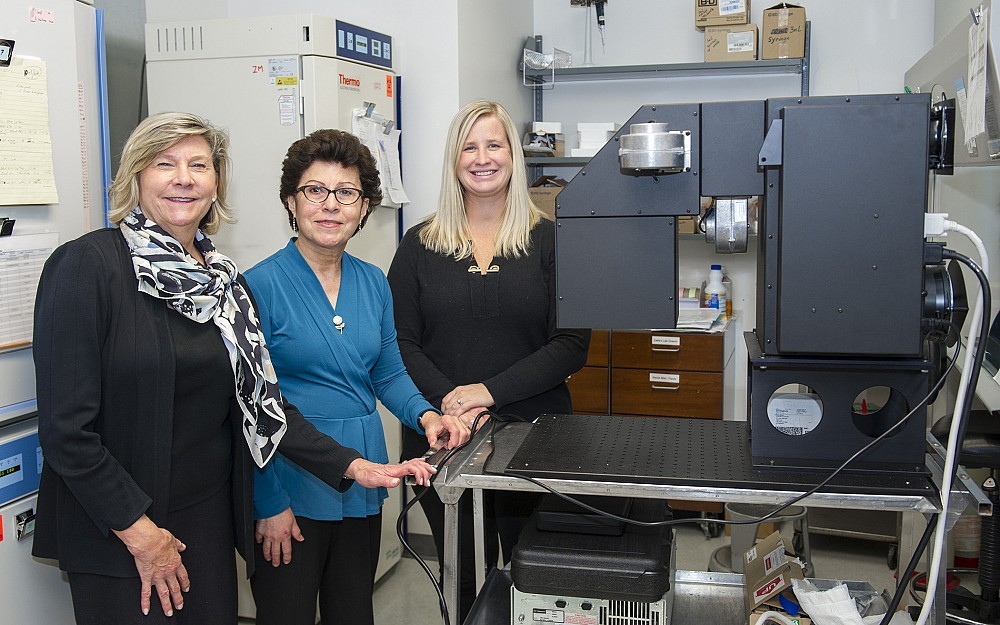
UC Researcher Lights Up Over New Equipment to Study Melanoma

CINCINNATIUniversity of Cincinnati (UC) melanoma researcher Zalfa Abdel-Malek, PhD, is over the moon about something just the opposite: a new solar UV simulator recently installed in her laboratory in the Department of Dermatology at the UC College of Medicine. "We had an urgent need for this equipment, which my staff now uses almost daily, Abdel-Malek says of the Oriel Instruments solar simulator that emits light encompassing the entire spectrum of solar ultraviolet radiation that reaches the earthboth UV and UVA raysto which all living things are exposed. Given that solar ultraviolet radiation is the main environmental factor that causes skin cancer, including melanoma, she says the simulator is being used to conduct experiments with skin cells and intact skin samples, as well as melanoma rodent models that are exposed to different doses of solar radiation in order to determine the impact on DNA. Abdel-Malek, professor and a member of the UC Cancer Institute and the Cincinnati Cancer Center, is widely known for her work with the melanocortin 1 receptor (MC1R), the receptor for a hormone called alpha-melanocyte stimulating hormone (alpha-MSH), which regulates skin pigmentation and the tanning response to sun exposure. Her research team was the first to discover that alpha-MSH repairs precancerous damage that UV rays cause to skin cell DNA, the genetic material within cells. The MC1R gene is a melanoma predisposition gene, since some of its genetic variants that result in fair skin, red hair and inability to tan are associated with increased risk for melanoma. The instrument, she says, has an added benefit, since it allows for investigating the effects of different dosage of (i.e. time of exposure to) the entire spectrum of solar UV on skin cells. The instrument the department had prior to could only emit the short wavelength UVB rays, which is highly carcinogenic, yet represents less than 10 percent of the UV rays received from the sun. Knowing that Abdel-Maleks team is on the forefront of skin science research, two regional melanoma foundationsMelanoma Know More (MKM) and the Andy Caress Melanoma Foundation (ACMF)helped finance the solar simulator with a joint contribution of $35,000 toward its purchase. "Dr. Abdel-Malek is focused on identifying high risk individuals, interrupting the growth of melanoma and developing preventive agents and the research holds promise for providing new weapons in the on-going battle against melanoma, says Candi Taggart, ACMF board member and mother to Andy Caress, the organizations founder, who lost his battle with melanoma in 2010. MKM board president Matt Fearn stated, "We are grateful to have such a strong partner in the University of Cincinnati and Dr. Abdel-Maleks research focus on prevention is the key component in eradicating the deadly effects of melanoma, and for us to play a small part in supporting the preventative research initiatives at the university fits squarely within our mission of awareness. Abdel-Malek says the instrument will certainly step up the sophistication of her teams testing methods which she says will be necessary to secure future state and federal funding toward melanoma research.
Related Stories
Cancer Center plays key role in lab research, clinical trials for new pancreatic cancer drug
September 1, 2026

WLWT and WCPO highlighted the contributions of University of Cincinnati Cancer Center researchers that helped lead to the recent FDA approval of daraxonrasib, a new treatment for pancreatic cancer.
Cancer Center physician receives $150,000 New Investigator Research Grant to study treatment-resistant leukemia
September 1, 2026
The University of Cincinnati Cancer Center’s Sarah Skuli, MD, PhD, received a two‑year, $150,000 Leukemia Research Foundation New Investigator Grant to study TP53‑mutated leukemia, a treatment‑resistant subtype with very poor outcomes.
Heavy social media use linked to depression
August 31, 2026

U.S. News and World Report, Yahoo! News, MSN, USA Today and other national media highlight a new study by the University of Cincinnati and Northwestern University that found a correlation between heavy social media use and depression in adults.