GIVEHOPE, BSI Engineering Provide Support for Pancreatic Cancer Research

Thanks to funding support from GIVEHOPE and BSI Engineering, Inc., scientists at the University of Cincinnati (UC) Cancer Institute can continue research that could help in the discovery of better treatments for patients with pancreatic cancer.
Since November 2011, the two organizations have fundraised over $315,000 and endowed over $50,000 for future pancreatic cancer research at the UC Cancer Institute.
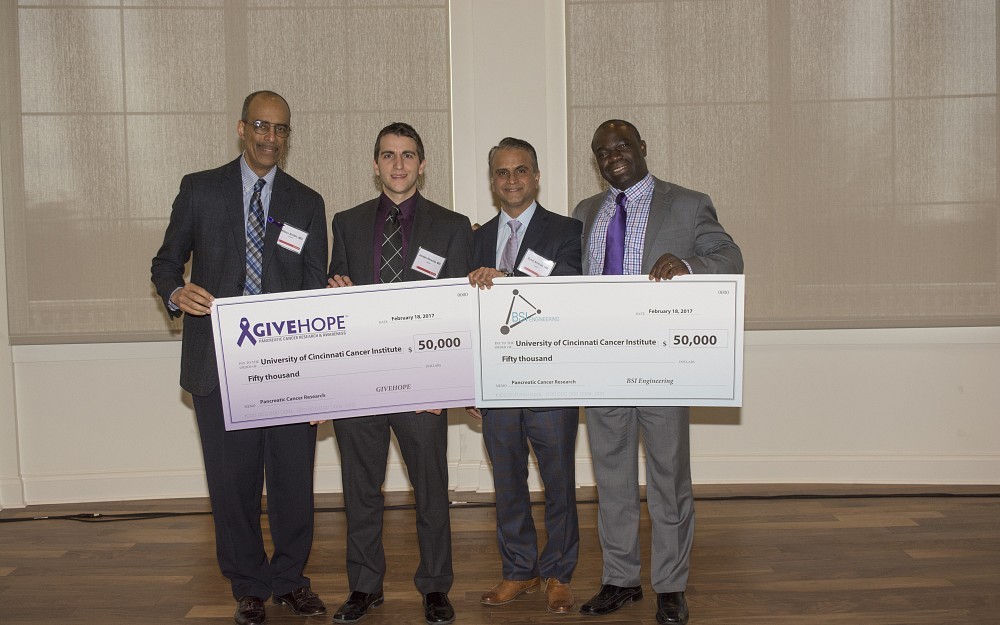
Two additional checks from these organizations, in the amount of $50,000 each, were gifted to the UC Cancer Institutes Pancreatic Cancer Center Feb. 18 during the institutes Pancreatic Patient Symposium.
"GIVEHOPE has done more to advance the awareness and research for pancreas cancer in Cincinnati than any other organization, says Syed Ahmad, MD, professor in the Department of Surgery, director of the Division of Surgical Oncology at the UC College of Medicine; UC Health surgical oncologist; and director of the Gastrointestinal Center and the Pancreatic Disease Center at the UC Cancer Institute. "They remain a close partner in our fight to improve the care and outcomes for patients with pancreas cancer.
Seed funding from community organizations like these has helped researchers like Vladimir Bogdanov, PhD, assistant professor and director of the Hemostasis Research Program in the Division of Hematology Oncology, Department of Internal Medicine at the UC College of Medicine, secure federal support to continue his studies of a novel therapeutic target for certain pancreatic cancer patients.
Bogdanov, a member at the UC Cancer Institute and the Cincinnati Cancer Consortium, conducts research focused on a novel form of Tissue Factor, the protein that starts the process of blood clotting, known as alternatively-spliced Tissue Factor (asTF). His studies have focused on effects of asTF on tumor growth and spread of pancreatic cancer.
Bogdanov, who has received a number of gifts from GIVEHOPE and BSI Engineering, Inc. over the years, says this funding is key in helping him continue work his laboratory while waiting for the federal funds to be awarded.
"In 2012, GIVEHOPEs grants have been instrumental for my lab in securing a larger, two-year exploratory grants from the National Cancer Institute, he says, adding that in 2015, he received a 5-year, $1.4 million grant from the National Cancer Institute. "When researchers are between grants, the work must continue somehow. These types of grants make it possible. They can even be our lifelines, sometimes.
"I am incredibly grateful to GIVEHOPE and BSI because their grants will help my lab continue its research that will hopefully lead to the discovery of more effective diagnostic and therapeutic approaches to fight pancreatic cancer.

GIVEHOPE presenting its check.

BSI Engineering presenting its check.
Related Stories
Heavy social media use linked to depression
August 31, 2026

U.S. News and World Report, Yahoo! News, MSN, USA Today and other national media highlight a new study by the University of Cincinnati and Northwestern University that found a correlation between heavy social media use and depression in adults.
On-site training in Speech & Hearing Clinic sets UC’s programs apart
August 27, 2026
At the University of Cincinnati’s Speech & Hearing Clinic, Doctor of Audiology and Speech-Language Pathology graduate students gain real-world experience while providing free speech and hearing services to the community.
Designing with cancer patients' needs in focus
August 27, 2026
Kristina Shin is designing garments that prioritize the comfort, function and confidence of breast cancer patients, addressing a need often overlooked by traditional fashion.