New Online Tool Could Help Address Drug Use in Pregnant Women

Opioid abuse is becoming prevalent in more and more segments of society today, including among pregnant women. A recent Substance Abuse and Mental Health Services Administration (SAMHSA) report to Congress found that from 2000-2009, there was a nearly fivefold increase in the United States in the number of infants exposed at birth to opioid drugs, such as heroin or prescription pain relievers. The report also found a nearly threefold increase in the number of infants born with a dependency on opioids during the same time period.
A new e-learning module at the University of Cincinnati will give health professionals a tool to help pregnant women who are addicted to opioids. Developed by Shauna Acquavita, PhD, assistant professor in the School of Social Work at the College of Allied Health Sciences, the module uses Screening, Brief Intervention, and Referral to Treatment (SBIRT), an evidence-based practice used to identify, reduce and prevent problematic use, abuse and dependence on alcohol and illicit drugs.
"I hope this e-learning module fills a really big need because providers struggle with how to address this, says Acquavita. "The question is, how do you screen for various drug issues or address alcohol use? Its really opening up a conversation that a lot of providers dont know how to start and having a screening tool will hopefully help that process.
When SAMHSA learned of this e-learning module, housed on the College of Allied Health Sciences website, the organization contacted the Centers for Disease Control (CDC) as well as the National Institute on Drug Abuse (NIDA). The CDC and NIDA reviewed the module and provided feedback, which Acquavita and her team implemented before the module launch. In addition, the Health Resources and Services Administration inquired about adapting the training module for use by healthy start community health workers.
"This screening is designed to be universal, says Acquavita. "Its not aimed at a specific population. There are women of all socioeconomic status who have substance abuse issues. Its important to be able to screen all women and have a conversation.
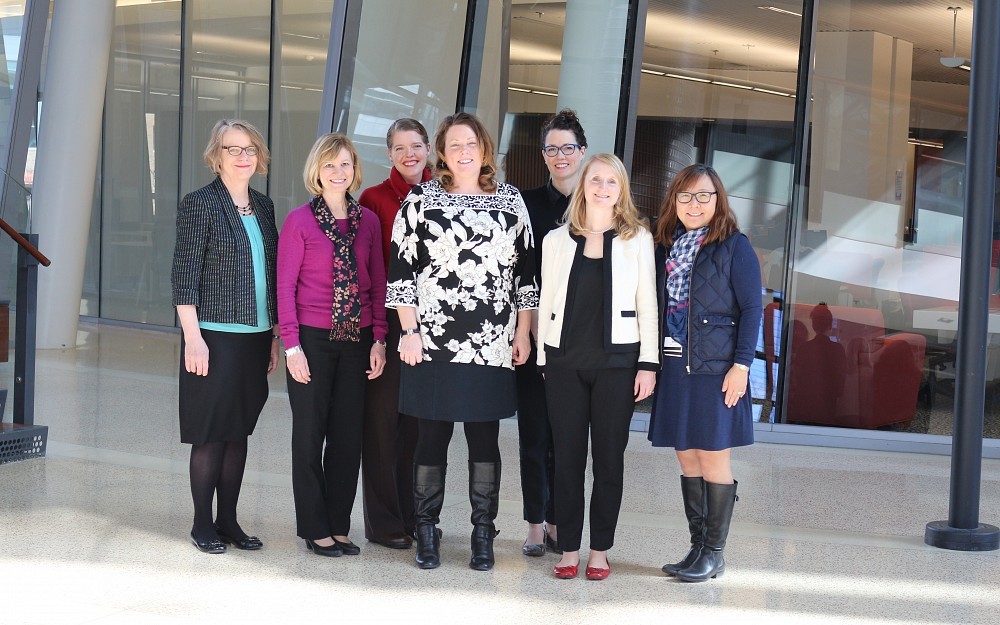
The SBIRT e-learning module is part of a $900,000 SAMHSA grant led by Acquavita, in partnership with Bonnie Brehm, PhD, a professor in the College of Nursing, Tiffany Diers, MD, associate professor at the College of Medicine and Karissa Kim, PharmD, associate professor in the College of Pharmacy.
The module is interactive, says Acquavita. "It includes PowerPoint slides, a glossary of terms, plus videos and other resources. The module also has scenarios with different options for users to choose, and it tells them if theyve made the right choice.
Acquavita has a background in research on substance use disorders as well as maternal and child health and says she knew there was a need for something like this.
"If we teach health professionals, even new health professionals, on how to have those hard conversations, theyll have an easier time and it can really help with prevention or early intervention, she says. "If were able to intervene early it can make such a difference.
Related Stories
Cancer Center plays key role in lab research, clinical trials for new pancreatic cancer drug
September 1, 2026

WLWT and WCPO highlighted the contributions of University of Cincinnati Cancer Center researchers that helped lead to the recent FDA approval of daraxonrasib, a new treatment for pancreatic cancer.
Cancer Center physician receives $150,000 New Investigator Research Grant to study treatment-resistant leukemia
September 1, 2026
The University of Cincinnati Cancer Center’s Sarah Skuli, MD, PhD, received a two‑year, $150,000 Leukemia Research Foundation New Investigator Grant to study TP53‑mutated leukemia, a treatment‑resistant subtype with very poor outcomes.
Heavy social media use linked to depression
August 31, 2026

U.S. News and World Report, Yahoo! News, MSN, USA Today and other national media highlight a new study by the University of Cincinnati and Northwestern University that found a correlation between heavy social media use and depression in adults.