Clinical Trial to Test HIV Prevention Drug Is Accepting Volunteers

CINCINNATIA clinical trial currently enrolling volunteers at University of Cincinnati (UC) College of Medicine will test whether an investigational drug, cabotegravir (CAB) is as safe and will work as well as an FDA-approved pre-exposure prophylaxis in high-risk populations.
UC is part of a multinational study launched by the HIV Prevention Trials Network (HPTN) to evaluate whether CAB can safely protect men who have sex with men and transgender women who have sex with men from acquiring HIV as well as daily oral doses of tenofovir disoproxil fumarate/emtricitabine, also marketed under the tradename Truvada.
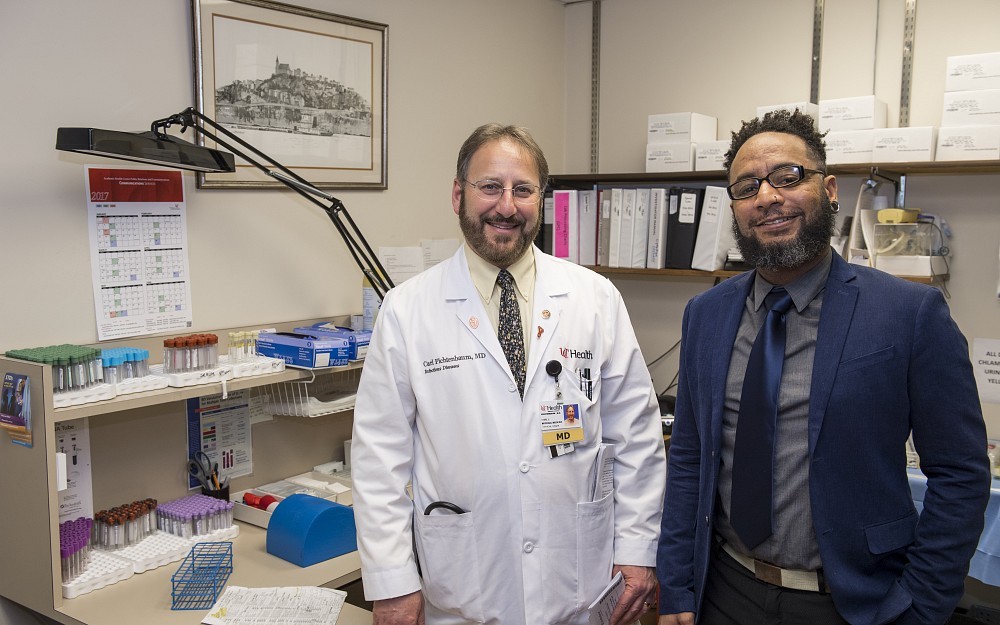
Carl Fichtenbaum, MD, professor in the Division of Infectious Diseases, is the principal investigator at UC. Other sites will be located across the United States, but also in Argentina, Brazil, Peru, India, Thailand, Vietnam and South Africa. Investigators hope to enroll up to 4,500 individuals, including about 100 in the Cincinnati/Tristate area, for up to 4½ years, says Fichtenbaum.
He says he hopes this study and other efforts will help to slow the spread of HIV in the Cincinnati Metropolitan area.
Currently, tenofovir disoproxil fumarate/emtricitabine is approved in the United States for HIV pre-exposure prophylaxis as part of a daily regimen. As part of the study, one group will receive CAB as a pill and a placebo pill for tenofovir disoproxil fumarate/emtricitabine every day for the first five weeks. This group will also receive CAB injection monthly for two months, and then for every two months afterward along with a placebo pill for tenofovir disoproxil fumarate/emtricitabine daily for up to 3½ years.
A second group will be given a real tenofovir disoproxil fumarate/emtricitabine pill and a placebo pill for CAB every day for five weeks. A placebo CAB injection will follow with real tenofovir disoproxil fumarate/emtricitabine pills every day for up to 3½ years. Three-and-half years into the study all participants in both groups will receive the real tenofovir disoproxil fumarate/emtricitabine pill.
The randomized double blind trial is designed for HIV-negative gay men or HIV-negative transgender women who have sex with men who are older than age 18 and are at high risk of being infected with HIV, says Fichtenbaum.
Some questions about the study, such as why cant participants know which one of the drugs they will be receiving, are expected, says Fichtenbaum.
"If people know what they are getting then they change their behavior and that changes the outcome of the study, says Fichtenbaum. "This is a way to take peoples behaviors out of it. Now clearly some people wont take their pills. Thats been true on every study. We will try to convince them but humans are humans and they do what they are going to do.
Jaasiel Chapman, clinical research community educator in the UC Division of Infectious Diseases, says study participants will be offered screening for various sexually transmitted diseases along with counseling as well as providing condoms to encourage the practice of safer sex.
Researchers in the study dont know if CAB works to protect individuals from HIV exposure. That message will be conveyed to participants in the study designed to determine the efficacy of CAB as an alternative to daily doses of tenofovir disoproxil fumarate/emtricitabine, which can be more than 90 percent protective against exposure to HIV infection.
"So essentially you have a timed release of the medication that is injected into the body and the medicine releases slowly over time lasting at pretty high levels for the full eight weeks, says Fichtenbaum, who is also a UC Health infectious diseases physician. "We are trying to get an alternative to having to take the pill every day to prevent HIV. Thats attractive to some people who dont want to have to remember to take a pill every day if they can take an injection every couple of months.
The most common side effects in people taking Truvada to reduce the risk of becoming infected with HIV include: abdominal pain, headache and decreased weight.
Previous studies have shown the most common side effects for individuals taking an injectable CAB has been pain at the location of the injection, swelling and nodules; other side effects have also included fever, fatigue, flu-like illness, headache and rash, according AIDSinfo, a website maintained by the U.S. Department of Health and Human Services.
African-American men who have sex with men have a one in two chance of contracting HIV within their lifetime and this population is among the groups Fichtenbaum says he hopes to enroll in the study. White men who have sex with men have a one in six chance of contracting HIV within their lifetime, says Fichtenbaum.
In the Cincinnati Metropolitan Statistical Area, there are between 3,000 and 5,000 people living with HIV and 10 to 20 percent do not know they are infected, says Fichtenbaum. Each year, there are between 150 and 200 new infections locally, he says.
Nationally, about 1.2 million Americans live with HIV and about 50,000 new infections occur annually, according to the Centers for Disease Control and Prevention.
Fichtenbaum receives research grants from Gilead Sciences and ViiV Healthcare and he has given continuing medical education talks for clinical care options funded by ViiV Healthcare.
For more information about enrolling in the trial please contact Jaasiel Chapman at chapmaja@ucmail.uc.edu or call 513-584-6279.
Related Stories
Cancer Center plays key role in lab research, clinical trials for new pancreatic cancer drug
September 1, 2026

WLWT and WCPO highlighted the contributions of University of Cincinnati Cancer Center researchers that helped lead to the recent FDA approval of daraxonrasib, a new treatment for pancreatic cancer.
Cancer Center physician receives $150,000 New Investigator Research Grant to study treatment-resistant leukemia
September 1, 2026
The University of Cincinnati Cancer Center’s Sarah Skuli, MD, PhD, received a two‑year, $150,000 Leukemia Research Foundation New Investigator Grant to study TP53‑mutated leukemia, a treatment‑resistant subtype with very poor outcomes.
Heavy social media use linked to depression
August 31, 2026

U.S. News and World Report, Yahoo! News, MSN, USA Today and other national media highlight a new study by the University of Cincinnati and Northwestern University that found a correlation between heavy social media use and depression in adults.