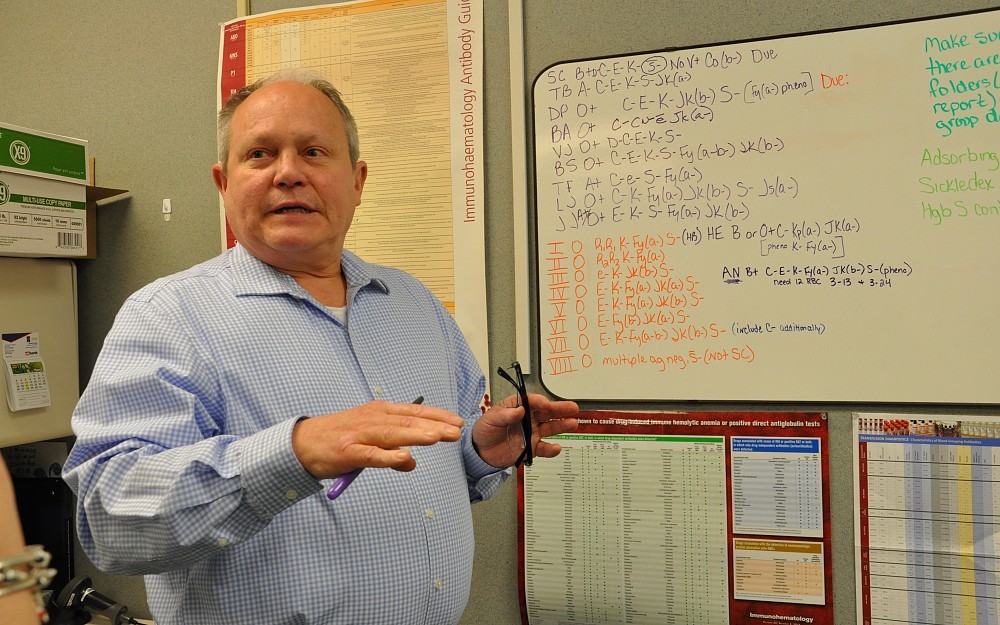
Hoxworth Lab Focuses on Finding and Phenotyping Rare Blood Types

Managing big data is a major challenge for many organizations, and the Hoxworth Blood Center is taking that challenge head on. Finding the right donor match for a patient is critical, especially in the case of sickle cell disease (SCD) patients. Thats where Hoxworths Immunohematology Reference Laboratory (IRL) comes in.
The IRL provides testing and consultation to help hospitals fulfill patients needs for rare types of blood. The IRL provides rare blood by maintaining local liquid and frozen rare blood inventories and by participating in the American Rare Donor Program (ARDP), a national search service.
"The ARDP is designed to be a database of sorts, says Greg Halverson, assistant director for the IRL. "We find a rare donor and we have to confirm phenotypically what they are. Then we send the ARDP the donors information and that goes into their database.
The ARDP is used extensively in finding donor matches for area patients living with SCD. The treatment protocol for sickle cell is a blood transfusion, which makes it critical to find a match for these patients as they will build up antibodies due to the large number of transfusions throughout their lifetime. The goal is to find a match from the same genetic background which can eliminate many of the negative reactions the patients will face if they receive blood from a non-matched donor.
For most blood transfusions, Halverson says patients are matched with donor blood based on their major blood types such as: O+, O-, A+, A-, B+, B-, AB+, and AB- (referred to as ABO and Rh blood type). An estimated five percent of patients, e.g., those with sickle cell anemia, thalassemia (Cooley's Anemia) or leukemia, need to find blood that is specifically matched and lacks certain antigens that the patient has developed antibodies against.
Halverson says an antigen is a type of protein on the surface of a red blood cell. When a patient receives a transfusion of blood carrying the same antigens as his or her own blood, the donor red cells are "welcomed." If the patient does not have the same antigens, they may develop antibodies to the antigens and their body may reject or react with future blood transfused with these antigens.
Providing incompatible blood for transfusions can cause life-threatening reactions, according to Halverson. Hoxworth needs blood donations from more multicultural donors to maintain a diverse inventory of antigen-negative blood, which helps avoid alloimmunization. Alloimmunization is an immune response to foreign antigens as the result of exposure to genetically different cells or tissues.
"There are 36 known different blood groups with well over 300 antigens, says Halverson. "What were trying to do is to study those variants and accumulate a stock supply of donors. The basic job of the IRL is finding antigen negative units for transfusion, managing the alloimmunization, and doing identification so we know what antibodies are present in the donated blood.
Kaleb Kinebrew and his twin brother Kameron, 19, know all too well what its like to live with SCD and having blood transfusions a regular part of their lives. The brothers, who graduated from Colerain High School and are now UC students, were diagnosed with SCD at birth and require blood transfusions to help avoid potentially deadly complications from the disease.
"I understand that people are afraid of needles and that (they say) they do not have time, said Kaleb. "I would challenge them to donate because it does not just benefit the person in need but also their friends and family. Everyone knows someone who has had to have a transfusion, so do it for them because someone else did it for them. Donating blood is paying it forward.
Sickle cell patients need, on average, 15 to 25 blood transfusions per year. About one in every 500 African-American children are born with the disease and patients respond best to blood with the same genetic heritage, according to Halverson. While the need is great, only four percent of donors at Hoxworth Blood Center are African-American.
Hoxworth has a daily goal of collecting 300 units of blood a day and the IRL phenotypes 60 of those donations a week in the hope of having 12,000 donors fully typed within three or four years. Thats where the challenge of managing all that data comes in.
"Whats not going to be easy to resolve is matching the donors to the recipients until we have enough donors tested, says Halverson. "The difficult part about that is identifying the rare blood donors we need to recruit and once we have found them, we have to let that population know how important they are.
Its a painstaking and time-consuming task to catalog all the various blood types and build that much-needed database of donors. However, Halverson and his team at the IRL are committed to do all they can to help Kaleb and Kameron and future patients just like them.
Tags
Related Stories
Heavy social media use linked to depression
August 31, 2026

U.S. News and World Report, Yahoo! News, MSN, USA Today and other national media highlight a new study by the University of Cincinnati and Northwestern University that found a correlation between heavy social media use and depression in adults.
On-site training in Speech & Hearing Clinic sets UC’s programs apart
August 27, 2026
At the University of Cincinnati’s Speech & Hearing Clinic, Doctor of Audiology and Speech-Language Pathology graduate students gain real-world experience while providing free speech and hearing services to the community.
Funding expands UC research into weight gain side effects of bipolar medication
August 26, 2026
University of Cincinnati researchers have been approved for funding by the Patient-Centered Outcomes Research Institute (PCORI) to expand the implementation of healthy lifestyle interventions and metformin prescription to help manage weight gain in overweight or obese youth taking second-generation antipsychotic medications.