An Old Drug May Offer a New Treatment for Young Heart Patients

A University of Cincinnati heart researcher hopes an old drug may offer a new cure for treating children born with only one functioning ventricle in the heart.
Jack Rubinstein, MD, associate professor in the Division of Cardiovascular Health and Disease and UC Health cardiologist, has received a $154,000 grant from the American Heart Association (AHA) and The Childrens Heart Foundation (CHF) to study how the use of Probenecid, a medication used to treat gout, might improve cardiac function and symptoms in children and young adults with a single functioning pumping chamber in the heart.
Most babies are born with two separate pumping chambers called ventricles, though some are born with a single ventricle, explains Rubinstein. These babies frequently undergo several surgeries that improve the flow of blood to the lungs and the rest of the body resulting in a configuration known commonly as "Fontan circulation.
Rubinstein, a member of the UC Heart, Lung and Vascular Institute, is working with co-investigators, Gruschen Veldtman, MD, professor of pediatrics at UC and director of adult congenital heart disease at Cincinnati Childrens Hospital Medical Center, and Jessica Woo, PhD, associate professor of pediatrics at UC and a Cincinnati Childrens researcher.
The research team will run a clinical trial that is randomized, placebo-controlled, double-blinded cross over designed to learn how Probenecid may help children with single ventricles. They hope to start enrolling in the trial by late summer. Probenecid has been in clinical use for decades starting in World War II to extend limited supplies of penicillin and subsequently to treat gout and gouty arthritis.
"We will measure how they feel and how their heart function works before and after receiving Probenecid, explains Rubinstein. "They will then have another month of the opposite treatment of either the placebo or the Probenecid, depending on what they had the first time.
"Our participants will not know, neither will their parents as to what they received first and then later for us to determine without bias if the drug worked, says Rubinstein.
The study has been under development for the past two years to ensure safety for everyone involved.
"We had to be very careful to make sure the study was well-designed and safe. If positive this could really change the management of kids with this disease, says Rubinstein.
The award Rubinstein received is one of five offered nationally during this round of grants totaling $561,798 in funding from the AHA and CHF.
"We are honored and excited to continue our research funding partnership with AHA, explains William Foley, executive director of The Childrens Heart Foundation. "Through this collaboration and our ongoing commitment to research focused on congenital heart defects, we strive to make a lasting impact in the lives of those with CHD. This $550,000 of new research will help bring innovative solutions to CHD survival rates and care
The American Heart Association has been a past supporter of Rubinsteins laboratory.
"We are committed to working with The Childrens Heart Foundation to fund these important research projects, to secure healthier futures for babies born with CHD, says Nancy Brown, CEO of the American Heart Association. "Innovations in research drive our work to improve the health of all Americans.

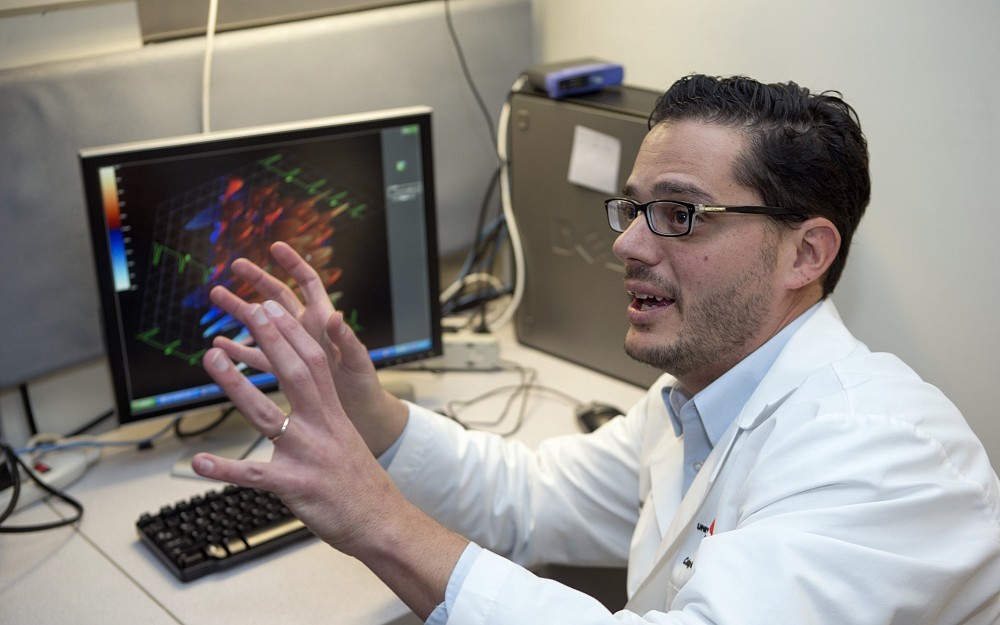
Jack Rubinstein, MD, is shown in his laboratory with Min Jiang, a research assistant.
Tags
Related Stories
Cancer Center plays key role in lab research, clinical trials for new pancreatic cancer drug
September 1, 2026

WLWT and WCPO highlighted the contributions of University of Cincinnati Cancer Center researchers that helped lead to the recent FDA approval of daraxonrasib, a new treatment for pancreatic cancer.
Cancer Center physician receives $150,000 New Investigator Research Grant to study treatment-resistant leukemia
September 1, 2026
The University of Cincinnati Cancer Center’s Sarah Skuli, MD, PhD, received a two‑year, $150,000 Leukemia Research Foundation New Investigator Grant to study TP53‑mutated leukemia, a treatment‑resistant subtype with very poor outcomes.
Heavy social media use linked to depression
August 31, 2026

U.S. News and World Report, Yahoo! News, MSN, USA Today and other national media highlight a new study by the University of Cincinnati and Northwestern University that found a correlation between heavy social media use and depression in adults.