Integrative Medicine Services Offered in Barrett Cancer Center

CINCINNATIA cancer diagnosis and treatment often means stress and physical hardships that can be difficult for patients to endure in order to heal.
This is why experts with UC Health Integrative Medicine are offering their services at the Barrett Cancer Center, the main adult ambulatory care center of the University of Cincinnati (UC) Cancer Institute, to help patients combat stress, problems with sleeping, nausea and other effects of the disease and treatment.
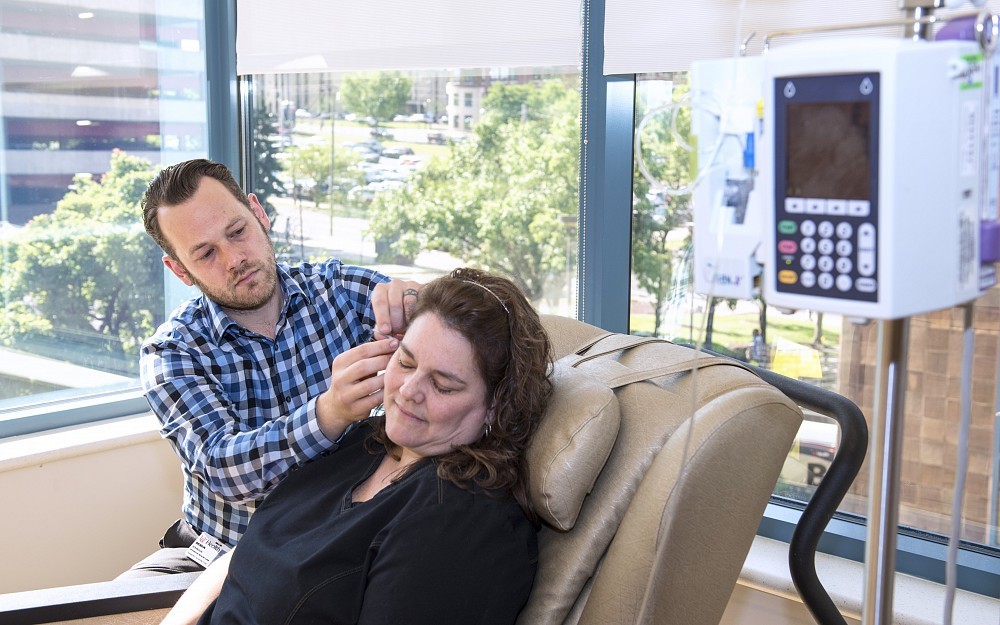
Derek Johnson, a licensed acupuncturist with UC Health, now spends Thursday mornings rounding with otolaryngologist and UC College of Medicine faculty member Keith Wilson, MD, to offer assistance with auricular acupunctureear acupunctureor advice on relaxation techniques, movement therapy or non-medical nutrition to patients with head and neck cancer. He also spends Fridays in the Center for Womens Cancer on the third floor of the Barrett Center, where he offers those same services in the infusion suite to patients and families.
"I use auricular acupuncture to activate therapeutic points in the ear that help curb side effects from treatment, Johnson says, adding that he incorporates key aspects of qi gong and tai chi as well, like mindfulness and breathing practices, to help patients manage their stress or discomfort. "I also provide advice about nutritionwhat and how to eat to support good appetite, digestion and blood support. Its really a way to engage the treatment process in a different way and fill gaps where traditional medicine, while necessary, may not be meeting the needs of the patient entirely for optimal healing and comfort.
The focus of integrative medicine is to help the whole person achieve overall wellness, says Sian Cotton, PhD, director of UC Health Integrative Medicine
"Physicians, our licensed integrative health specialists and patients work as partners to engage body, mind and spirit for the optimal health of the patient, says Cotton, who is also a professor within the UC College of Medicine and director of and UCs Center for Integrative Health and Wellness. "Patients and families undergoing cancer care benefit from robust supportive services that help to offset the negative side effects associated with traditional treatments, and improve well-being and functioning. The top cancer centers in the country offer integrative health services as part of the optimal cancer care. We are proud that UC and UC Health have embraced this concept to provide outstanding evidence-informed supportive services to our local cancer community.
"Everyone has their specialty, and oncologists are focused on the delivery of care in order to get the patient to a place where they can recover, says Johnson. "Our team supports that recovery, and were bringing our services to them earlier in the process and in tandem with the physician so they dont have to seek it elsewhere or wait until they develop long-lasting symptoms.
These services are offered for patients at the Barrett Center, and the hope is to offer additional services and to expand offerings in the future; no appointment for these services in the infusion suite are required.
For questions about scheduling an appointment with a member of the UC Health Integrative Medicine team, call 513-475-9567 (WLNS).

 I use auricular acupuncture to activate therapeutic points in the ear that help curb side effects from treatment, Johnson says.
Related Stories
Cancer Center plays key role in lab research, clinical trials for new pancreatic cancer drug
September 1, 2026

WLWT and WCPO highlighted the contributions of University of Cincinnati Cancer Center researchers that helped lead to the recent FDA approval of daraxonrasib, a new treatment for pancreatic cancer.
Cancer Center physician receives $150,000 New Investigator Research Grant to study treatment-resistant leukemia
September 1, 2026
The University of Cincinnati Cancer Center’s Sarah Skuli, MD, PhD, received a two‑year, $150,000 Leukemia Research Foundation New Investigator Grant to study TP53‑mutated leukemia, a treatment‑resistant subtype with very poor outcomes.
Heavy social media use linked to depression
August 31, 2026

U.S. News and World Report, Yahoo! News, MSN, USA Today and other national media highlight a new study by the University of Cincinnati and Northwestern University that found a correlation between heavy social media use and depression in adults.