BRACK Helps Build a Better Physician

Its July, and new residents fresh out of medical schools are completing their first week of training in residency programs in hospitals and healthcare programs across the nation. They hope to become board-certified physicians, with most completing their training during the next three to seven years.
At UC, educators in the College of Medicine have collected a wealth of data on the new residents skills and knowledge in hopes of building a better doctor. During the latter half of June, the new residents participated in a learning assessment known as the Baseline Resident Assessment of Clinical Knowledge, commonly referred to as BRACK.
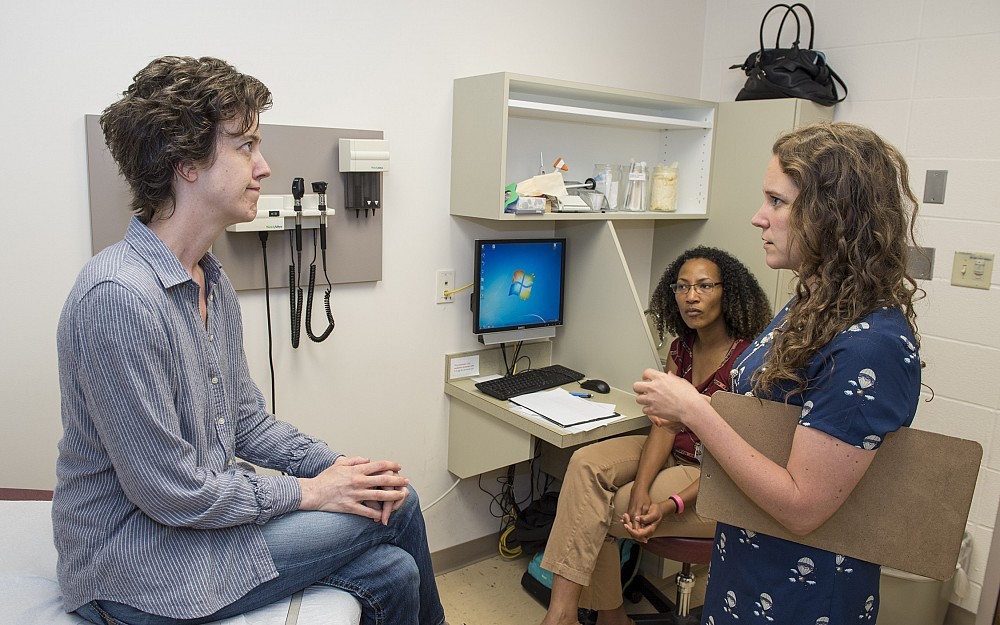
BRACK was first piloted at UC in 2011. During the BRACK evaluations, residents spend two hours in eight mini clinical sessions with standardized patients and physician preceptors in mock exam rooms in the College of Medicines Simulation Center.
Professionalism, the ability to perform a medical history and physical exam, generating a differential diagnosis list, knowing when to order appropriate tests and how to interpret those results when presented with a common medical scenario, as well as communicating a treatment plan for a patient, are all evaluated during the BRACK.
"I think the idea that they get to practice before they encounter a real patient is very empowering to them, explains Paul Wojciechowski, MD, assistant professor of anesthesiology and a co-principal BRACK investigator. "That continues to be a really strong theme across BRACK. They enjoy the fact they get the chance to interact with faculty and senior residents prior to seeing patients. The learning that occurs is incredibly valuable.
During BRACK orientation, the residents learn how their interactions should flow with simulated patients and physician preceptors. Residents come from medical schools from across the country and may not have seen a patient during the last few months of their medical school education. They are often busy with elective rotations, interviews and travel related to finding a specialty program that will accept them for residency.
"Residents identify BRACK as getting them into the mode of thinking about some technical details, such as which antibiotic to choose for a patient, and when they might call a senior resident or an attending physician or call for rapid response. True emphasis is placed on when to call for help, says Wojciechowski.
"If they encounter a patient who has new chest pain or shortness of breath and who is in the hospital, they would learn here that they can and should reach out to an attending or senior resident as soon as possible, he adds. "I think in the past that was not welcomed, and they wanted people to try to work through things themselves; now, we know these patients require immediate attention. One thing they learn here is it is okay to call for help early.
The BRACK encounters are videotaped and reports are sent to the UC Health residency program directors with case-specific feedback on each new physician, says Amy Bunger, PhD, assistant designated institutional official and co-principal BRACK investigator.
It also provides an opportunity for UC Health to initiate a change in medical culture among a new crop of physicians, says Bunger, who is also an assistant professor in the Department of Medical Education.
"One of the major initiatives at UC Medical Center is to become a more transparent culture with respect to safety and reporting systems safety errors, says Bunger. "A couple of years ago, we only got a few hundred reports a month, and now, we are steadily getting a thousand opportunities a month to do better. People often think the higher the number, the less safe the system is.
"In fact, the research shows the converse, she adds. "The more transparent people are about incident reporting, the safer the culture. BRACK provides an opportunity to set that expectation to help us improve. We actually ask them in several of the simulated cases that purposefully contain a mistake whether and how they would file an incident report.
Bunger and Wojciechowski say residents are also informed during BRACK about the resources available to help patient populations who might have trouble accessing healthcare in the community.
"Some patients wouldnt even think that accessing care at a community health center is a good option for them, says Wojciechowski. "They always feel like they have to come here to the hospital. However, it becomes quite a burden sometimes, if they have to get a friend or a family member to drive them here when they can access healthcare in their neighborhood. We can help the residents connect those dots.

Amy Bunger, PhD, and Paul Wojciechowski, MD, monitor BRACK evaluations in the College of Medicine's Simulation Center.

Erik Evans, MD, confers with Amy Bunger, PhD, during BRACK evaluations at the College of Medicine's Simulation Center.
Related Stories
On-site training in Speech & Hearing Clinic sets UC’s programs apart
August 27, 2026
At the University of Cincinnati’s Speech & Hearing Clinic, Doctor of Audiology and Speech-Language Pathology graduate students gain real-world experience while providing free speech and hearing services to the community.
Designing with cancer patients' needs in focus
August 27, 2026
Kristina Shin is designing garments that prioritize the comfort, function and confidence of breast cancer patients, addressing a need often overlooked by traditional fashion.
UC, NKU renew longstanding partnership supporting Army ROTC cadets
August 26, 2026
The University of Cincinnati Army ROTC and Northern Kentucky University (NKU) have renewed a longstanding partnership that supports students preparing to become Army officers and leaders in their communities. The universities formalized the renewed agreement during a signing event Aug. 11 at NKU.